Curanex Pharmaceuticals (CURX): capital-driven development with concentrated ownership
Curanex Pharmaceuticals is a development-stage botanical drug company that discovers and plans to commercialize therapies for inflammatory diseases. The company currently monetizes through equity financing and strategic capital raises rather than product revenue, with an IPO and follow-on underwriting activity the primary sources of operating cash to support R&D while commercial operations remain nascent.
For a compact investor read on customer and capital relationships that matter to CURX, see Null Exposure’s collection of relationship intelligence: https://nullexposure.com/
How Curanex operates and where value will come from
Curanex is a classic early-stage biopharma: research and regulatory progress drives future revenue potential, not current product sales. Public filings and summary financials show zero revenue trailing twelve months and a negative EPS, confirming the company’s reliance on external capital to fund operations. The business model depends on advancing botanical candidates through clinical development and then monetizing through licensing, partnerships, or direct commercialization — outcomes that will materialize only if trials and regulatory paths succeed.
Key operational characteristics:
- Contracting posture — capital-market centric: the firm’s immediate counterparties are financial sponsors and underwriters rather than commercial customers; capital raises and underwriting agreements determine near-term runway and dilution.
- Concentration — ownership and coverage: insiders hold a large stake (approximately 67.8% of shares), while institutional ownership is reported at zero, signaling high insider concentration and limited institutional support.
- Criticality — R&D is mission-critical, commercial scale is future: current operations are R&D-heavy with no product revenue; therefore relationships that provide cash and development services are critical.
- Maturity — developmental stage: the company profile and financial metrics identify CURX as developmental-stage biotech, not a commercial-stage revenue generator.
One reported commercial/market relationship — what it means
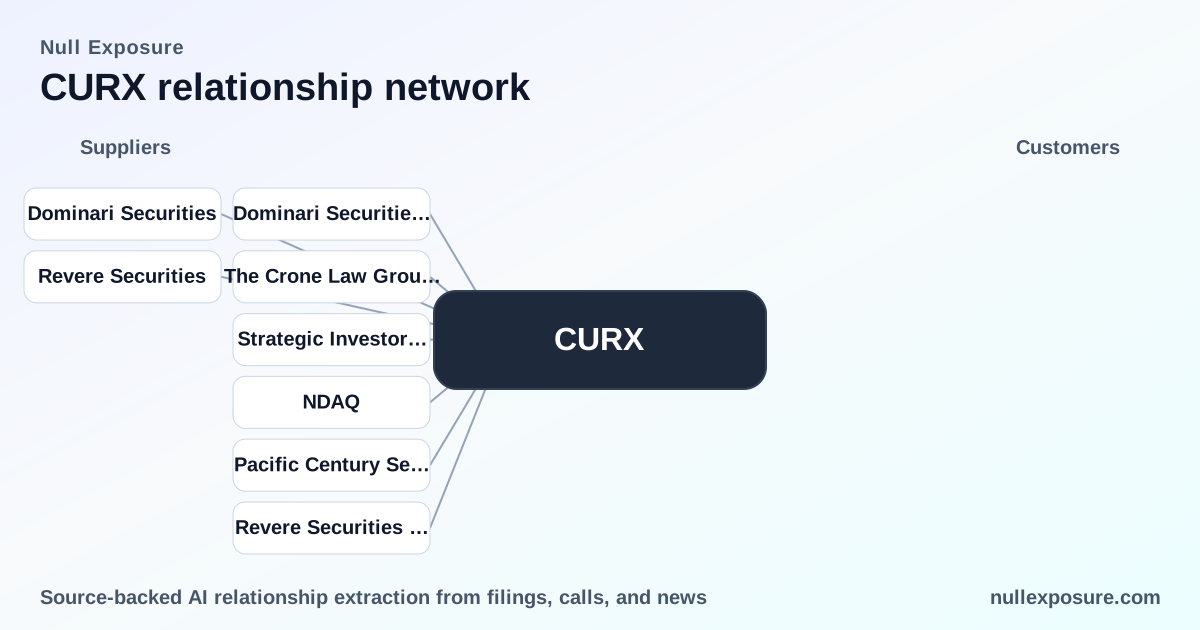
Notable relationship from the customer-scope results: Dominari Securities LLC.
Dominari Securities LLC acted as the lead underwriter for CURX’s IPO and exercised the over-allotment option in full, buying 562,500 additional shares at the $4.00 IPO price, which provided immediate incremental capital and conventional IPO stabilization support. This action is reported in the company’s IPO press release on GlobeNewswire dated September 12, 2025. According to that release, the over-allotment exercise injected an additional $2.25 million of proceeds at the offering price, reinforcing initial underwriting demand and standard aftermarket stabilization behavior.
Source: A GlobeNewswire press release issued September 12, 2025, describing the underwriters’ exercise of the overallotment option in connection with CURX’s IPO.
Relationship-by-relationship detail (complete coverage)
Dominari Securities LLC — lead underwriter and over-allotment purchaser. Dominari executed its full option, acquiring 562,500 shares at $4.00 per share as described in the company’s IPO announcement, which delivered immediate incremental proceeds and indicates conventional underwriter support during the offering. Source: GlobeNewswire press release, 2025-09-12.
(Null Exposure’s customer-scope results for CURX return a single relationship record; the company’s capital-market ties are therefore the dominant customer-facing relationship identified in the public feed.)
What the underwriting activity implies for investors
The underwriters’ full exercise of the over-allotment option is a routine capital-market event but it has direct investor implications:
- Short-term balance-sheet boost: the $2.25 million in additional proceeds (562,500 shares × $4.00) increases cash for R&D and operations without a separate financing round.
- Near-term dilution is fixed at the exercise amount: the additional shares are distributed to the market as part of the IPO mechanics; investors should treat this as already-realized dilution rather than a new, outstanding financing ask.
- Stabilization signal but not a commercial validation: underwriting support primarily signals demand and pricing confidence at IPO, not validation of clinical or commercial prospects.
Financial and share-structure signals that matter
Use these company-level datapoints when sizing risk and upside:
- No reported revenue (RevenueTTM = 0) and negative EPS (-$0.02) place valuation dependence squarely on clinical progress and later commercial actions.
- Market capitalization reported near $10.6 million and shares outstanding roughly 28.34 million with float about 8.91 million describe a thin public float and modest market value.
- Insider ownership ~67.8% and institutional ownership at 0% highlight high insider concentration and almost no sell-side institutional cushion, increasing volatility and potential for insider-driven governance outcomes.
- Balance of maturity indicators (developmental-stage description, no operating margins) confirm that the firm is pre-commercial and capital-dependent.
Constraints and red flags (company-level signal)
The Null Exposure customer-scope extraction returned no explicit operational constraints for CURX. That absence means no vendor-level or customer-level contractual red flags were identified in the customer data set, but investor attention should remain on company-level constraints implied by the profile: reliance on equity markets for funding, limited institutional ownership (which reduces secondary-market liquidity and strategic investor influence), and high insider concentration. These are behavioral and structural constraints on corporate flexibility rather than third-party contractual restrictions.
Investment takeaways and tactical considerations
- Position CURX as a speculative, development-stage equity where upside is tightly tied to clinical milestones and licensing prospects, not near-term revenue.
- Capital-supply risk is the dominant operational risk: underwriter support in the IPO closed a near-term funding need, but the company will likely require additional financing to progress multiple clinical programs.
- Liquidity and governance risk are elevated given a small float and very high insider ownership. Active investors should price in wider bid-ask dynamics and limited institutional defense in the event of adverse news.
- Monitor subsequent capital raises, partnership announcements, and clinical milestones for the primary value inflection points.
For deeper relationship mapping and a comparable analysis across peer capital relationships, visit Null Exposure: https://nullexposure.com/
Bottom line
Curanex is an equity-funded, development-stage botanical therapeutics company. The single customer-scope relationship surfaced — Dominari Securities LLC exercising the IPO over-allotment — is a capital-markets event that temporarily strengthens the balance sheet but does not alter the company’s pre-commercial risk profile. Investors should treat CURX as a financing-dependent speculative play where clinical and licensure outcomes will ultimately determine valuation.