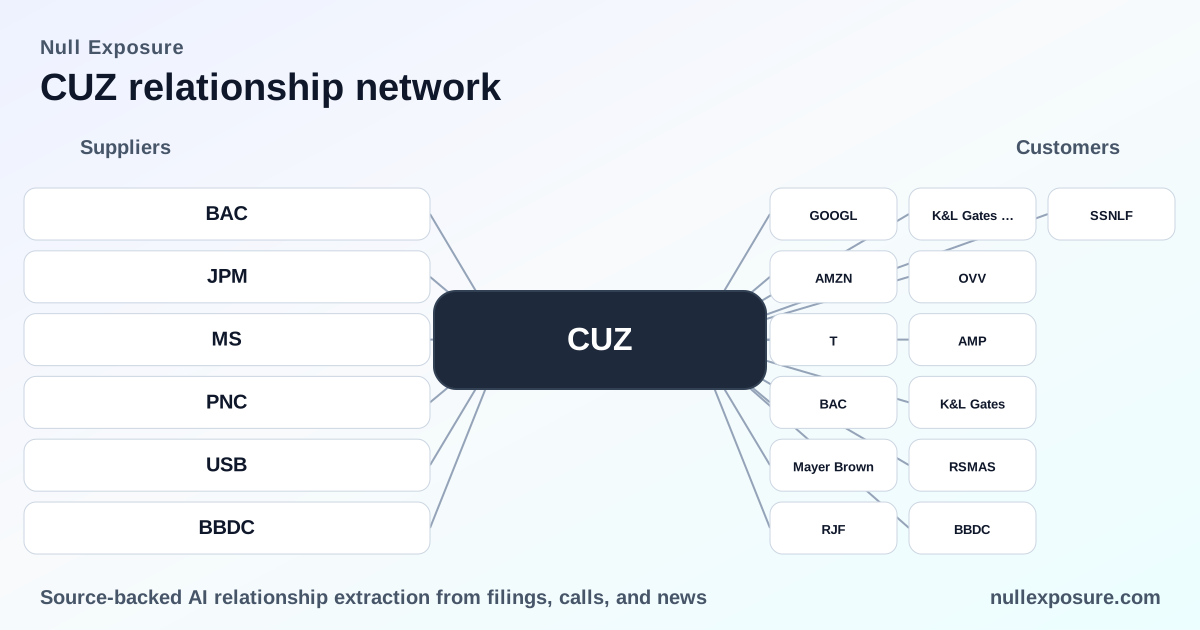
Cousins Properties (CUZ): Tenant Momentum and Concentration — FY2026 Customer Map
Cousins Properties is a self-managed REIT that develops, acquires and operates primarily Class A office and opportunistic mixed‑use properties in Sun Belt gateway cities, and it monetizes through long‑term lease cashflows, ancillary property fees, and development/management fee income. The company’s revenue base is driven by contractual rents and operating expense recoveries, with a stabilized portfolio that generated roughly $1.0 billion in trailing revenues and a heavy weighting to tenant relationships in Austin, Atlanta, Charlotte, Dallas, Nashville and other Sun Belt markets. For a concise, transaction‑level view of tenant exposures visit https://nullexposure.com/.
How Cousins’ customer economics actually work
Cousins runs a business that is contract‑heavy, regionally concentrated and tenant‑dependent in the following ways:
- Contracting posture — long‑dated revenue: The company reports substantial non‑cancelable lease cash flows extending well past 2030, and a weighted average rent profile that reflects multi‑year commitments; this underpins predictable rental property revenue and supports valuation multiples typical for stabilized office REITs. (Company filings as of Dec. 31, 2025)
- Geographic focus — Sun Belt office nodes: Operations concentrate in Austin, Atlanta, Charlotte, Tampa, Phoenix, Dallas and Nashville, which concentrates both leasing upside and local market cyclicality into a handful of fast‑growing U.S. metros. (Company overview and FY2025 MD&A)
- Concentration and criticality — meaningful top tenants: The top 20 tenants account for roughly 38.6% of annualized rent, with the single largest tenant representing about 8.9% of annualized rent, creating measurable single‑tenant risk even as a diversified roster supports occupancy. (FY2025 disclosure)
- Revenue mix and role: Most revenues are derived from operating leases (rental property revenues) while fee income from development and management is a material secondary stream; Cousins is therefore both landlord (seller of space) and services provider (fee income). (Annual report, FY2025)
- Relationship stage and maturity: The portfolio is broadly stabilized and highly leased (run‑rate occupancy in the high‑80s to low‑90s percent), indicating a set of mature, active tenant relationships with ongoing renewal dynamics. (FY2025 operating metrics)
Collectively these characteristics explain why lease renewals and a handful of large new leases are the primary drivers of short‑term earnings momentum and medium‑term cashflow certainty.
Tenant roll call: the relationships documented in FY2026 reporting
Below are the customer relationships identified in the public reporting and media coverage for FY2026. Each entry is a short plain‑English summary with the source cited.
AT&T (T)
Cousins reported a 166,000 sq. ft. new lease with AT&T at Northpark, part of 211,000 sq. ft. of leasing activity at that asset during the quarter. Source: Q4 FY2025 earnings call transcript as reported by InsiderMonkey (published March 9, 2026).
Bank of America (BAC / Bank of America)
Bank of America’s lease in Charlotte expired during the quarter, a development management highlighted when reporting portfolio occupancy, and management reiterated a year‑end 2026 occupancy target. Source: Q4 FY2025 earnings call transcript and related press summary in The Globe and Mail (May 2026).
Oracle (Oracle Corporation / ORCL)
Cousins executed a 116,000 sq. ft. long‑term lease with Oracle at Neuhoff in Nashville, described as a leasing momentum catalyst for that mixed‑use development. Source: TradingView/Zacks coverage and SG Yahoo Finance reporting (May 2, 2026).
Google (GOOGL)
Google is cited as one of Cousins’ two largest technology customers and is the anchor tenant at assets such as Sail Tower in Austin that the company owns or transacted. Source: Q4 FY2025 earnings discussion and The Real Deal coverage of Austin assets (May 2026).
Amazon (AMZN)
Management identified Amazon as the largest tenant company in the portfolio and discussed tenant utilization in the context of broader corporate office trends. Source: Q4 FY2025 earnings call transcript and The Globe and Mail press reporting (May 2026).
K&L Gates LLP (K&L Gates)
K&L Gates is listed among the tenants at a Charlotte Class‑A office property recently acquired by Cousins; the purchase included multiple professional‑services occupiers. Source: Law360 report on the Charlotte property acquisition (March 9, 2026).
Mayer Brown
Mayer Brown is another named professional‑services tenant occupying space at the Charlotte acquisition that Cousins closed in early‑2026. Source: Law360 coverage of the Charlotte purchase (March 9, 2026).
Raymond James (RJF)
Cousins completed two renewals with Raymond James totaling 55,000 sq. ft. across Buckhead and Northpark, underscoring renewal activity in key Atlanta submarkets. Source: Q4 FY2025 earnings call transcript as summarized by InsiderMonkey (March 9, 2026).
RSM
RSM is identified among professional‑services occupiers in a fully‑leased Barings headquarters asset, evidencing professional‑services concentration in specific assets. Source: InsiderMonkey’s earnings call summary referencing building tenant composition (March 9, 2026).
Ameriprise Financial (AMP)
Ameriprise features among established professional tenants in properties completed since 2017, contributing to stabilized occupancy and tenant mix diversity. Source: InsiderMonkey’s FY2025 earnings call summary (March 9, 2026).
Barings (BBDC)
Barings leases approximately 30% of a noted building and serves as a major, institutional occupant that anchors other professional‑services tenants. Source: InsiderMonkey Q4 FY2025 earnings call reporting (March 9, 2026).
Ovintiv (OVV)
Ovintiv functions as the prime tenant and sole customer in a building where it subleased substantially all space, a structure that concentrates cashflow risk into a single corporate counterparty for that asset. Source: Q4 FY2025 earnings transcript and Globe and Mail press release excerpts (May 2026).
McGuireWoods
Cousins completed an early long‑term renewal with McGuireWoods for 127,000 sq. ft. at 201 North Tryon, a material renewal in Charlotte that improves near‑term lease visibility. Source: The Globe and Mail reporting on the FY2025 earnings call (May 2026).
Samsung (SSNLF / Samsung)
Samsung represents the largest scheduled expiration through the end of 2026 at Briarlake in Houston, with management highlighting the November lease expiration as the principal near‑term expirations risk. Source: Q4 FY2025 earnings remarks as reported by The Globe and Mail (May 2026).
Banyan Street Capital
Banyan Street Capital acquired Harborview Plaza from Cousins and Lafayette Street Capital for $39.5 million, reflecting asset disposition activity and third‑party capital recycling. Source: MarketScreener transaction note (Feb. 20, 2026; cited in May 2026 press).
What the tenant map implies for investors
- Cashflow visibility is high where long‑term anchors exist: the portfolio’s long dated lease schedule and the presence of several large, sophisticated corporate tenants support predictable base rents and justify mid‑cycle valuation multiples.
- Concentration is the primary operational risk: with the top 20 tenants accounting for nearly 40% of annualized rent and several single‑tenant buildings (e.g., Ovintiv), tenant departures or non‑renewals at a handful of assets can move occupancy and FFO materially.
- Geographic exposure is a double‑edged sword: Sun Belt growth supports leasing demand and rent resilience, but market‑specific downturns or office‑use shifts in any of the core cities will have outsized effects.
- Deal flow and asset rotation are in effect: disposals (Harborview Plaza) and new large leases (Oracle, AT&T, McGuireWoods renewals) signal active portfolio management that offsets some concentration risk and drives MODERATION in NAV volatility.
Bottom line and next step
Cousins operates a leases‑first, fee‑augmented REIT model with long‑dated contractual cashflows and a concentrated set of large tenants whose renewals and expirations determine near‑term earnings variance. Investors should weigh high occupancy and long weighted‑term leases against meaningful tenant concentration and market concentration in Sun Belt offices.
For a consolidated view of tenant exposures and relationship trends, see the home page at https://nullexposure.com/.