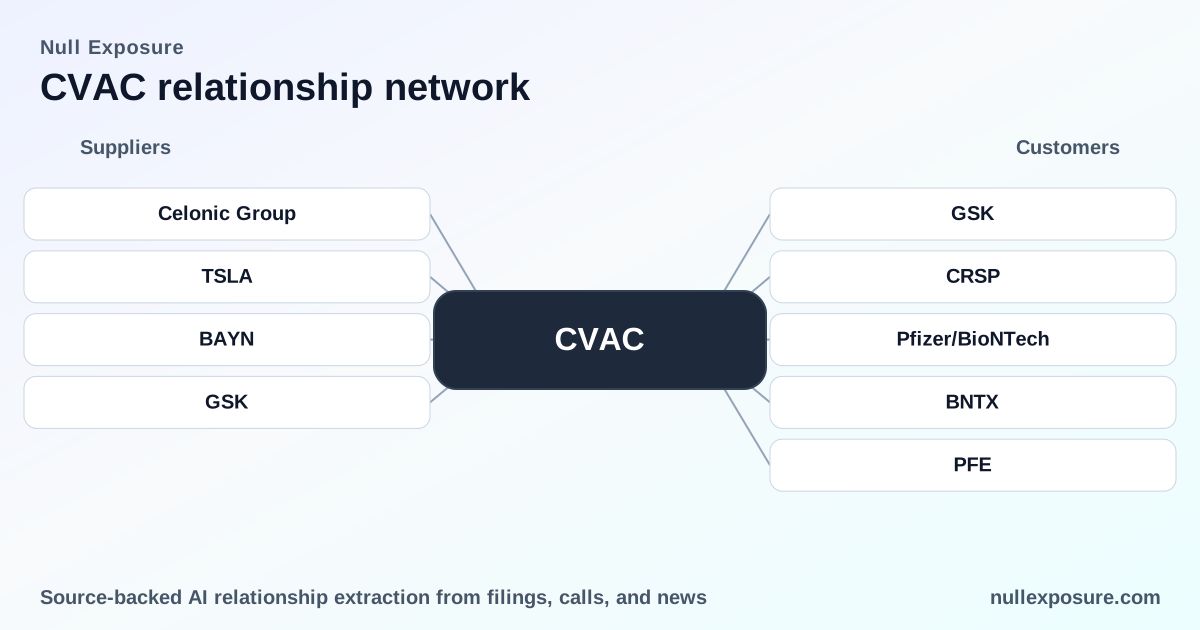
CureVac (CVAC) — who pays, who licenses, and what that means for investors
CureVac operates as a clinical-stage mRNA developer that monetizes intellectual property and platform technology through large-scale licensing deals, royalties and milestone receipts from major pharmaceutical partners, while transitioning its internal R&D focus toward oncology. For investors evaluating counterparty risk and revenue durability, the business now reads as a licensor-consolidation story: material near-term cash flows driven by a small number of pharma partners, followed by an acquisition-led exit that reconfigures the company’s public profile. For a complete look at counterparties and source documents, see NullExposure’s company page: https://nullexposure.com/.
How CureVac’s operating model converts technology into cash
CureVac’s monetization is built around three commercial levers: exclusive and non-exclusive licenses, royalty streams on licensed products, and milestone / one-time payments tied to strategic partnerships. The company’s contracting posture is transaction-focused—CureVac sells rights to its mRNA backbone and manufacturing know‑how rather than building a diversified commercial footprint. That posture produces high revenue concentration (a handful of counterparties accounted for the overwhelming share of 2025 revenue) and lumpy earnings, driven by one-off license closings and periodic royalty receipts.
- Concentration: Major flows in 2025 came from GSK, BioNTech and Pfizer, indicating single-counterparty materiality at the company level.
- Criticality: CureVac’s second-generation mRNA backbone functions as an enabler for partners’ vaccine candidates, making its IP strategically important to counterparties but delivered under controlled licensing terms (non‑exclusive in key cases).
- Maturity: The revenue mix is a hybrid of mature license monetizations (large, discrete upfronts recognized in prior periods) and recurring royalties that are modest and volatile today as partner programs progress through clinical and commercialization milestones.
For a quick reference of counterparties and coverage of every relationship cited in primary reporting, see the breakdown below. If you want the raw news links and a consolidated view of contract texts, visit NullExposure’s company page: https://nullexposure.com/.
Customer and partner relationships — the complete list and what each means
BioNTech (BNTX / BioNTech SE)
CureVac was fully acquired by BioNTech, removing its shares from public trading and folding CureVac’s platform into BioNTech’s broader mRNA business; earlier in 2025 CureVac also recognized license fees from BioNTech totaling €11.1 million for the first nine months. Source: aktiencheck report on the BioNTech takeover (March 2026) and InvestingNews Q3 2025 results (https://investingnews.com/curevac-announces-financial-results-for-the-third-quarter-and-first-nine-months-of-2025-and-provides-business-updates/).
GlaxoSmithKline Biologicals SA (GSK / GlaxoSmithKline)
GSK has been CureVac’s largest commercial counterparty in 2025, delivering €43.3 million in revenue for the first nine months of 2025 and smaller amounts reported for interim periods; GSK also paid a substantial one‑time consideration in prior quarters under a licensing arrangement and agreed additional payments (reported at $50 million) to monetize existing license claims. Source: InvestingNews Q3 2025 release and boerse.de / EQS press release and 4Investors coverage (FY2025 reporting, March 2026).
CRISPR Therapeutics (CRSP)
CRISPR Therapeutics accounted for a small, visible revenue line in 2025—reported as €1.8 million for the first nine months—representing a modest partner engagement rather than a material revenue driver. Source: InvestingNews Q3 2025 release (September 30, 2025).
Pfizer (PFE)
Under the U.S. license agreement executed in August 2025, CureVac recognized royalties and license‑related cash, including €11.1 million in Q3 2025 tied to royalties under the U.S. License Agreement that CureVac granted jointly to BioNTech and Pfizer. Source: InvestingNews Q3 2025 release (reporting Q3 results).
Pfizer / BioNTech (joint license)
CureVac granted BioNTech and Pfizer a non‑exclusive license to produce, use, import into the United States and sell mRNA‑based COVID‑19 and influenza vaccines, with that license converting to global scope upon completion of the BioNTech acquisition. This structure produced both upfront and royalty economics and allowed CureVac to retain an IP‑licensing role while enabling major manufacturers’ U.S. distribution. Source: company releases and coverage summarized in boerse.de/EQS and PharmaceuticalCommerce reporting (FY2025).
Additional notes on related press coverage
Multiple outlets tracked the financial consequences of these agreements and the acquisition: RTTNews highlighted the removal of a €480.4 million one‑time revenue item from 2024 that materially depressed year‑over‑year comparatives in 2025; ad-hoc news and other press summarized the nine‑month 2025 revenue split across GSK, BioNTech and CRISPR. Sources: RTTNews Q3 2025 coverage and ad-hoc-news (FY2025 commentary).
What the relationship map signals for valuation and risk
- Revenue volatility and reversibility: CureVac’s public financials in 2025 show a classic post‑licensing revenue profile—very large discrete payments in prior periods and smaller recurring royalties thereafter, producing steep top‑line declines year‑over‑year once major up‑front items are exhausted (RTTNews, Q3 2025).
- High counterparty concentration: GSK accounted for the majority of 2025 license‑related revenue, with BioNTech / Pfizer forming the second tier; that concentration elevates counterparty risk and makes future topline highly dependent on contract renewals and partners’ program progress (InvestingNews Q3 2025; boerse.de/EQS).
- Strategic outcome: acquisition and IP consolidation: The BioNTech takeover finalized in early 2026 consolidates the technology into a larger, integrated mRNA franchise and removes CureVac’s standalone public equity upside while delivering an exit path for shareholders (aktiencheck, March 2026).
- Contracting posture: The company’s preference for non‑exclusive licensing in major markets preserves upside through royalties but limits single‑partner exclusivity premium; this mitigates commercial execution risk for partners while preserving CureVac’s licensing optionality (PharmaceuticalCommerce, FY2025).
Constraints and signals from the reporting
The available relationship-level reporting contains no explicit operational constraints in the dataset provided. Company-level signals embedded in public releases show a focus on IP monetization, transactional licensing posture, and consolidation via acquisition, which together indicate a mature monetization phase rather than early-stage platform commercialization.
Investment takeaway
- Short-term cash realized, long-term public optionality reduced: 2024–2025 produced large monetizations and subsequent royalty flows; the BioNTech acquisition transforms CureVac from an independent public licensor into part of a larger mRNA industrial platform, removing the public equity instrument.
- Concentration and lumpy earnings are principal risks: Investors and operators should treat future revenue forecasts as partner‑driven and milestone‑dependent, with GSK and BioNTech/Pfizer exposures central to scenario analysis.
- For counterparty and contract diligence, review the Q3 2025 releases and acquisition disclosures cited above to model residual royalty streams and to estimate the timing and probability of future license monetizations.
For a consolidated feed of these news items, filings and a relationship map that supports deal‑level diligence, visit NullExposure’s company page: https://nullexposure.com/.