Cavco Industries (CVCO): How financing relationships underpin manufactured-home sales
Cavco Industries builds, distributes and retails factory-built homes and captures margin across manufacturing, retail distribution and captive finance. The company monetizes through home sales (to independent distributors, community operators and retail customers), warranty and ancillary services, and a finance arm—CountryPlace Mortgage—that originates and services loans and sells them into government-sponsored channels. CountryPlace’s status as an approved seller/servicer and Ginnie Mae issuer materially extends Cavco’s product economics by converting retail demand into financeable mortgages and securitized liquidity. Learn more about how we source and present counterparty intelligence at https://nullexposure.com/.
Executive thesis: vertical integration with finance as a distribution amplifier
Cavco’s operating model is vertically integrated: factory production, company-owned retail and independent distribution are coupled with a captive lending capability that converts retail purchases into financeable loans. This configuration increases unit economics by internalizing origination and servicing revenue while smoothing demand via third‑party mortgage channels (Fannie Mae, Freddie Mac, Ginnie Mae). Investors should treat Cavco as a residential-construction operator that leverages a regulated-finance conduit to increase close rates and fee income.
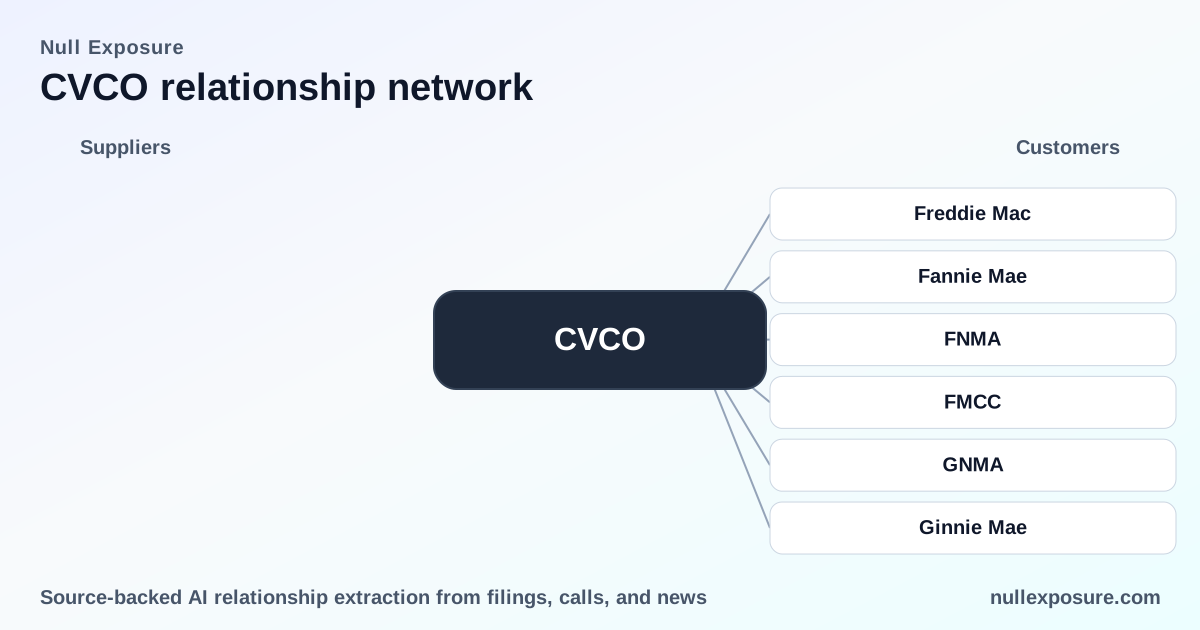
The finance relationships that matter — one concise view of every counterparty found in public reporting
This section summarizes each counterparty relationship captured in Cavco’s customer‑scope results. Each entry contains a plain-English summary and a direct source reference.
Fannie Mae
CountryPlace Mortgage is an approved Fannie Mae seller/servicer that offers conforming and non‑conforming mortgages and home‑only loans to purchasers of factory‑built homes, enabling Cavco to deliver financed closings that are saleable to the agency. According to Cavco’s fiscal 2026 earnings releases and webcast notices, CountryPlace’s Fannie Mae approval is an explicit channel for placing manufactured‑home mortgages (GlobeNewsWire, Jan 29, 2026; QuiverQuant, Mar 9, 2026).
Freddie Mac
CountryPlace Mortgage is likewise approved to sell and service loans to Freddie Mac, providing another agency conduit for converting retail home purchases into investor‑grade mortgage assets. Management disclosures in Cavco’s fiscal‑year communications list Freddie Mac as an approved counterparty for CountryPlace (QuiverQuant webcast alerts and GlobeNewsWire fiscal reports, Jan–Mar 2026).
Ginnie Mae
CountryPlace Mortgage is an issuer for Ginnie Mae mortgage‑backed securities, which allows Cavco-originated loans backed by government guarantees to be pooled and securitized—supporting liquidity for lower‑downpayment buyers of manufactured homes. Management referenced Ginnie Mae issuance capability in investor communications around the fiscal 2026 quarter (Markets/Business Insider and company releases, Mar–May 2026).
UMH (UMH Properties)
Cavco provided a rendering and partnered with UMH for a showcase project, demonstrating an operating relationship with a public manufactured‑housing REIT and illustrating product placement in community settings. The partnership was mentioned in industry press discussing solutions for affordable housing (REIT.com article, FY2024 reporting referenced in March 2026 coverage).
What these relationships mean for Cavco’s operating and business model
Cavco’s agency approvals and community partnerships are not peripheral; they are core to its commercial delivery. The financing approvals convert retail demand into financeable collateral, reduce buyer friction and expand addressable demand for factory‑built housing. The UMH partnership signals continuing integration with community operators and downstream channels.
- Contracting posture: Cavco’s customer warranties are short‑term (one‑year for manufacturing defects), which indicates limited post‑sale long‑tail obligations and keeps lifecycle warranty exposure concentrated in the near term.
- Counterparty composition: The company sells primarily to individual retail buyers through both independent distributors and company‑owned stores; this implies a high volume of consumer relationships and a retail sales profile that benefits from captive financing.
- Geographic footprint: Sales and distribution are North America‑centric (48 U.S. states and Canada), with notable concentration of retail stores in Texas—this creates regional exposure that is also a strength given demand patterns in Sun Belt markets.
- Roles and revenue capture: Cavco operates simultaneously as seller (manufactured homes), financier (CountryPlace Mortgage) and servicer (third‑party servicing fees), creating multiple revenue streams per unit sold.
- Relationship maturity and stage: The company reports active, ongoing distribution and financing operations; after production begins orders become non‑cancelable, indicating revenue visibility once builds commence.
- Scale signal: Related‑party sales disclosed for fiscal years show mid‑tens of millions (roughly $54–65 million historically), putting related‑party transaction flows into a $10m–$100m spend band context at the company level.
Key investment considerations and risks
- Revenue diversification through finance is a structural advantage. Captive origination and servicing convert retail closings into fee and interest income and let Cavco participate in secondary‑market spreads via agency sales and Ginnie Mae securitizations.
- Agency dependence creates both lift and regulatory linkage. Approvals from Fannie Mae, Freddie Mac and Ginnie Mae are revenue multipliers but tie Cavco to agency underwriting standards and servicing requirements—operational compliance is critical.
- Retail concentration and geographic exposure are material. Heavy retail footprint in Texas and a distribution network focused on U.S./Canada make demand sensitive to regional housing cycles and local policy changes.
- Warranty and short-term obligations limit long-term liability. One‑year manufacturing warranties compress post‑sale risk into the near term, improving cash flow predictability but concentrating replacement or repair exposure.
Bottom line and next steps for investors
Cavco’s business model is strengthened by an integrated finance capability that moves manufactured‑home demand into agency channels and securitization markets. For investors and operators evaluating counterparties, the combination of seller/servicer approvals plus active servicer economics is a structural advantage that supports both top‑line and fee income.
If you want a concise counterparty map and signal package for Cavco and comparable manufactured‑housing players, visit https://nullexposure.com/ for structured intelligence and source‑backed relationship profiles.
Sources cited in this piece include Cavco’s public earnings and webcast notices and industry reporting: GlobeNewsWire and company fiscal‑quarter releases (Jan–Mar 2026), QuiverQuant investor notices (Mar 2026), Yahoo Finance and Markets/Business Insider coverage (Mar–May 2026), and REIT.com industry reporting (referenced March 2026).