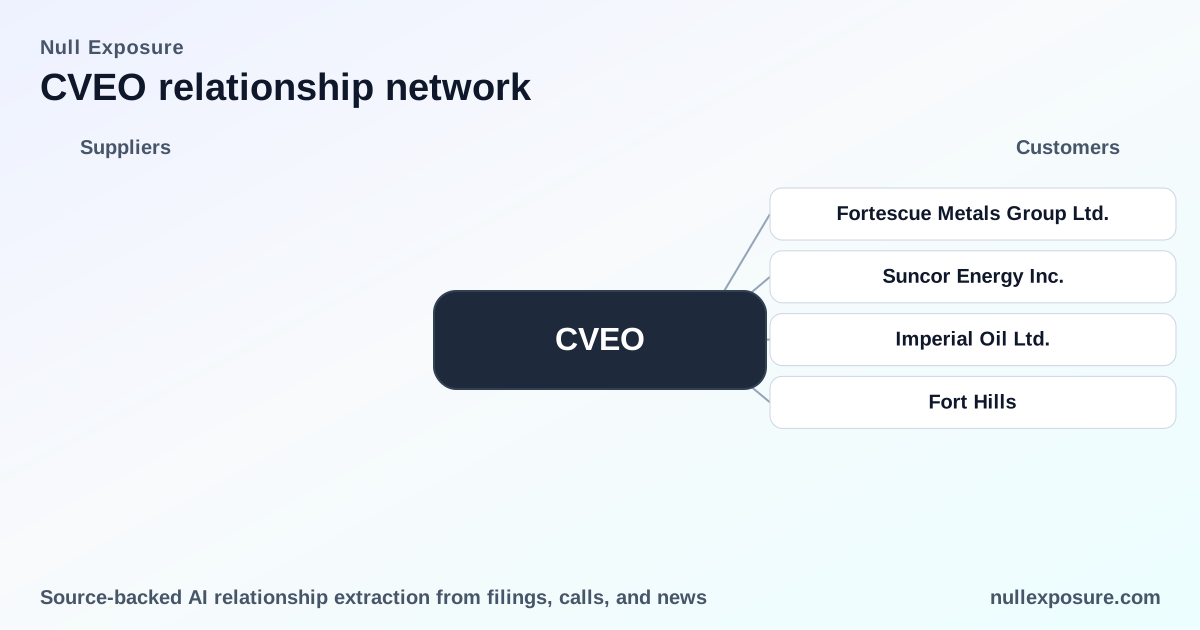
Civeo (CVEO) — Customer Map and Commercial Risks for Hospitality-in-Remote-Workforces
Civeo operates workforce accommodation and hospitality services for global natural-resources operators and monetizes through a mix of multi-year, take-or-pay lodging contracts and short-term, project-based mobile asset deployments, supplemented by ancillary catering and facilities services. The company’s revenue profile is concentrated around a small number of large enterprise customers and geography-exposed operations in Australia and Canada, producing a business that combines highly visible cash flows from long-term sites with demand volatility on short-term projects. For deeper relationship analytics, see https://nullexposure.com/.
How Civeo’s commercial model delivers revenue and where risk concentrates
Civeo’s core product is hospitality for remote workforces: lodging, catering, housekeeping, and facility maintenance at lodges and villages the company owns or operates. The company converts those services into predictable revenue through long-term, take-or-pay or exclusivity contracts for fixed-site villages while retaining flexibility and upside through mobile assets contracted on a project basis to follow drilling, pipeline, and seismic activity. Civeo also acquires operating villages with embedded long-term customer commitments to extend revenue visibility; for example, a February 2025 asset purchase in Australia included associated long-term customer contracts.
Key business-model characteristics:
- Contracting posture: Predominantly long-term contractual coverage for fixed sites, with a material short-term, project-based channel through mobile assets.
- Concentration: Revenue is concentrated in a handful of large customers; concentration creates counterparty and renewal risk.
- Criticality: Services are operationally critical for remote projects, producing elevated switching costs and bargaining leverage when occupancy is high.
- Maturity: Many customer relationships are long-standing, supporting stability but also embedding dependency on a few counterparties.
Constraints and what they signal about operational risk
The company-level signals from public filings and disclosures are clear and actionable:
- Long-term contracts dominate revenue: a majority of income is derived from multi-year, take-or-pay or exclusivity contracts tied to owned lodges and villages — this delivers revenue visibility and collateral value for the real-estate-like assets.
- Short-term project exposure exists: mobile assets that follow customer activity are contracted on a project basis, creating cyclical variability in utilization and margins.
- Customer mix skews large enterprise: Civeo serves large, investment-grade energy and mining companies, concentrating counterparty credit exposure.
- Geographic exposure is concentrated in APAC and North America: Australia and Canada are the strategic markets that generate the bulk of revenues, leaving Civeo sensitive to regional commodity cycles and regulatory conditions.
- Service-provider role and maturity: Civeo acts as a specialized hospitality operator for remote workforces with many long-standing customer relationships, lowering churn risk but increasing renewal importance. These constraints position Civeo as an asset-heavy operator with stable base cash flows complemented by cyclical project revenue, and they define the primary levers investors should monitor: contract renewals, occupancy trends, and enterprise-counterparty credit quality.
Customer relationships that drive performance
Below I cover every customer relationship disclosed in the company materials and reporting results.
Fortescue Metals Group Ltd.
Fortescue is one of Civeo’s two largest customers, each accounting for more than 10% of revenues in 2024. This places Fortescue in the category of a material anchor client whose operational decisions have direct revenue consequences for Civeo. According to Civeo’s Form 10‑K for the year ended December 31, 2024, Fortescue accounted for more than 10% of 2024 revenues.
Suncor Energy Inc.
Suncor is the other customer that accounted for over 10% of revenues in 2024 and 2023, representing a second material concentration point in Canada’s oil-sands activity where Civeo operates lodging and support services. This disclosure is documented in Civeo’s 2024 Form 10‑K.
Imperial Oil Ltd.
Imperial Oil was a material customer historically: Civeo reported that Imperial Oil accounted for more than 10% of revenues in 2022, underscoring that the company’s list of large customers has shifted over time and that customer composition can change with project cycles. This detail is included in the company’s 2024 Form 10‑K describing prior-year concentrations.
Fort Hills
Fort Hills is cited in an operational context: Civeo reported year-over-year revenue and adjusted EBITDA decreases driven by lower build rooms and the loss of Fort Hills–related occupancy after the sale of the McClelland Lake lodge. The comment comes from a Q2 2025 earnings call transcript summarized on InsiderMonkey and illustrates how discrete asset sales and site-level occupancy changes can remove meaningful revenue streams in the near term (InsiderMonkey transcript, Q2 2025).
What these relationships imply for investors
- Concentration risk is real and measurable. Two customers accounted for over 10% of revenue in 2024; an adverse commercial outcome with either Suncor or Fortescue would materially affect top-line stability.
- Take-or-pay contracts provide protection, but not immunity. Long-term contracts underpin asset values and cash flow visibility, but contract expirations and renegotiations are binary events that reset pricing and utilization.
- Short-term revenue amplifies cyclical swings. Mobile assets and project work produce margin upside when commodity activity is strong and occupancy is elevated; they also amplify downside when customers cut build rooms or sell assets (as with Fort Hills).
- Regional exposure concentrates macro risk. Heavy operations in Australia and Canada concentrate Civeo to regional mining and energy cycles, making commodity prices and regional capex plans leading indicators of occupancy.
- Valuation context: Civeo’s trailing revenue (TTM $638.8M) and market capitalization (~$336M) imply an investor view that prices in both operational leverage and concentration risk; the company’s EV/EBITDA of ~6.7 signals a valuation that reflects earnings recovery potential under stable contract rollouts.
What investors should watch next
- Monitor contract renewal schedules with Suncor, Fortescue, and other large counterparties and any changes to exclusivity or take-or-pay terms.
- Track occupancy and utilization metrics for owned villages and the deployment rate of mobile assets quarter to quarter.
- Watch asset transactions and disposals that can remove contracted occupancy (e.g., the McClelland Lake sale) and how proceeds are redeployed.
- Follow regional capex trends in Australian mining and Canadian oil-sands activity as leading indicators of demand.
- Assess counterparty credit trends for large customers; problems at a material client would transmit quickly to Civeo’s top line.
For a concise relationship dashboard and ongoing monitoring tools, visit https://nullexposure.com/ and review the customer intelligence coverage.
Bold takeaways: Civeo’s revenue is anchored by long-term contracts with a handful of very large customers, which provides predictability and simultaneously concentrates commercial risk; short-term mobile work offers upside but increases cyclical volatility. Investors should prioritize contract pipeline visibility and site-level occupancy trends when modelling earnings and downside scenarios.