Commercial Vehicle Group (CVGI): Customer relationships that drive revenue and risk
Commercial Vehicle Group designs and manufactures seating, electrical systems, and assemblies for commercial, electric and autonomous vehicles and monetizes through a mix of long‑term program contracts and purchase‑order business plus transitional services income; the company recognizes product sales at shipment and reported approximately $723.4 million of revenue for the year ended December 31, 2024. CVG’s revenue model is concentrated around OEM program wins and aftermarket/distributor channels, with program life economics (five‑ to seven‑year production windows) producing recurring revenue streams when contracts are awarded.
For a mapped view of CVG’s customer relationships and how each contributes to program exposure, see the CVG customer page at NullExposure: https://nullexposure.com/
The customer roster that matters — concise portraits and sources
-
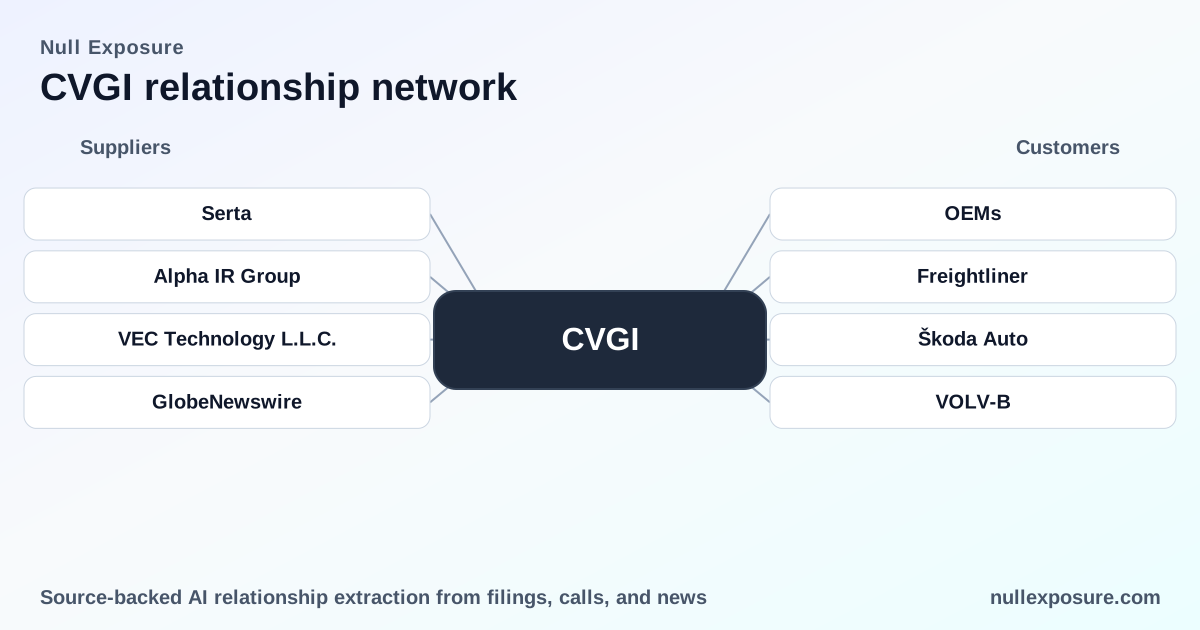
OEMs
CVG is deeply embedded with vehicle OEMs as the principal channel for its seating and electrical systems; the FY2024 Form 10‑K explicitly notes that many OEM customers and their suppliers have unionized work forces, underlining program and labor dynamics that affect delivery and cost. According to the company’s FY2024 10‑K filing, OEM relationships are central to the business and are governed by program‑level commercial arrangements (Form 10‑K, FY2024). -
Zoox
CVG has secured a supply relationship with autonomous ridesharing company Zoox to provide wire harnesses and related electrical components, marking a strategic expansion into electric and autonomous vehicle platforms and accelerating Global Electrical Systems revenue and margins. This development was reported in 2026 news coverage, including an Intellectia.ai story on the company’s board and contract announcements and a StocksToTrade article highlighting the partnership’s contribution to segment growth (news reports, FY2026). -
Freightliner
CVG was awarded the standard seat position for Freightliner Class 8 production beginning with the 2007 model year, demonstrating a long‑standing OEM program relationship that underpins large commercial truck revenue. TruckingInfo covered the seat development agreement and program award in 2026, noting the production position with Freightliner Class 8 trucks (TruckingInfo, FY2026). -
Škoda Auto (Volkswagen Group)
Škoda Auto is cited as a leading customer in CVG’s Czech operations, with Volkswagen/Škoda personnel visiting CVG’s Czech facility to review local capabilities and partnerships — evidence of CVG’s integration into European OEM supply chains. The company referenced Škoda’s engagement with its Czech facility in a GlobeNewswire press release describing support efforts in 2022 (GlobeNewswire, FY2022). -
VOLV‑B (Volvo Group, Volvo 3P)
CVG announced a partnership with Volvo 3P — Volvo AB’s development and purchasing unit for Mack, Renault V.I., and Volvo Truck Corp — to supply truck seating, signaling program wins within Renault/Mack/Volvo platforms and reinforcing European heavy‑truck exposure. TruckingInfo reported the Volvo 3P collaboration in 2026 under the VOLV‑B ticker context (TruckingInfo, FY2026). -
Volvo 3P
The Volvo 3P relationship is recorded separately in the coverage and reiterates CVG’s selection by Volvo’s centralized procurement arm for seating programs across multiple truck brands, which increases program scale and program‑life revenue potential. The TruckingInfo story documents the Volvo 3P partnership and its program implications (TruckingInfo, FY2026).
Key takeaway: CVG’s customer book mixes legacy heavy‑truck OEMs and new entrants in electric/autonomous vehicle programs; each relationship is a potential multi‑year revenue stream once a program is awarded.
Explore the full company‑level customer mapping at NullExposure: https://nullexposure.com/
What CVG’s contract and relationship constraints reveal about the operating model
-
Contracting posture: CVG operates as a program supplier. The company holds long‑term program contracts that typically span five to seven years and include limited termination rights for the supplier, creating durable revenue when programs stay in production. The company also maintains framework agreements where awarded business covers a program’s supply needs rather than specific quantities, while parallel short‑term purchase‑order relationships persist for some customers (evidence from company disclosures on contract terms).
-
Concentration and criticality: Customer concentration is material. Receivables from the top five customers represented roughly 54.7% of total receivables as of December 31, 2024, indicating high exposure to a small group of OEM buyers. Program awards to those customers therefore materially affect revenue and working capital.
-
Role and maturity of relationships: CVG functions primarily as a manufacturer and seller of customized components, and sometimes as a service provider via transition services agreements that generate ancillary income during divestitures or program transitions. These features indicate mature supplier relationships with embedded operational roles beyond one‑off supply.
-
Global footprint and delivery risk: Manufacturing operations span North America, Europe, and Asia‑Pacific — the company lists sites in the U.S., Mexico, China, U.K., Czech Republic, Ukraine, Morocco, Thailand, India and Australia — making CVG a global supplier exposed to regional operational, labor and geopolitical risks. The FY2024 disclosures emphasize sales concentration across North America, EMEA and APAC.
-
Government and fleet exposure: CVG’s end markets include fleet operators, owner‑operators and governmental agencies, meaning some contract demand is tied to fleet procurement cycles and public sector purchasing patterns.
Investment implications: upside and risks tied to customers
-
Upside: Program economics and diversification into EV/autonomous platforms deliver upgrading margin potential when electrical systems scale (Zoox partnership is a visible catalyst). Long program lives translate into predictable revenue streams after award, especially for standard seat positions on Class‑8 trucks with Freightliner and Volvo 3P.
-
Risks: High customer concentration and exposure to OEM procurement cycles put revenue and receivable health at risk if a major OEM reduces orders or shifts suppliers. Unionized work forces among OEMs and suppliers introduce labor cost and continuity considerations, and the multinational manufacturing footprint creates execution risk from local disruptions.
-
Operational levers: CVG’s mix of long‑term program contracts, framework agreements and transactional purchase‑order business provides revenue stability and flexibility, while transition services income demonstrates the company’s ability to monetize transitional engagements.
Bottom line for investors and operators
Commercial Vehicle Group is a program‑centric supplier whose profitability and cash conversion depend on program awards with a handful of large OEMs and the company’s ability to scale electrical systems businesses into EV and autonomous vehicle platforms. Revenue durability flows from multi‑year program contracts, while downside stems from customer concentration and operational exposure across geographies and unionized supply chains. Investors should weigh the Zoox and Volvo/Freightliner program wins as credible drivers of medium‑term growth against the materiality of the top‑customer receivable concentration.
For investors and corporate strategists who want a structured customer exposure view, review the CVG customer mapping at NullExposure: https://nullexposure.com/