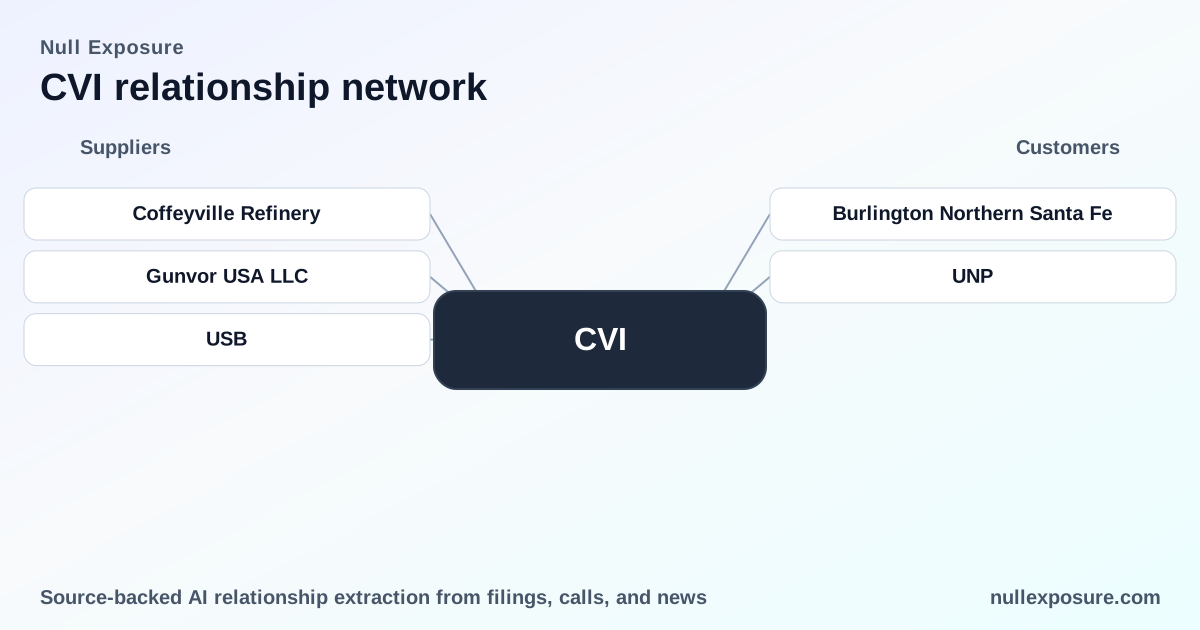
CVR Energy (CVI): Customer Relationships That Drive Margins and Risk
CVR Energy operates as an integrated petroleum refiner, renewable fuels producer, and nitrogen fertilizer manufacturer (through CVR Partners), monetizing through refining and renewables margins, sale of fertilizer products, and value capture from regulatory credits such as California’s LCFS. Revenue is driven by a mix of long‑standing commercial offtakes, indexed spot sales, and a concentrated pool of large counterparties whose purchasing patterns and logistics choices materially affect CVR’s cash flow volatility and operating leverage. For a concise summary of the coverage behind this analysis, visit https://nullexposure.com/.
How investors should read CVR’s customer footprint
CVR’s customer relationships are best understood as a layered commercial model:
- Contract mix: The company operates with a blend of long‑term offtakes and short‑term or spot contracts. Long‑term commitments exist, primarily around renewables and certain fertilizer deliveries, while a large portion of petroleum and bulk product sales are indexed to market prices. This dual posture produces both revenue stability for portions of the business and exposure to market swings for the remainder.
- Concentration and criticality: The Renewables segment is highly concentrated—two customers account for roughly half of renewable net sales each—creating concentrated counterparty risk. The Petroleum and Nitrogen Fertilizer segments also report single customers responsible for double‑digit percentages of segment sales, which is material to CVR’s financial outcome.
- Logistics dependence: Railroads are a primary distribution channel for CVR Partners’ fertilizer products; changes in rail service or freight pricing are direct operational levers on margins.
- Geographic profile: Customers are largely North American (PADD II and adjacent regions), with renewable economics partly driven by shipments into California for LCFS credits.
- Commercial maturity: Many relationships are mature and long‑standing, especially in bulk commodity channels where spot and indexed pricing remains common.
These company‑level constraints come directly from CVR’s FY2024 disclosures and are essential for assessing counterparty concentration, delivery risk, and the sensitivity of results to commodity prices and regulatory credits.
Rail partners: Burlington Northern Santa Fe
Burlington Northern Santa Fe is identified as one of the primary railroads CVR Partners uses to distribute nitrogen fertilizer via railcars, underscoring logistics reliance on Class I rail service for bulk product delivery. According to CVR Energy’s 2024 Form 10‑K, rail distribution is routed “primarily using the Union Pacific or Burlington Northern Santa Fe railroads.” (CVR Energy 10‑K, FY2024)
Rail partners: Union Pacific (UNP)
Union Pacific is likewise named as a primary railroad used to ship CVR Partners’ nitrogen fertilizer products via railcars, reflecting the company’s dependence on major freight rail networks for moving large volumes of bulk fertilizer. This is documented in CVR Energy’s FY2024 10‑K. (CVR Energy 10‑K, FY2024)
Duplicate entry: UNP (repeat mention from filing)
CVR’s FY2024 filing contains multiple references to Union Pacific in the same logistics context; the repeat mention reinforces rail service as an explicit operational channel rather than a peripheral detail. The same passage in CVR Energy’s 2024 Form 10‑K references Union Pacific as a primary carrier. (CVR Energy 10‑K, FY2024)
Pet coke supply customer: UAN
A counterparty identified as UAN reports that its Coffeyville facility obtained an average of 42% of its pet coke from CVR Energy’s Coffeyville refinery over the past five years, supplied under a long‑term agreement, with other third‑party supply contracts scheduled to end in December 2025. This is described in UAN’s FY2024 filing and signals a meaningful, multi‑year feedstock relationship between CVR’s refinery and this buyer. (UAN FY2024 filing)
What the constraints tell investors about CVR’s operating model
The company disclosures together paint a coherent commercial posture:
- Contracting posture: CVR runs a hybrid model — long‑term offtakes provide baseline stability (evidenced by remaining performance obligations and renewable offtake agreements), while the bulk of petroleum sales and many fertilizer transactions remain short‑term or spot‑priced, exposing EBITDA to commodity swings and basis differentials.
- Concentration risk: The Renewables segment is critically concentrated—two customers each represent roughly 50% of renewables net sales—creating high counterparty risk and negotiating leverage concentrated in a few buyers. Petroleum and Nitrogen segments each have a customer representing roughly 10–14% of segment sales, which is material and meaningful for scenario analysis.
- Maturity and counterparty type: Many relationships are mature and active, reflecting long‑standing commercial patterns in bulk markets; government sales (the Department of Defense purchases jet fuel at Wynnewood) introduce a small but notable counterparty class.
- Geographic and regulatory sensitivity: Sales that capture LCFS credits rely on shipments into California and similar regional programs, concentrating demand and regulatory exposure.
These are company‑level signals taken directly from CVR’s FY2024 disclosures and should be incorporated into credit and operational stress testing when modeling the business.
Risks that translate directly into valuation levers
- Logistics disruption: Dependence on Union Pacific and BNSF for fertilizer distribution means service outages or rate increases compress margins quickly. Rail exposure is an operational risk that translates to cash‑flow volatility.
- Concentrated revenue: Renewables’ customer concentration can produce cliff effects if either of the two major offtake partners reduces volumes or seeks price concessions; this is a key downside scenario.
- Commodity/market price exposure: The mix of spot and indexed contracts in petroleum and fertilizer sales means refining and fertilizer margins remain sensitive to NYMEX prices and Group 3 basis differentials.
- Regulatory credit dependency: Renewable diesel profitability is partially driven by LCFS and other state programs; changes in credit prices or policy uptake materially affect renewables economics.
For investors building models or evaluating counterparty credit, these are the operational levers that map directly into revenue and EBITDA variance.
If you want a deeper counterparty map and contract‑type breakdown for CVR, visit https://nullexposure.com/ for the full repository of parsed filings and relationship signals.
Bottom line: what to watch in the next 12 months
- Monitor rail service and freight spreads on Union Pacific and BNSF as a proxy for distribution cost pressure.
- Track the two large renewables buyers—any contract renewals, pricing shifts, or volume changes will disproportionately affect renewable margins.
- Watch pet coke supply contracts (notably the agreement with UAN) and third‑party supply expirations around December 2025 for potential feedstock re‑pricing or substitution risk.
- Model LCFS credit trajectories and California shipment volumes; renewable earnings hinge on regulatory credit economics.
Bold takeaway: CVR’s revenue profile blends predictable long‑term offtakes with high‑volatility spot flows; investors must couple commodity scenarios with counterparty and logistics stress tests to capture the true earnings risk.