Cadrenal Therapeutics (CVKD): Customer Landscape and Commercial Levers for Investors
Cadrenal Therapeutics is a clinical-stage biopharmaceutical company developing therapies for renal disease and related disorders while expanding into anticoagulation through recent asset acquisitions. The company monetizes primarily through partnering, licensing, milestone payments and future royalties rather than product sales today: pre-revenue clinical programs and license-derived royalties are the primary near-term commercial levers. For a concise investor briefing and ongoing relationship tracking, visit https://nullexposure.com/.
One-line thesis for investors
Cadrenal’s valuation and near-term upside hinge on successful clinical development and the conversion of licensing arrangements into recurring royalty streams; operational risk is concentrated in partner commercialization and government-level reimbursement dynamics.
The deal that matters: Sichuan Haisco Pharmaceuticals holds China rights to frunexian
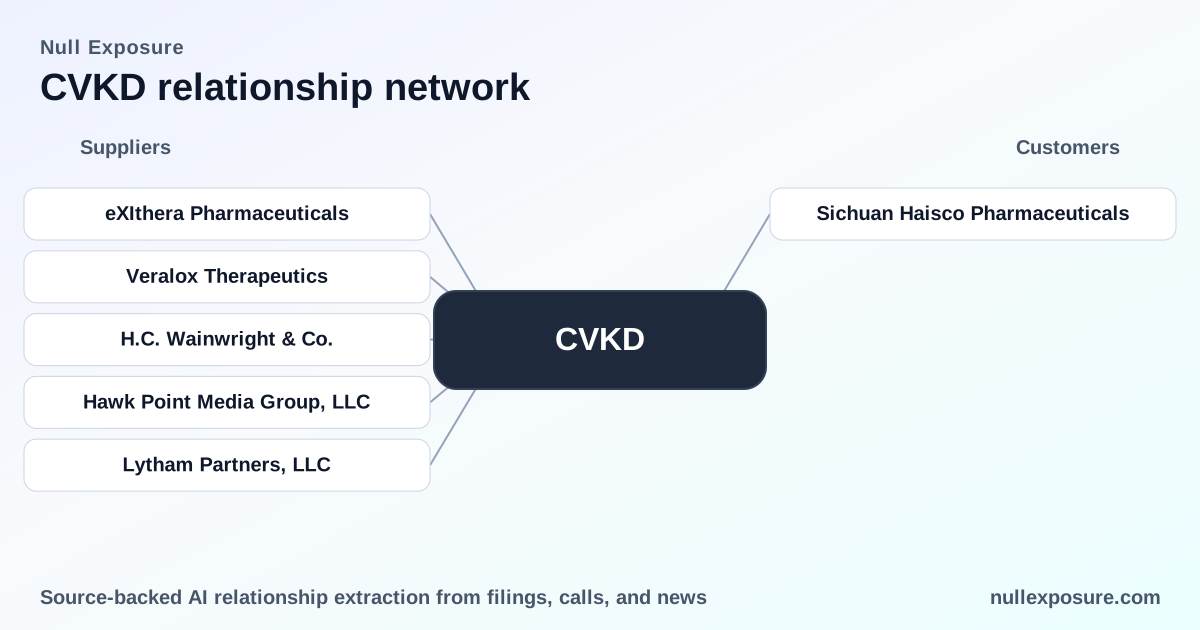
Sichuan Haisco Pharmaceuticals retains exclusive rights to develop and commercialize frunexian in China under a pre-existing license agreement, and Cadrenal is contractually entitled to royalties on any future sales of frunexian in that territory. The Chinese partner has already completed a Phase 1 trial for frunexian in China, signaling clinical progress under that license. According to a GlobeNewswire press release dated September 15, 2025, Cadrenal’s acquisition of the eXIthera portfolio preserved the license arrangement and associated royalty economics for China. (Source: GlobeNewswire, Sept 15, 2025)
Why this single-customer (partner) link is strategically significant
- Royalty upside without commercialization capex: The Haisco license converts clinical progress into a potential royalty revenue stream for Cadrenal without the company bearing Chinese launch and distribution costs. That structure preserves capital for other programs.
- Geographic de-risking for a specific asset: Holding a partner with Chinese Phase 1 data accelerates the path to market in a large and high-growth healthcare market, conditional on later-stage success and regulatory approvals.
- Concentration risk: With no current product revenue and limited commercial infrastructure, Cadrenal’s capacity to generate income in the near term is heavily dependent on a small number of partner-managed opportunities such as this China license.
All relationships covered: the complete list in this report
- Sichuan Haisco Pharmaceuticals — Under the existing license, Haisco holds China rights to frunexian and completed a Phase 1 trial there; Cadrenal will receive royalties on future Chinese sales. (GlobeNewswire press release, Sept 15, 2025)
Operating-model constraints and what they signal about business risk
Cadrenal’s public filings identify government and health administration reimbursement as a central commercialization constraint: the company explicitly warns that its ability to commercialize products “will depend in part on the extent to which reimbursement will be available from government and health administration authorities.” This language is a company-level signal about how Cadrenal expects revenue to be realized and the levers that will control effective market access.
Interpreting that constraint in practical terms:
- Contracting posture: Cadrenal operates as a partner-and-license-centric developer rather than a vertically integrated commercial seller. Licensing grants and royalty clauses are core contractual instruments.
- Concentration: The company is pre-revenue (Revenue TTM = $0) and relies on a small number of partner relationships and acquired assets to generate future income; this represents high counterparty concentration risk until direct revenues diversify.
- Criticality: Reimbursement outcomes at the government/health administration level will be critical to converting partner development success into meaningful cash flows, especially in regulated payor markets.
- Maturity: Cadrenal is an early-stage clinical company with negative earnings (Diluted EPS TTM -6.91) and modest market capitalization (~$20.3M), indicating that the firm’s commercial maturity remains limited and dependent on partner execution and external funding.
Financial and shareholder context that matters for relationship risk
- Zero product revenue today means the economic value of partner deals and royalties is disproportionate to the company’s valuation and survival runway.
- Insider and institutional ownership: Insiders hold about 17.0% and institutions about 6.6% of the float, suggesting a concentrated ownership base where management and early stakeholders maintain material control over strategy and potential future financing decisions.
- Analyst sentiment: Market analysts show a modestly positive stance (two Buy ratings and an analyst target price listed at $27.67), but these views are predicated on successful clinical outcomes and the conversion of license economics to cash flows.
What investors should watch next
- Clinical milestones for frunexian outside China and any regulatory filings or launch plans that could trigger royalties or milestone payments.
- Haisco’s development timeline and partnering disclosures: updates from the Chinese licensee will be the main observable driver of the China royalty pathway.
- Reimbursement and pricing frameworks in key markets: as noted in Cadrenal’s filings, government reimbursement policy will determine the ultimate revenue yield for licensed products.
- Cash runway and financing activity: given negative EBITDA and zero revenue, capital markets access and partner milestone receipts will dictate the firm’s ability to advance other programs.
Bottom line for investors
Cadrenal’s near-term commercial profile is dominated by licensing-derived royalties and partner execution rather than product sales. The Sichuan Haisco license for frunexian in China represents the clearest pathway to royalties today and thus deserves focused monitoring. However, company-level constraints around government reimbursement and the firm’s pre-revenue status create material execution risk until multiple partnered programs or direct commercial revenues diversify the income base.
For ongoing tracking of Cadrenal’s partner developments and revenue triggers, consider subscribing to updates at https://nullexposure.com/.
Final read: position, risks, and timing
Positioning in Cadrenal is effectively a bet on the success of partner-led development programs and the conversion of those programs into reimbursed revenue streams in major markets. Investors should weight the upside from royalty economics against concentration risk, government reimbursement exposure, and the company’s early-stage financial profile.