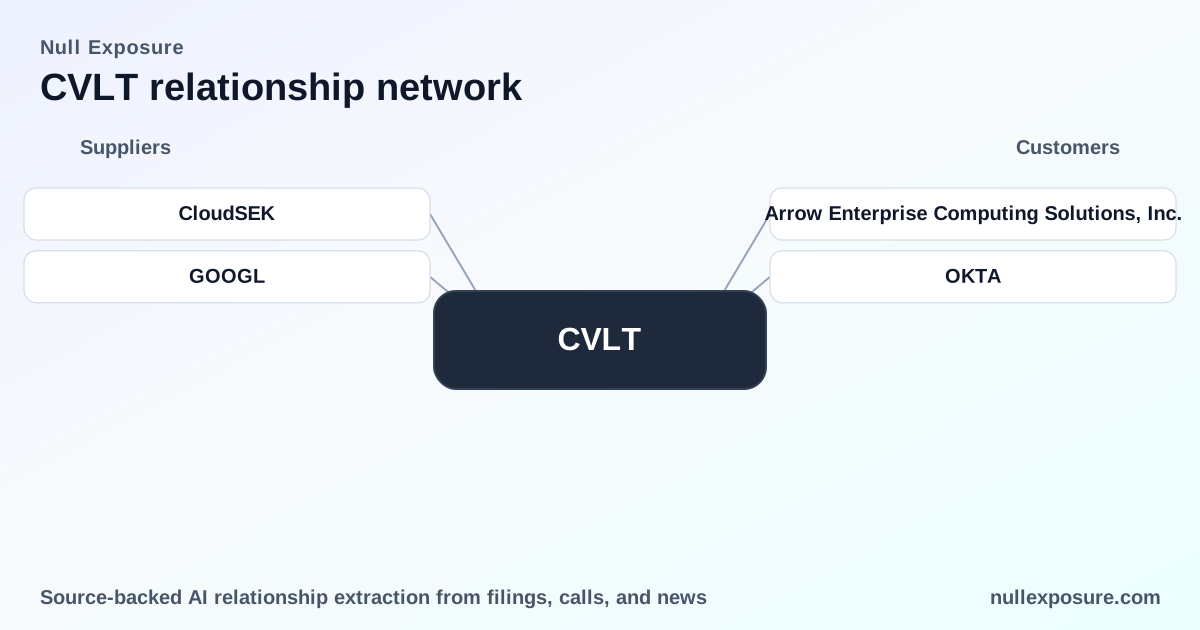
CommVault (CVLT) — Customer Relationships and Commercial Constraints That Drive Revenue Predictability
CommVault sells data protection and information management software and complementary services through a mix of perpetual licenses, subscriptions, appliances and partner-managed offerings; the company monetizes via multi-year subscription and support contracts, one‑time perpetual license sales, and professional services tied to deployments and support renewals. For investors, the critical operating facts are a diversified customer base, a subscription-heavy revenue mix with one- to three‑year terms, and significant global support commitments that underpin recurring revenue and renewal risk. Learn more at https://nullexposure.com/.
How CommVault’s commercial model actually captures value
CommVault’s revenue engine combines recurring and transactional strands. Subscription and term-based arrangements account for a growing share of revenues, with subscription terms typically one to three years and support contracts renewed annually, which creates predictable short‑to‑medium term cash flow but exposes the company to regular renewal cycles. Perpetual licenses continue to contribute revenue at delivery, and integrated hardware appliances (HyperScale X) and professional services add margin and customer lock‑in through operational dependency.
- Contracting posture: A hybrid of subscription and perpetual licensing, with the bulk of support agreements on annual cycles and subscription terms stretching to three years.
- Customer concentration and criticality: Customer base spans thousands of organizations across SMB, mid‑market, large enterprise and government, which reduces single‑counterparty concentration while elevating solution criticality given customers’ reliance on data protection.
- Geography and go‑to‑market: Global footprint via direct and indirect channels, supported by 24/7 global real‑time support operations.
- Product maturity: A portfolio that includes mature on‑premises software, SaaS options, integrated appliances and partner‑managed deployments, enabling multiple monetization paths and cross‑sell opportunities.
These commercial realities translate into meaningful recurring revenue visibility (remaining performance obligations reported at the end of FY2025) but also steady renewal risk because many support contracts are annual.
What the documented customer relationships tell investors
Below are every customer/relationship mention captured in the available materials, with a concise take on the nature and source of each relationship.
Arrow Enterprise Computing Solutions, Inc.
CommVault maintains a non‑exclusive distribution agreement with Arrow Enterprise Computing Solutions to manage reseller partners and improve distribution efficiency, positioning Arrow as a channel manager rather than a strategic exclusive reseller. According to CommVault’s FY2025 10‑K, Arrow’s role is to “enable a more efficient and effective distribution channel for our products and services by managing our reseller partners.” (FY2025 10‑K filing).
Okta (news mention)
CommVault public communications in March 2026 highlighted an extension of identity resilience capabilities to Okta in the context of rising identity‑driven cyber risk, signaling product integration or complementary go‑to‑market alignment for identity‑centric protection. A Finviz report from March 9, 2026 covered the announcement: “Commvault Extends Identity Resilience to Okta Amid Exploding Identity‑Driven Cyber Risk.” (Finviz, March 9, 2026).
OKTA (duplicate news mention)
A second March 2026 media entry repeats the same announcement linking CommVault to Okta, reinforcing that the identity resilience extension received multiple syndications in the financial press during that period. The same Finviz coverage documents the March 9, 2026 mention of the Okta extension in broader market commentary. (Finviz, March 9, 2026).
Thoma Bravo (acquisition interest reported)
Market rumors and press coverage in spring 2026 identified Thoma Bravo among private‑equity firms that expressed interest in CommVault, including a prior offer referenced by sources—this is relevant for strategic optionality and potential valuation upside or transaction risk. Reuters reporting of a potential sale process, syndicated by Benzinga on May 2, 2026, noted Thoma Bravo as an interested party. (Benzinga/Reuters, May 2, 2026).
How these relationships interact with CommVault’s constraints and strategy
The relationships above slot into CommVault’s broader operating profile without contradicting company‑level constraints:
- Channel distribution through Arrow aligns with CommVault’s mix of direct and indirect sales, and supports partner‑managed delivery options and appliance distribution; this reduces go‑to‑market friction and broadens reseller reach while preserving non‑exclusive partner flexibility.
- Technology alignments with identity platforms like Okta expand CommVault’s relevance in cybersecurity workflows, increasing the criticality of its offerings inside customer stacks and supporting cross‑sell into identity‑driven protection use cases.
- M&A interest from firms such as Thoma Bravo underscores strategic value perceived by private capital and could accelerate product consolidation, go‑to‑market scale or premium pricing, depending on outcome.
Constraints that shape revenue predictability and risk profile
Treat these constraints as company‑level signals that materially affect investor judgment:
- Short-term support contracts predominate: Most support and maintenance agreements are one‑year terms, and CommVault actively pursues renewals, which creates a steady cadence of renewal decisions that drive near‑term revenue risk (company FY2025 disclosure).
- Subscription as primary recurring revenue driver: Subscription revenues derive from term‑based arrangements (typically one to three years), and SaaS and term licenses are core to future recurring cash flows (company FY2025 disclosures).
- Perpetual licensing retained: Perpetual licenses are still recognized at delivery, keeping a transactional revenue component that affects quarter‑to‑quarter volatility.
- Wide counterparty mix: Customer base spans small business to large enterprise and government, yielding a diversified book of business that reduces single‑counterparty concentration but increases the diversity of support demands.
- Global support and delivery: CommVault operates globally with 24/7 support infrastructure, supporting international renewals and elevating operating leverage from scale.
- Product segmentation across software, services and hardware: The presence of software, services and integrated appliances (HyperScale X) drives multiple monetization vectors and higher switching costs for customers once deployed.
Key investor takeaway: CommVault combines recurring subscription economics with perpetual sales and appliance/service revenue, supported by global channels and partner relationships that de‑risk single‑counterparty concentration but commit the company to frequent renewal cycles. The March–May 2026 newsflow (Okta integrations; M&A interest) increases optionality on growth and strategic outcomes.
Final read for allocators and operators
For investors prioritizing recurring revenue stability, CommVault’s subscription focus and global support footprint deliver measurable revenue visibility through remaining performance obligations, but the annual cadence of support renewals and partial reliance on perpetual licenses preserve near‑term churn risk. For operators and partners, the Arrow distribution relationship institutionalizes indirect channel scale, while identity integrations with Okta position CommVault to capture security spend adjacent to backup and recovery.
If you want a concise competitor and partner map or to track future customer‑relationship disclosures and sales motion changes for CommVault, visit https://nullexposure.com/ for ongoing coverage and relationship intelligence.