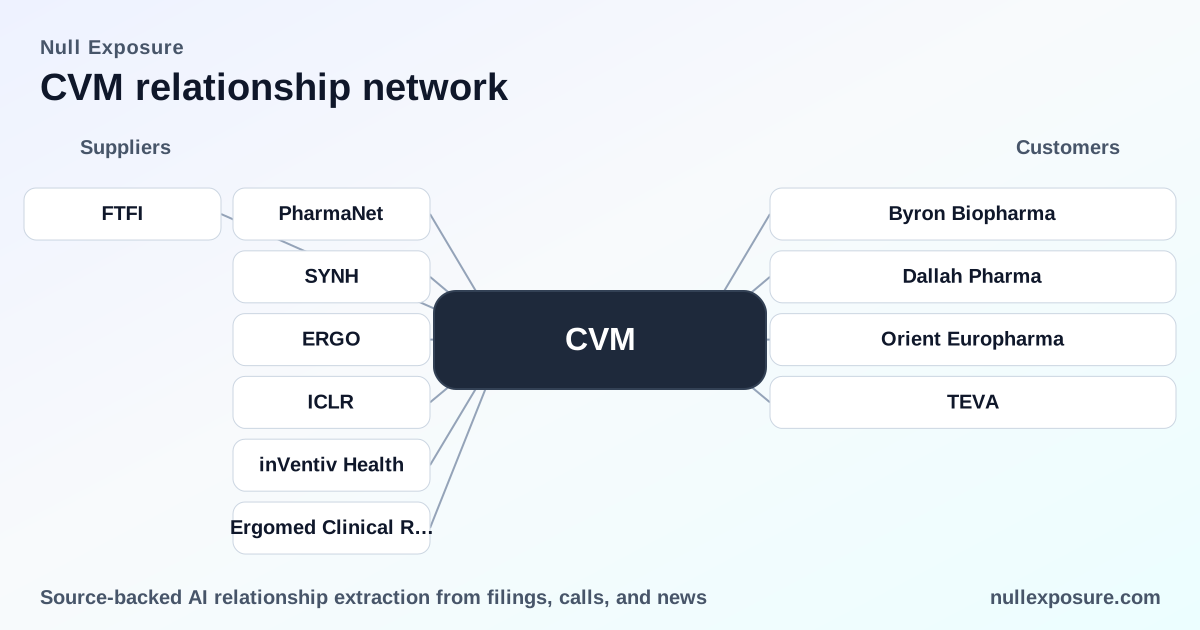
CEL-SCI (CVM): Commercial partners are the bridge to revenue — and the concentration risk investors need to price
CEL-SCI is a clinical-stage immunotherapy company that develops treatments for cancer and infectious diseases and monetizes through research milestones, licensing, and regional commercialization agreements with distributors and pharmaceutical partners. The company’s commercial strategy is explicitly partner-driven: limited in-house commercialization and dependent on regional licensees to access markets. For a concise corporate snapshot and access to relationship data, see https://nullexposure.com/.
Why partner names matter for valuation
CEL-SCI’s operating model is research-first and distribution-second. That structure reduces near-term capital outlay for global launches but creates outsized operational leverage to a small set of commercial partners. With minimal revenue and negative EBITDA in FY2025, the company’s route to sustainable top-line growth is through the execution and scaling of those partner agreements rather than internal sales forces. The FY2025 SEC disclosures feed directly into that story: partner agreements are the practical path to addressable markets in the Middle East, Israel, Turkey and other regions.
What the FY2025 partner list signals about the business
The FY2025 filings, summarized in external press coverage, list a handful of commercialization and distribution agreements. This is a concentrated, externally reliant commercialization posture: the company outsources marketing and market access to localized players rather than building global commercial infrastructure. From an investor perspective, that implies the following business-model characteristics as company-level signals (no single constraint text tied to a named partner in the source set):
- Contracting posture: CEL-SCI uses licensing/distribution agreements to transfer regional commercialization responsibilities and costs to partners.
- Concentration: A small number of named partners implies single-partner outcomes could materially affect commercial rollout timelines and revenue realization.
- Criticality: Partners are critical to revenue generation; without successful execution by these partners, product launches and market penetration stall.
- Maturity: The parties are at the commercialization agreement stage (not just research collaborations), indicating readiness to move toward market entry pending regulatory and operational milestones.
- Disclosure posture: The FY2025 filings enumerate partners but do not disclose detailed commercial milestones or revenue guarantees in the press summary reviewed, which leaves actual near-term cash flow visibility limited.
For more context on how to interpret partner concentration in clinical-stage biotechs, visit https://nullexposure.com/.
Relationship-by-relationship: what investors must know
Byron Biopharma
CEL-SCI lists an agreement with Byron Biopharma for regional distribution, indicating a localized commercialization channel that will carry launch responsibility and market access in selected territories. According to a TradingView recap of CEL‑SCI’s FY2025 10‑K (published March 2026), Byron Biopharma is one of the named distribution partners.
Dallah Pharma
CEL-SCI has signed an agreement with Dallah Pharma for commercialization in Saudi Arabia, positioning the company to access a major Gulf market through a domestic commercial partner. This is documented in the FY2025 10‑K summary reported by TradingView in March 2026.
Orient Europharma
Orient Europharma is identified as a distribution partner covering certain regions, which gives CEL‑SCI a channel to international markets without building its own commercial infrastructure. TradingView’s report of the FY2025 filing (March 2026) lists Orient Europharma among the additional agreements.
TEVA
CEL‑SCI’s filings note a marketing agreement with Teva Pharmaceutical for Israel and Turkey; the presence of Teva provides a significant strategic marketing partner given Teva’s established commercial footprint in those markets. TradingView’s March 2026 coverage of CEL‑SCI’s FY2025 10‑K highlights Teva as a named collaborator for those territories.
Teva Pharmaceutical
The FY2025 summary lists Teva Pharmaceutical explicitly for marketing in Israel and Turkey, reinforcing the same commercial relationship described above and confirming Teva’s role as CEL‑SCI’s regional marketer. TradingView’s recap of the FY2025 10‑K (published March 2026) repeats Teva’s inclusion among the company’s commercialization partners.
What investors should price in (practical risk checklist)
- Execution risk on partner rollouts: With minimal internal commercial capability, CEL‑SCI’s ability to convert regulatory approvals into revenue is highly dependent on these partners executing launches and securing reimbursement.
- Concentration risk: A small group of partners creates single-point failures; setbacks with any one partner could materially delay revenue recognition.
- Commercial visibility: FY2025 public disclosures list partners but provide limited financial detail on milestones, royalties, or guaranteed payments; investors should treat revenue timing as uncertain until partner milestone schedules are disclosed.
- Geographic diversification vs. single-market exposure: The partner set spans the Middle East, Israel and Turkey, which diversifies geographic exposure but concentrates risk in non-U.S. markets where reimbursement and regulatory dynamics differ materially from U.S. pathways.
- Counterparty quality matters: Teva is a strategically important partner given its scale; Teva’s participation substantially de-risks commercialization in Israel and Turkey relative to smaller distributors, while smaller partners like Byron Biopharma and Orient Europharma carry more execution uncertainty.
- Financial runway: CEL‑SCI’s FY2025 financials show minimal revenue and negative EBITDA; commercialization success with these partners is essential to move the firm toward positive cash generation.
Constraints and disclosure posture
No discrete contractual constraints (such as milestone obligations, exclusivity clauses, or termination penalties) were extracted from the parsed FY2025 materials used in the summaries. Company-level signal: the FY2025 filings disclose partner names and territories without providing granular, public-facing contract economics in the press summary reviewed, which reduces near-term cash-flow visibility and increases reliance on subsequent partner disclosures or company updates.
Bottom line for investors
CEL‑SCI is a classic research-stage biotech that has chosen a partner-based commercialization strategy; that strategy preserves capital but concentrates commercial execution risk in a handful of third parties. Teva’s involvement is the single largest reassurance in the partner set due to its commercial scale; the remaining distributors provide market access but carry typical small-partner execution risk. Investors should view upcoming partner milestone disclosures, regulatory progress and any publicized commercial rollouts as the primary catalysts that will materially de-risk the valuation.
For ongoing monitoring and deeper partner analytics, visit https://nullexposure.com/ — the partner list and FY2025 filing summaries are the core signals that will move CEL‑SCI’s revenue outlook from theoretical to realized.