Carvana (CVNA): How retail sales and financing underpin the business
Carvana operates an e‑commerce platform to buy and sell used cars across the United States and monetizes by capturing retail vehicle sales margins, ancillary products (warranty and protection packages), trade‑in arbitrage, and financing income tied to those retail transactions. The company recognizes revenue on a spot basis upon delivery, which produces high transaction volume and clear top‑line visibility while placing the burden of inventory funding and receivables management squarely on Carvana and its financing partners. For a synopsis of the underlying research platform used here, visit https://nullexposure.com/.
The core commercial model in one line
Carvana is a high‑volume, spot‑sale retailer of used vehicles to individual consumers; vehicle delivery triggers revenue recognition, and the company augments margins through captive and third‑party financing and F&I services.
What the public relationship data shows
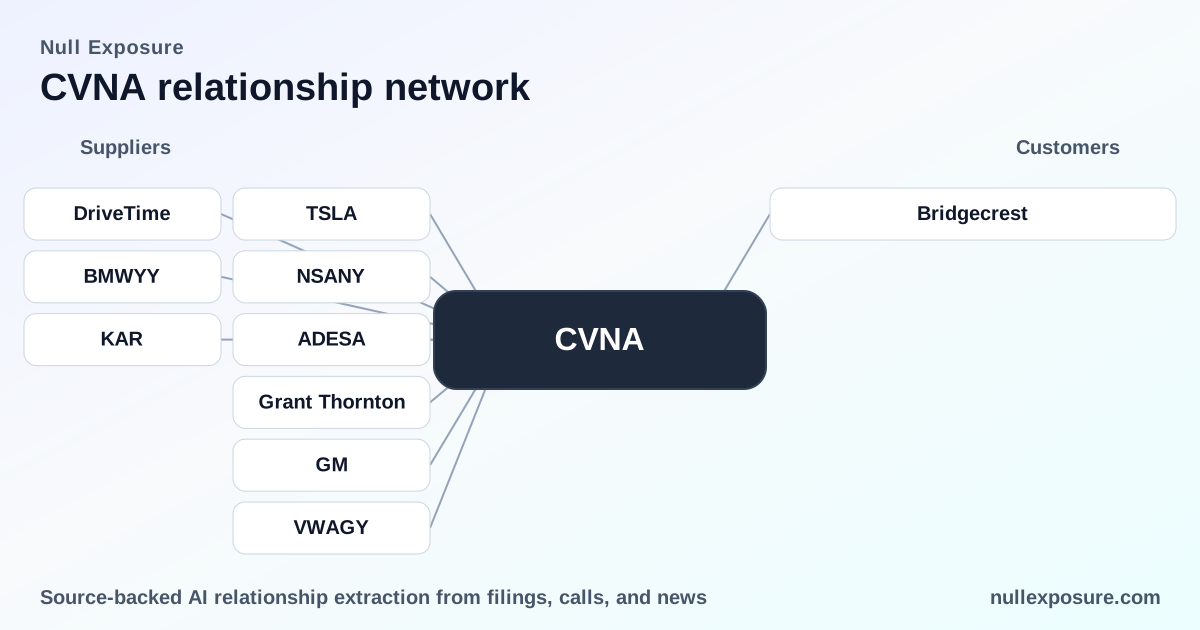
Two counterparties surface in recent public reporting and media coverage: Bridgecrest and ECCW. Both relationships touch financing and securitization layers that support Carvana’s retail engine.
Bridgecrest — related financing linkage highlighted in short‑seller reporting
A January 2026 short‑seller report, recapped by Sahm Capital, alleges that investigators found “dozens of loans tied to cars that CVNA sold” appearing on VinAudit reports and on the balance sheet of Bridgecrest, which the report states is fully owned by Carvana chairman and major shareholder Ernie Garcia. The allegation, if accurate, points to a closer-than-disclosed link between retail originations and a specific financing vehicle. (Sahm Capital, coverage of a Gotham City short report, January 28, 2026.)
ECCW — Carvana loans referenced in ABS portfolios
Earnings commentary and transcripts for Eagle Point Credit (ticker ECCW) explicitly list auto asset‑backed securities exposures that include “Carvana and Chase autos, PenFed autos,” indicating that Carvana-originated receivables have been included in publicly referenced ABS pools used by credit investors. This positions securitization buyers such as ECCW as downstream holders of Carvana-related credit risk. (Earnings transcript coverage reported by The Globe and Mail / Motley Fool, March 2026.)
Operating constraints and what they imply for investors and operators
The company-level constraint signals—drawn from Carvana’s filings and public disclosures—describe a business with clear commercial characteristics and structural implications for capital providers and operators.
- Contracting posture: Spot transactions dominate. Revenue is recognized upon vehicle delivery or customer pickup, which simplifies revenue recognition but accelerates the timing mismatch between inventory acquisition and revenue inflow. Evidence: company filings describing retail vehicle sales recognition on delivery.
- Counterparty profile: Individual retail buyers are the core counterparties, not large commercial clients. This drives distribution economics but increases customer‑level default dispersion and servicing complexity.
- Geography and scale: Substantially all activity is U.S.-centric, with logistics and distribution serving over 80% of the U.S. population; this makes Carvana highly exposed to U.S. macro and regional used‑car market cycles.
- Materiality and criticality: Retail vehicle sales are both material and critical to the company’s economics—the largest revenue source and the basis for financing and aftermarket product sales.
- Relationship maturity: The retail channel is active and scaling, evidenced by year‑over‑year unit growth (416,348 vehicles sold in 2024 vs. 312,847 in 2023).
- Segment posture: The customer relationship sits squarely in Carvana’s core product—used vehicle ecommerce—which explains the priority of funding allocation, logistics investment, and customer service infrastructure.
Taken together, these constraints indicate a capital‑intensive, high‑velocity retail model where working capital, access to financing, and securitization markets are strategic levers for growth and margin stability.
Why the disclosed relationships matter for credit and equity investors
- Financing linkages are not peripheral. Public mentions of Carvana loan pools in ABS portfolios (ECCW) and allegations tying loans to a named financing entity (Bridgecrest) indicate the company’s receivables are actively used in credit markets and potentially concentrated in related vehicles. Investors must treat securitization markets and partner balance sheets as extensions of Carvana’s funding and risk profile.
- Related‑party or affiliate financing raises governance questions. The Bridgecrest allegation directly implicates the ownership circle; investors should expect heightened scrutiny, regulatory attention, and potential re-pricing of credit if such linkages are substantiated.
- Revenue timing reduces contract risk but raises capital risk. Spot sales lower long‑duration customer counterparty risk but increase reliance on inventory financing, warehouse facilities, and securitization windows to sustain throughput.
For a concise view of how these relationship signals fit into broader credit and market research workflows, see https://nullexposure.com/.
Practical steps for analysts and operators evaluating Carvana exposure
- Stress test securitization rollovers and ABS buyer demand under slower used‑car turnover scenarios.
- Model related‑party financing probability and potential balance‑sheet contagion in downside cases where Bridgecrest‑style holdings are confirmed.
- Track warranty and return flows: a 7‑day return policy and a 100‑day limited warranty are operational levers that influence post‑sale reconditioning cost and resale velocity.
- Monitor geographic concentration of inventory and logistics throughput because U.S. regional demand shocks translate quickly into working capital pressure given the spot sale model.
Key takeaways for investors
- Carvana is a spot, retail‑centric platform that monetizes sales, F&I, and aftermarket products; its economics rely on continuous access to external capital and securitization channels.
- Public disclosures link Carvana receivables to ABS buyers (e.g., ECCW) and allege loans tied to a named financing operator (Bridgecrest), elevating the importance of counterparty transparency and funding continuity.
- Operational constraints—spot contracting, individual retail counterparties, U.S. geography, and material retail revenue—create a business that scales rapidly but requires constant funding and careful credit oversight.
If you want a structured feed of relationship signals and constraints for portfolio stress testing and counterparty monitoring, explore our research hub at https://nullexposure.com/.