Chicago Rivet & Machine Co (CVR): Customer Footprint and Commercial Risks
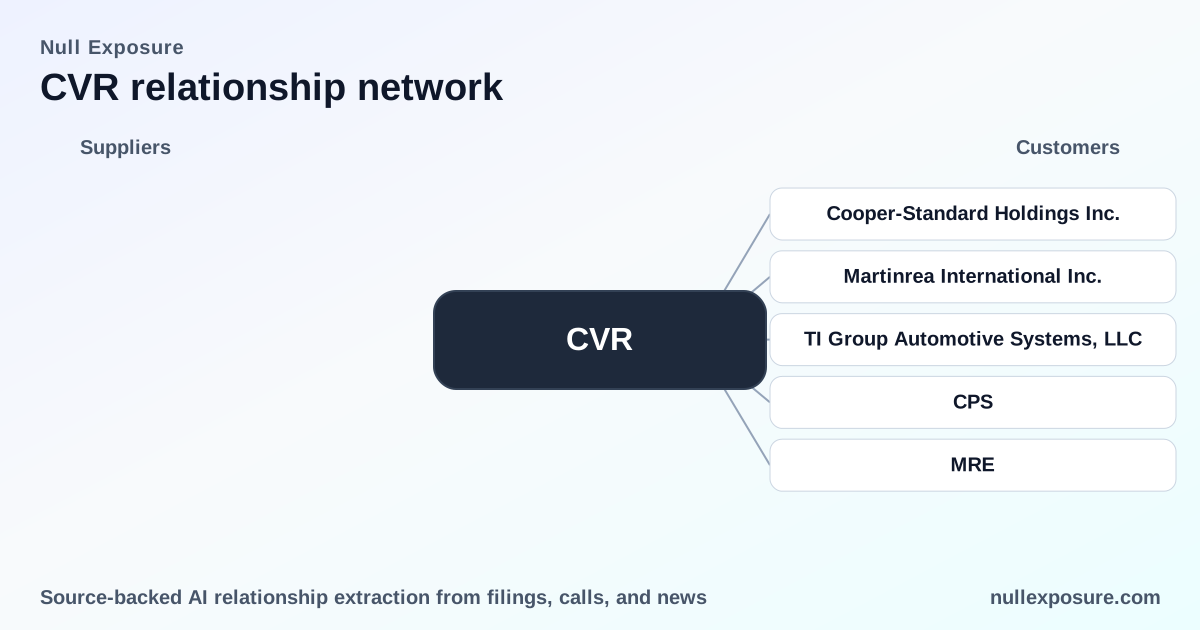
Chicago Rivet & Machine Co manufactures rivets, cold-formed fasteners and automatic rivet-setting equipment and monetizes by selling these components and machines into the North American automotive supply chain. The business is commercialized through direct sales and independent representatives to a concentrated group of large automotive suppliers; the top three customers collectively account for roughly a third of revenue, creating both revenue leverage and customer-concentration exposure. For a concise company profile, see Null Exposure: https://nullexposure.com/.
Executive thesis for investors
Chicago Rivet operates a low-margin, manufacturing-based revenue model that is highly dependent on a small number of automotive Tier‑1 customers. Revenue recognition is dominated by short-term contracts and ongoing order flow rather than long-term take-or-pay agreements, so cash and earnings volatility are tied directly to procurement cycles at Cooper‑Standard, Martinrea and TI Group. The balance of high customer concentration, North‑American geographic focus, and short contract tenure defines the company's near-term commercial risk/reward profile.
Who the customers are — quick, source-backed summaries
Cooper‑Standard Holdings Inc.
Sales to Cooper‑Standard accounted for approximately 9% of Chicago Rivet’s consolidated revenues in 2024 and 14% in 2023, according to the company’s 2024 Form 10‑K. A March 2026 press report also lists Cooper‑Standard among the company’s significant automotive customers, reinforcing the 10‑K disclosure.
Martinrea International Inc. (MRE)
Martinrea represented about 13% of consolidated revenues in 2024, per Chicago Rivet’s FY2024 10‑K, up slightly from 11% in 2023. A March 2026 Quartz earnings summary also identifies Martinrea as one of the principal buyers in the company’s North American automotive end market.
TI Group Automotive Systems, LLC
TI Group accounted for approximately 13% of revenues in 2024 and 16% in 2023, the Form 10‑K reports. TI Group also appears in contemporary market coverage as a named major customer, confirming its role as an anchor buyer for Chicago Rivet’s fasteners and assembly equipment.
(Note: company disclosures and market reporting consistently list the same three buyers — Cooper‑Standard, Martinrea and TI Group — as the principal commercial anchors. Source references: Chicago Rivet 2024 Form 10‑K; industry press including a March 2026 Quartz article.)
Operating model and business-model constraints — how customer relationships shape economics
Chicago Rivet’s operating model is defined by a small set of company-level signals that investors must price into both upside and downside scenarios:
-
Contracting posture: short-term. The company recognized $214,300 of revenue under short-duration contracts at December 31, 2024 and disclosed $115,009 in remaining performance obligations expected to be recognized in Q1 2025, with contract assets of $48,811, indicating predominantly near-term revenue realization rather than long-dated contracts. This creates lower revenue visibility quarter-to-quarter and a reliance on continuing order flow.
-
Geographic concentration: North America. The principal market is the North American automotive industry, concentrating demand risk on U.S./Canadian/Mexican auto OEM and Tier‑1 sourcing patterns and regional production volumes.
-
Customer concentration: material and persistent. During 2024, the top three customers each accounted for at least 9% of consolidated revenue, and the three together comprised roughly 35% of revenue, making customer retention and pricing leverage critical to topline stability.
-
Relationship role: seller-driven, mixed channels. The company solicits sales through employees and independent sales representatives, which supports broad access to Tier‑1 buyers but limits contractual lock‑in; revenues depend on execution and competitive pricing rather than embedded contractual barriers.
-
Business segment orientation: manufacturing. Operations are split between fastener manufacturing (rivets, cold‑formed fasteners, screw machine products) and assembly equipment (automatic rivet-setting machines), meaning capital intensity, tooling cycles, and product life cycles drive margins and investment needs.
Collectively, these constraints imply high commercial cyclicity, concentrated counterparty risk, and modest revenue visibility, while the manufacturing base provides defensible product specialization for assembly line customers.
What each relationship implies for valuation and operations
-
Cooper‑Standard: As a single customer accounting for nearly a tenth of revenue, Cooper‑Standard is a material counterparty whose procurement decisions directly impact quarterly sales; loss or price pressure from this buyer would materially compress revenue. (Source: Chicago Rivet 2024 Form 10‑K; company disclosures.)
-
Martinrea (MRE): Martinrea’s share (roughly 13% in 2024) makes it a strategic Tier‑1 customer; continued orders support factory utilization and gross margin recovery, while any program cancellations would materially reduce throughput. (Source: Chicago Rivet 2024 Form 10‑K; March 2026 industry coverage.)
-
TI Group Automotive Systems, LLC: TI Group is another revenue anchor at ~13% of sales in 2024 and historically higher in 2023; the relationship underpins the company’s positioning in rivet and assembly-equipment supply chains and influences investment cadence in tooling and machinery. (Source: Chicago Rivet 2024 Form 10‑K; March 2026 coverage.)
Risk checklist for investors and operators
- Customer concentration risk: Top three customers represent a large revenue share; scenario analysis should stress potential loss or price compression from any single buyer.
- Short contract duration: Limited backlog and short performance obligations reduce visibility into subsequent quarters; plan liquidity and working capital accordingly.
- End-market cyclicality: North‑American automotive production cycles and model change schedules will drive order variability.
- Margin pressure and scale: The company reports negative operating margins and limited EBITDA scale relative to its peers, implying operating leverage is required to reach sustainable profitability. (Company financials show TTM revenue ~$27.9M and negative operating margin per filings.)
For a consolidated documentary view and tracking tools, see the company page at Null Exposure: https://nullexposure.com/.
Conclusion — tactical implications
Chicago Rivet is a specialized supplier with material exposure to a handful of Tier‑1 automotive customers, short-term contract economics, and North American revenue concentration. For investors, upside hinges on stable order flow from the named customers and margin improvement via scale or cost recovery; downside is concentrated and contract-tenure driven. Operators should prioritize customer retention programs, nimble working-capital management, and diversification strategies to reduce single-buyer exposure.
If you want the structured relationship data and filing extracts that underpin this commentary, review the full CVR customer profile on Null Exposure: https://nullexposure.com/.