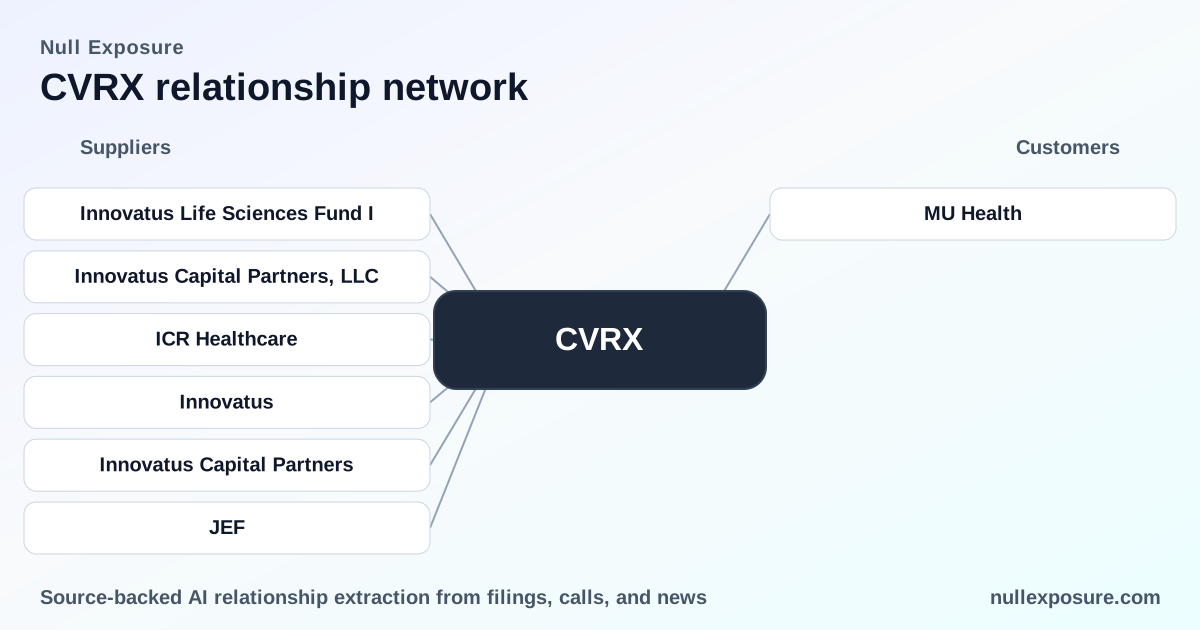
CVRx’s Commercial Trajectory: Implantable Hardware, Hospital Buyers, and Early-Stage Expansion
CVRx commercializes Barostim, an implantable neuromodulation system sold principally to hospitals and implanting centers; the company generates revenue by selling the hardware (IPG and stimulation lead) and supporting clinician programming and procedures through a direct sales force in the U.S. and Germany and distributor networks in parts of Europe. Revenue is concentrated in North America and Europe, reimbursement pathways (including CMS) support procedure economics, and commercialization is measured by the growth in active implanting centers rather than recurring software fees. For a concise customer map and monitoring of announced implants, visit the NullExposure homepage: https://nullexposure.com/.
Market context and investor thesis
- CVRx is a commercial‑stage medical device company whose second‑generation Barostim is positioned as a therapy to improve symptoms in patients with HFrEF. Monetization is hardware sales to hospitals and implant centers, augmented by clinical support and procedure enablement.
- Reimbursement and procedure economics matter: Barostim procedures fall into a New Technology APC with an average payment amount in the tens of thousands of dollars—supporting hospital willingness to purchase and schedule implants.
- Commercial health: CVRx reported 252 active U.S. implanting centers as of December 31, 2025 (up from 223 year‑over‑year), indicating maturing commercial penetration rather than pilot-stage distribution.
How CVRx goes to market and what that implies for operators
- Direct sales in priority geographies (U.S., Germany) drive higher control over training and implantation outcomes; distributors in Austria, Spain and other European countries extend reach where direct coverage is cost‑ineffective.
- Hospitals are the purchasing entities; that translates to buyers with procurement cycles, capital approvals, and sensitivity to reimbursement—CVRx’s contracting posture must accommodate hospital purchasing rules and procedural coding.
- Concentration signal: management states revenues derive from U.S. and European customers, implying regional dependence that investors must monitor for payer and regulatory variability.
- Criticality and spend band: the Barostim implant is a one‑time hardware purchase per patient with estimate average payment levels around $45,000 under the relevant APC coding, placing individual procedure economics below many high‑cost OR interventions but high enough to require clear clinical and economic justification.
- Maturity: the product is commercial and scaling — growth in active centers and publicized first implants at new hospitals are the primary early indicators of adoption.
Customer relationships recently disclosed (what they show about rollout) This section lists every customer relationship surfaced in the available reporting; each entry contains a plain‑English summary and the direct public source.
Methodist University Hospital — first implant collaboration
Methodist University Hospital completed its first Barostim implant with clinical collaboration from CVRx, indicating the hospital has moved from training to active commercial use. Source: TradersUnion news post covering May 2, 2026, reporting the inaugural implant and collaboration.
Orlando Health South Lake Hospital — partnership for inaugural procedure
CVRx partnered with clinicians at Orlando Health South Lake Hospital to perform the hospital’s first Barostim implant, a signal that CVRx continues to open new implanting centers through direct clinical support. Source: TradersUnion coverage referencing the partnership and first implant activity, reported May 2, 2026.
Ascension Alexian Brothers — company‑supported inaugural implant
CVRx supported the inaugural Barostim implant at Ascension Alexian Brothers, with named physicians performing the procedure, demonstrating the company’s role in on‑site clinical enablement during rollout. Source: TradersUnion article (May 2, 2026) noting CVRx’s support of the first implant performed by Drs. Georges Haidar, Ashish Haryani, and Baqir Lakhani.
MU Health — supported first commercial implant
MU Health executed its first Barostim implant with support from CVRx, signifying expansion into additional hospital systems and penetration outside initial early adopters. Source: TradersUnion news item published March 9, 2026, reporting CVRx’s support of MU Health’s inaugural procedure.
Lawnwood Medical Center — milestone 15th implant completed
Lawnwood Medical Center reported completion of its 15th Barostim implant under care by Dr. Philip Seibel and team, which is a rare example in these announcements of a higher cumulative implant count at a single center and evidence of an established implanting program. Source: TradersUnion news item dated May 2, 2026, describing the center’s 15th procedure.
What these relationships collectively reveal
- Proof of commercial execution: multiple hospitals announcing first implants and one center reporting a multi‑procedure milestone indicates CVRx is converting training and sales activity into repeatable clinical workflows.
- Sales and clinical enablement strategy validated: CVRx’s active, hands‑on support at first implants demonstrates a go‑to‑market model that prioritizes clinician training and early clinical outcomes to accelerate adoption.
- Adoption is hospital‑centered: every publicized relationship identifies hospitals or health systems as the customer, consistent with company statements that hospitals, not physicians directly, are the purchasing entities.
Operational and risk implications for investors
- Reimbursement tailwind: CMS reimbursement across U.S. regions is a structural advantage—it lowers economic friction for hospitals considering the procedure, and the New Technology APC payment level (roughly $45k average) anchors procedure economics.
- Concentration and geography: CVRx derives revenues from the U.S. and Europe and relies on direct sales in key markets (U.S., Germany) with distributor partners elsewhere; regional payer dynamics and distributor execution are the primary commercial risk vectors.
- Customer profile and contracting posture: hospital buyers imply longer sales cycles and contract negotiation complexity but also higher per‑transaction economics; the relationship is transactional and capital‑acquisition driven rather than subscription or recurring revenue.
- Maturity and scaling indicators: the increase to 252 active U.S. implanting centers by year‑end 2025 signals a commercial inflection point; investors should track center activation rates and per‑center implant volumes as leading indicators of revenue acceleration.
Key takeaways for investors and operators
- Barostim is a hardware‑centric, hospital‑sold therapy with reimbursement that supports procedure economics.
- CVRx’s commercialization is progressing from pilot to scale as new centers activate and some centers report repeat procedures.
- Primary risks are regional concentration, hospital procurement cycles, and distribution execution in parts of Europe.
For investors focused on customer traction, NullExposure maintains an updated map of disclosed hospital activations and procedural milestones; review the broader customer coverage at https://nullexposure.com/ to monitor new implant announcements and center activation trends.