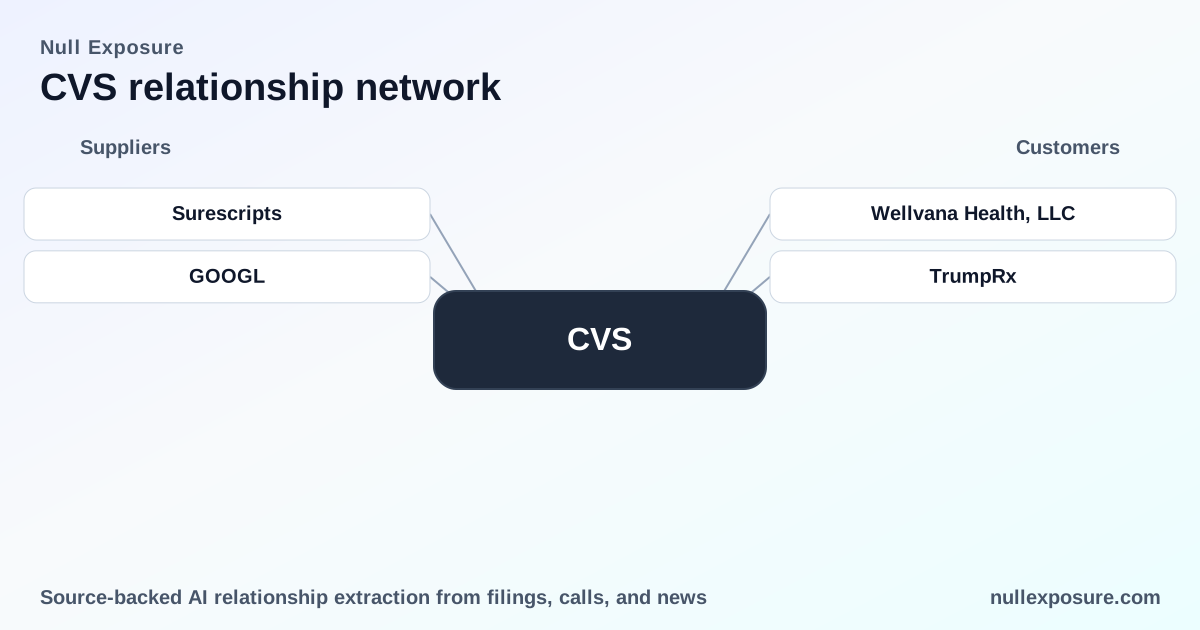
CVS Health: Customer Relationships That Anchor Scale and Policy Exposure
CVS Health runs a vertically integrated health platform combining retail pharmacies (CVS Pharmacy), pharmacy benefit management (Caremark), and health insurance (Aetna), monetizing through prescription dispensing margins, PBM contract fees and rebates, and insurance premiums. The company's customer relationships span strategic retail partnerships, specialty-distribution networks, bidders/transaction counterparties, and federal government payors—each shaping revenue durability and regulatory sensitivity. Learn more about how these relationship dynamics translate to commercial and policy risk on the NullExposure homepage: https://nullexposure.com/
What this customer map tells an investor
CVS’s customer list is not a collection of casual partners: it reflects active commercial distribution roles, transaction counterparties, and longstanding government payor exposure. These relationships collectively reinforce CVS’s two core revenue engines—retail/pharmacy distribution and managed-care premiums—while concentrating policy and contract risk around federal programs. Below I walk through every named relationship pulled from public reporting and contemporaneous coverage, and then synthesize the operating constraints that govern how CVS contracts and delivers.
Customer-by-customer takeaways
Wellvana Health, LLC
CVS divested its MSSP (Medicare Shared Savings Program) operations to Wellvana in March 2025, signaling a transfer of those managed-care operations and related patient flows to an outside operator. According to CVS’s FY2025 10‑K, the company completed the MSSP divestiture in March 2025.
TrumpRx
Caremark serves as a pharmacy partner to TrumpRx to support access and affordability for fertility medicines, reflecting PBM-style distribution and formulary/service coordination rather than an equity relationship. This role was confirmed on CVS’s Q4 2025 earnings call where management described Caremark as a “key pharmacy partner to TrumpRx.”
Puma Biotechnology (PBYI)
Puma’s specialty distribution network lists CVS as one of six specialty pharmacy partners for the PumaPatientlynx hub, positioning CVS within specialty-drug fulfillment for oncology patients and hub services. A May 2026 Investing.com article on Puma Biotechnology’s FY2026 commentary enumerated CVS among the six specialty pharmacy partners.
TGT / Target Corp.
Target’s new store openings continue to include in-line CVS Pharmacy locations, reflecting CVS’s ongoing retail franchise model and co-location distribution strategy inside third-party big-box formats. Progressive Grocer’s May 2026 reporting on Target’s expansion noted the inclusion of CVS Pharmacy at the Buckeye store location.
GenieRx Holdings LLC
GenieRx emerged as the stalking-horse bidder for Omnicare after negotiating an agreement with CVS, offering $250 million in cash, which frames CVS as an active transaction counterparty and seller in long-term care pharmacy assets. The Sun’s May 2026 coverage reported on GenieRx’s stalking-horse bid and the $250 million offer tied to a CVS agreement.
Giftify, Inc. (GIFT)
Giftify powers the CVS gift card exchange platform, indicating CVS’s use of third-party fintech/payment partners to broaden retail payment and gift-card liquidity. A GlobeNewswire item referenced on Finviz (March 2026) noted Giftify, Inc. powers the CVS Gift Card Exchange.
JPMorgan (JPM‑P‑M referenced)
A federal judge allowed JPMorgan employees to pursue litigation alleging mismanagement of health benefits, with claims that overpayments for prescriptions and premiums relate to CVS Caremark administration—highlighting litigation and payor-side disputes tied to PBM operations. TradingView coverage (March 2026) summarized judicial action allowing the suit linked to CVS Caremark.
How these relationships translate into CVS’s operating model and constraints
The evidence set from filings and media reporting describes a company operating under several structural constraints that investors should incorporate into valuation and risk scenarios.
-
Contract tenor leans short-term and rate-sensitive. CVS’s government-facing contracts (notably Medicare-related arrangements) are described as annual capitation or premium arrangements paid monthly and adjusted for membership and risk—conditions that produce recurring but re-priceable revenue streams and require active contract management. (Company disclosure on capitation and CMS payment mechanics.)
-
Significant government counterparty concentration. The U.S. federal government accounted for a material share of consolidated revenues (18–24% across recent years), creating policy and payment-rate exposure that materially affects cash flow if CMS or federal health policy changes. (Company disclosures reporting federal revenue percentages for 2022–2024.)
-
Geographic concentration in North America with national scale. The company’s client base and membership are dispersed throughout the U.S., with core operations and contract coverage focused domestically—supporting national scale but limiting diversification into other regions. (Company statements on geographic distribution of medical membership and client base.)
-
Dual commercial roles: service provider and seller. CVS operates both as a service provider (PBM, managed-care administration, clinical services) and as a seller (retail dispensing, consumer goods), which complicates margin dynamics because selling and servicing expose the company to differing competitive and regulatory pressures simultaneously. (Segment descriptions from company filings.)
-
Relationships are generally active and operational. CVS reports active government-plan offerings (for example, PDP plans in all 50 states) and ongoing retail co-location deals, indicating ongoing revenue generation rather than one-off transactions.
-
Segment maturity and revenue mix favor services and benefits. The Health Services and Health Care Benefits segments underpin recurring managed-care and PBM revenue streams while Pharmacy & Consumer Wellness drives retail cash-flow, producing a mixed-margin profile that requires integrated operational management. (Company segment disclosures.)
Collectively, these signals create a business profile where scale advantages and recurring revenue are tempered by re-pricing risk from payors, regulatory sensitivity, and litigation exposure.
Investment implications: what to watch and why it matters
-
Upside stems from distribution and integration efficiencies. CVS’s presence in specialty distribution (Puma), integrated retail footprint (Target co-locations), and third-party payment integrations (Giftify) sustain non-premium revenue and cross-sell opportunities—supportive of long-run revenue stability.
-
Downside centers on payor and legal exposure. Material revenue from federal programs and active litigation tied to PBM administration are primary downside drivers. Changes in CMS payment policies, PBM regulatory action, or large litigation settlements would directly pressure margins and cash flow.
-
Transaction activity is strategic and value-sensitive. Deal processes (Omnicare stalking-horse bid) indicate CVS will pursue portfolio reshaping—investors should treat such transactions as both capital-allocation signals and potential sources of one-time gains or charges.
For deeper analysis of counterparty exposures and how they translate to cash-flow scenarios, visit NullExposure’s platform: https://nullexposure.com/
Bottom line
CVS’s customer relationships reinforce its integrated platform but concentrate exposure where policy and contract re-pricing matter most. Investors should weigh the stability of retail and specialty distribution against material government revenue dependence and PBM-related legal risk when modeling forward earnings and capital allocation.