Covista (CVSA): Customer relationships that move the revenue needle
Covista is a healthcare-education operator that converts instructional assets and institutional partnerships into recurring tuition and contract revenue. The company runs accredited learning programs across the United States and select Caribbean jurisdictions, and monetizes through student tuition, clinical-placement services and institutional training partnerships with healthcare systems and employers. For investors, the primary customer signal to watch is how Covista scales enterprise partnerships with health systems — these deals accelerate enrollment, widen placement pipelines and raise revenue visibility. Learn more about Covista customer intelligence at https://nullexposure.com/.
One partnership that matters: SSM Health went public in Q4 commentary
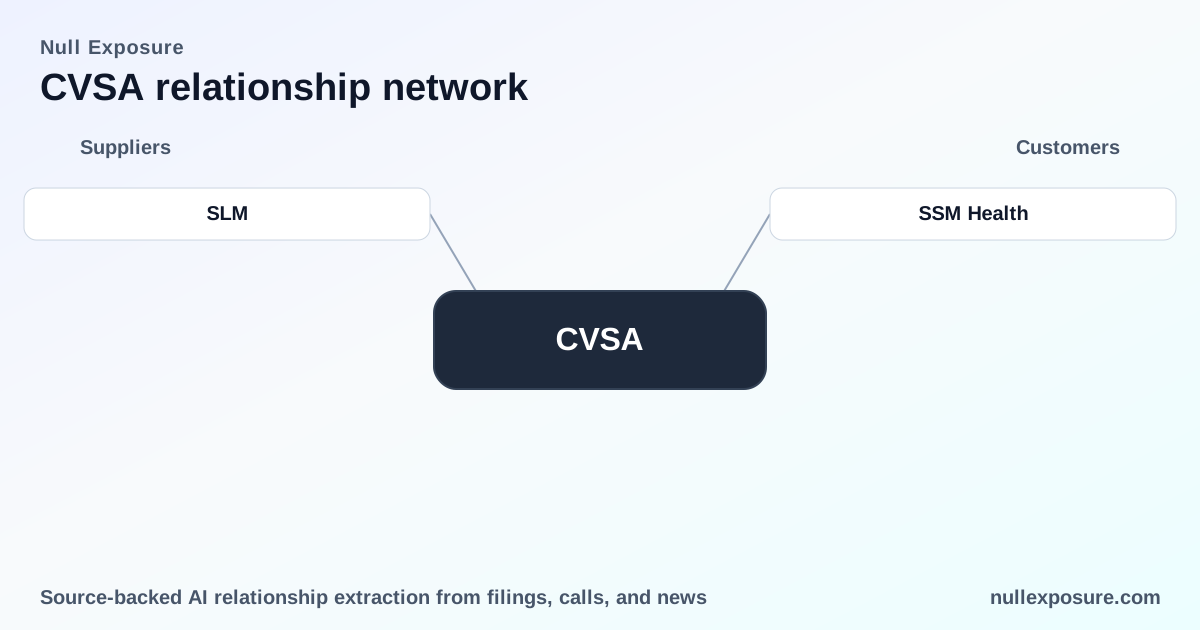
Covista management highlighted a newly announced partnership with SSM Health on the company’s Q4 2025 earnings call. The mention was succinct but deliberate; management framed the SSM relationship as an example of their strategic direction toward large health-system collaborations. According to the Q4 2025 earnings call (transcript dated March 7, 2026), the company presented SSM Health as a tactical customer partner that demonstrates the model they are replicating. (Q4 2025 earnings call, Covista, March 7, 2026.)
What the SSM Health tie-in implies about go-to-market
The SSM Health mention is short on deal terms but heavy on signal. SSM Health is a sizable integrated health system, and Covista’s public acknowledgement signals a push into enterprise-level, institutional contracting instead of purely retail student acquisition. That posture drives three operational characteristics for Covista’s business model:
- Contracting posture: The company is positioning toward multi-stakeholder agreements with health systems and employers, which translate into longer sales cycles but higher lifetime value per customer.
- Criticality: Education and workforce development are directly tied to health-system staffing needs, making Covista’s services strategically important to partners and increasing the stickiness of relationships once implemented.
- Maturity and scale: At Covista’s scale (Revenue TTM ~$1.89B; Operating Margin ~22.9%), enterprise partnerships are a natural lever to convert scale into higher-margin, contract-backed revenue.
These are company-level signals supported by the SSM Health announcement; the public disclosure of even a single large-system partnership suggests management is focused on expanding institutional channels.
Financial context that frames customer risk and upside
Covista’s financial profile informs how customer relationships affect investor returns. Revenue is substantial ($1.89B TTM) and gross profitability is healthy ($1.08B gross profit TTM), while operating margin sits in the mid-20s, implying the company has room to absorb strategic investments in partnership development without materially degrading profitability. Other relevant figures: market capitalization roughly $3.9B and EBITDA ~$428.9M. These metrics support two practical conclusions:
- Risk absorption: Covista’s margin profile and EBITDA create bandwidth for front-loaded costs to establish institutional partnerships (e.g., onboarding, curriculum integration, placement logistics).
- Concentration sensitivity: Because management is leaning into large-system agreements, a small number of enterprise customers could become materially important to revenue growth — that dynamic warrants monitoring but is not yet evident in public disclosures.
All customer relationships uncovered in public sources
- SSM Health — Covista referenced a new partnership with SSM Health during its Q4 2025 earnings call, using the relationship as a concrete example of Covista’s strategic move toward health-system collaborations. (Q4 2025 earnings call, Covista, March 7, 2026.)
This list reflects the full set of customer relationships disclosed in the sources reviewed for this customer-scope analysis. The headline is that SSM Health is the only explicitly named customer relationship in the Q4 2025 public commentary; management used it to illustrate a replicable partnership construct rather than to disclose a long roster of new accounts.
What investors should watch next
Investor due diligence should monitor four practical indicators that will show whether the SSM Health announcement is a one-off reference or the start of a repeatable enterprise strategy:
- Deal cadence: public disclosures of additional health-system partnerships or detailed timelines for rollouts with SSM Health.
- Contract economics: whether future partnerships include upfront implementation fees, guaranteed minimums, or shared-service revenue models that improve predictability.
- Customer concentration trends: changes in the revenue mix to see if institutional partners start contributing a growing share of consolidated revenue.
- Placement and completion metrics: operational KPIs that convert partnerships into sustained tuition and placement cashflows.
Key takeaways for investors:
- SSM Health is an explicit signal that Covista is prioritizing enterprise health-system partnerships.
- Covista’s financial scale and margin profile provide capacity to invest in longer-term partnership builds without near-term margin erosion.
- The strategic shift increases upside if partnerships scale, but it raises customer-concentration risk that must be tracked through subsequent disclosures.
If you want a deeper look at Covista’s partnership rollouts and how these deals influence valuation sensitivity, visit https://nullexposure.com/ for detailed customer-analysis reports.
Bottom line
Covista’s brief disclosure of a partnership with SSM Health on the Q4 2025 call represents a strategic inflection point: management is using enterprise health-system relationships as a growth vector that leverages the company’s existing instructional assets and market footprint. For investors, that means monitor deal flow and contractual economics closely — the next set of partnership announcements will determine whether this is a repeatable revenue model or an isolated, strategic example.