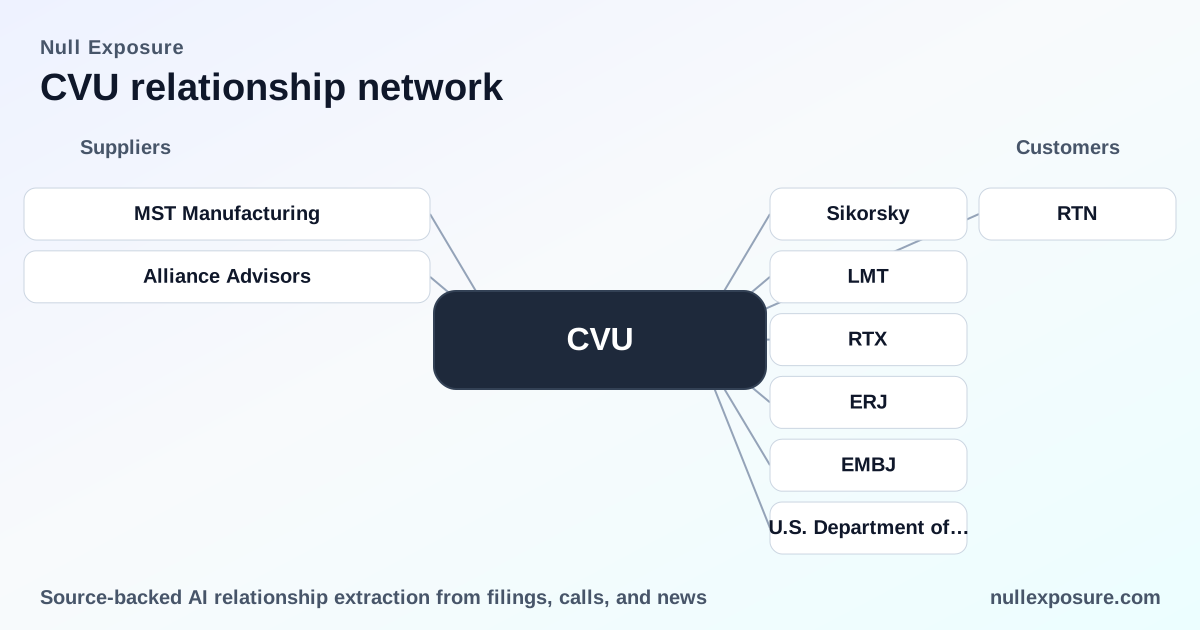
CPI Aerostructures (CVU): A supplier-led aerospace portfolio underpinned by long-duration defense work
CPI Aerostructures operates as a precision manufacturer and integrated services provider to defense and commercial aerospace OEMs and the U.S. government, monetizing through long-term production agreements, funded program orders and IDIQ/long-term agreements that build backlog and recurring revenue. The company converts engineering and production capacity into cash flow by executing program-by-program awards (pods, wing and missile assemblies, engine inlets, RF/EMI enclosures and sustainment spares) for prime contractors and direct DoD customers, supported by a backlog that the company discloses at scale. For investors, the core thesis is straightforward: defense program stability and long-term contracts support predictable revenue, while customer concentration and small market capitalization amplify program and counterparty risk. For more on how we source relationship intelligence, visit https://nullexposure.com/.
Defense primes drive the revenue line — the operating model in plain English
CPI is primarily a Tier‑1 supplier and prime contractor that manufactures complex aerostructures and provides MRO, kitting and supply‑chain services to OEMs and government programs. Company disclosures and releases show that revenue is dominated by long‑duration contracts and government work, reflected in a multi‑hundred million dollar backlog and repeat awards across a narrow set of large customers. That structure creates high revenue visibility when programs perform, but concentration risk if a handful of customers slow ordering.
- The company reports a backlog of roughly $510 million as of December 31, 2024, with ~95% of that backlog attributable to government contracts, signalling a defense‑heavy revenue mix (company filings cited in corporate releases).
- Management characterizes the business as both a manufacturer of structural assemblies and a provider of engineering, program management and MRO services, which makes cash generation dependent on program execution as much as production capacity.
If you want to track these client wins and funded orders closely, check CPI Aero’s company page at https://nullexposure.com/.
Relationship map: who pays CPI Aero and for what
Below I list each customer relationship visible in recent filings and press releases and what it concretely means for CPI Aero’s top line.
Raytheon / Raytheon Technologies (RTX)
CPI was authorized for Lot‑5 production on the Next Generation Jammer Mid‑Band (NGJ‑MB) program and subsequently received funded follow‑on orders totaling about $6 million to produce airborne pods and air management system components. According to GlobeNewswire and follow‑on releases in late 2025 and March 2026, Raytheon’s Advanced Products & Solutions unit placed funded orders and earlier contract awards were valued in the tens of millions for the NGJ program. (GlobeNewswire Nov 20, 2025; GlobeNewswire Mar 3, 2026)
Lockheed Martin / Lockheed Martin Aeronautics (LMT)
Lockheed Martin Aeronautics placed several additional orders totaling $9 million against an existing Long Term Agreement to produce Rudder Island Drag Chute Canister assemblies for F‑16 Block 70/72 jets, with deliveries through 2028. CPI’s corporate releases and media summaries in February 2026 describe these follow‑on awards as LTA‑driven funded orders. (GlobeNewswire Feb 24, 2026; Yahoo Finance summary Mar 2026)
Sikorsky (a Lockheed Martin Company)
CPI received multiple purchase orders from Sikorsky for HIRSS (Hover Infrared Suppression System) module assemblies used as spares on UH‑60 Black Hawks and other sustainment work, historically totalling in the low‑to‑mid tens of millions in discrete award announcements. Company news releases (including a 2019 GlobeNewswire release and later filings) cite funded orders issued against multi‑year IDIQ arrangements. (GlobeNewswire 2019; company releases 2025–2026)
Embraer S.A. (EMBJ / ERJ)
Embraer placed additional orders totaling about $4.2 million under a Life‑of‑Program agreement to have CPI manufacture engine inlet assemblies for the Phenom 300 business jet; CPI notes it has supplied engine inlets to Embraer since 2012. This is a civil aviation repeat‑order relationship that provides steady aftermarket and production revenue. (GlobeNewswire Feb 26, 2026; Investing.com / press coverage Mar–May 2026)
Collins Aerospace / Hamilton Sundstrand
CPI received orders from Collins Aerospace (Hamilton Sundstrand is referenced as a Collins business) for RF/EMI shielded enclosures, a component class CPI highlights as recurring work with long‑standing program relationships. The March 12, 2026 GlobeNewswire release details follow‑on orders and management comment on the long relationship. (GlobeNewswire Mar 12, 2026)
Northrop Grumman Corporation (NOC)
Northrop Grumman is listed among CPI’s OEM defense customers in the company’s FY‑end reporting; these relationships cover pod structures, radar and reconnaissance systems and related components. The inclusion in CPI’s 2025 results indicates program diversification across major U.S. primes. (GlobeNewswire Mar 31, 2026)
L3Harris (LHX)
L3Harris is named in CPI’s summary of OEM customers supporting a range of military aircraft and systems, signalling additional program exposure to large defense primes beyond Lockheed and Raytheon. (GlobeNewswire Mar 31, 2026)
U.S. Department of Defense / U.S. Air Force
CPI serves as a prime contractor as well as a Tier‑1 subcontractor to the U.S. Department of Defense—primarily the U.S. Air Force—providing both production and sustainment services under government contracts and IDIQ vehicles. Company statements in filings and press releases explicitly classify the DoD as a primary counterparty. (Company filings and SahmCapital press releases, 2025–2026)
Gulfstream
CPI lists Gulfstream among the platforms it supplies (including G650) in press coverage summarizing customer platforms; this highlights exposure to select large business‑jet OEMs alongside broader defense work. (GuruFocus / press summaries 2026)
What the relationship constraints tell investors about risk and structure
Company‑level signals from filings and press coverage establish these operational characteristics: long‑term contract posture, government centricity, North American revenue concentration, material customer concentration and manufacturing as the core segment.
- Contracting posture: CPI emphasizes long‑term and life‑of‑program agreements that create multi‑year visibility; management has described multi‑year awards and LTAs in public releases (company filings and press statements).
- Counterparty mix: The government is a primary counterparty—CPI is both prime contractor and Tier‑1 supplier to primes; approximately 95% of backlog is government‑attributable as disclosed for year‑end 2024.
- Geography and concentration: Revenue is primarily U.S.‑based; outside‑U.S. sales were small relative to total revenue in 2024. Top three customers generated 36%, 24% and 14% of 2024 revenue, indicating high materiality to a handful of counterparties.
- Scale: Backlog and contract scope put CPI into a $100m+ spend band profile for awards and program exposure, while market capitalization (~$50m as reported) remains small in absolute terms—this mismatch amplifies execution and liquidity sensitivity.
Bottom line for investors
CPI Aerostructures is a specialized manufacturing‑led supplier whose growth and profitability are tightly coupled to defense prime programs and a handful of large customers. The company’s backlog and repeat orders from Raytheon, Lockheed Martin, Sikorsky, Embraer and Collins provide revenue visibility; customer concentration and small equity market size create asymmetry—good upside from program wins, meaningful downside from program slowdowns or funding shifts. Financials show modest operating margins but negative EPS on a small market cap base, underscoring the importance of execution and funded order flow to valuation (company financial summary, FY‑end disclosures).
For ongoing monitoring of customer awards and funded orders that materially affect CPI’s outlook, see our tracking and relationship summaries at https://nullexposure.com/.
Key takeaway: defense program wins de‑risk revenue in the near term; customer concentration and execution remain the primary investor risks.