Curtiss‑Wright (CW): Customer relationships driving durable defense and nuclear revenue
Curtiss‑Wright operates as an engineering-led manufacturer and services provider that monetizes through the sale of highly engineered products and recurring services to aerospace, defense and critical industrial customers. The company recognizes most revenue as product sales (roughly $2.98bn of $3.50bn in the latest period) with a meaningful services stream, and a large share of sales tied to government end‑use (58% in 2025) that produces long-duration contract revenue and predictable lifetime program economics. For investors, the combination of long-term program contracts, deep OEM and prime relationships, and exposure to nuclear SMR and defense modernization argues for durable cash flow with distinct program execution and inventory funding risks. Learn more at https://nullexposure.com/.
How these customer ties shape the business model
Curtiss‑Wright’s commercial posture is defined by four operating constraints that explain how revenues translate to valuation:
- Contracting posture: long‑term, programmatic sales. The company routinely executes multi‑year engineering and production contracts (generally 2–5 years) that recognize revenue over time and require working capital and inventory investment for production ramp‑cycles.
- Counterparty concentration: material government exposure, broad customer base. Government end‑use represented 58% of sales in 2025, signaling heavy reliance on defense and government budgets, yet no single customer exceeded 10% of sales—so concentration risk is aggregated to the government channel rather than to a single prime.
- Geography: North American revenue dominance but global program reach. The U.S. is the large revenue base (roughly $2.55bn of $3.50bn consolidated), while international relationships and OEM partnerships provide program diversification and exportable product lines.
- Product/service mix and maturity: engineered product leader with recurring services. Product sales dominate, and services contribute recurring, margin‑supporting revenue; many relationships progress from prototyping and engineering to production and lifetime sustainment.
These characteristics produce predictable top‑line trajectories tied to program awards, balanced by working‑capital and program‑execution risk that investors must underwrite.
Customer relationships: observed wins, partners and program exposures
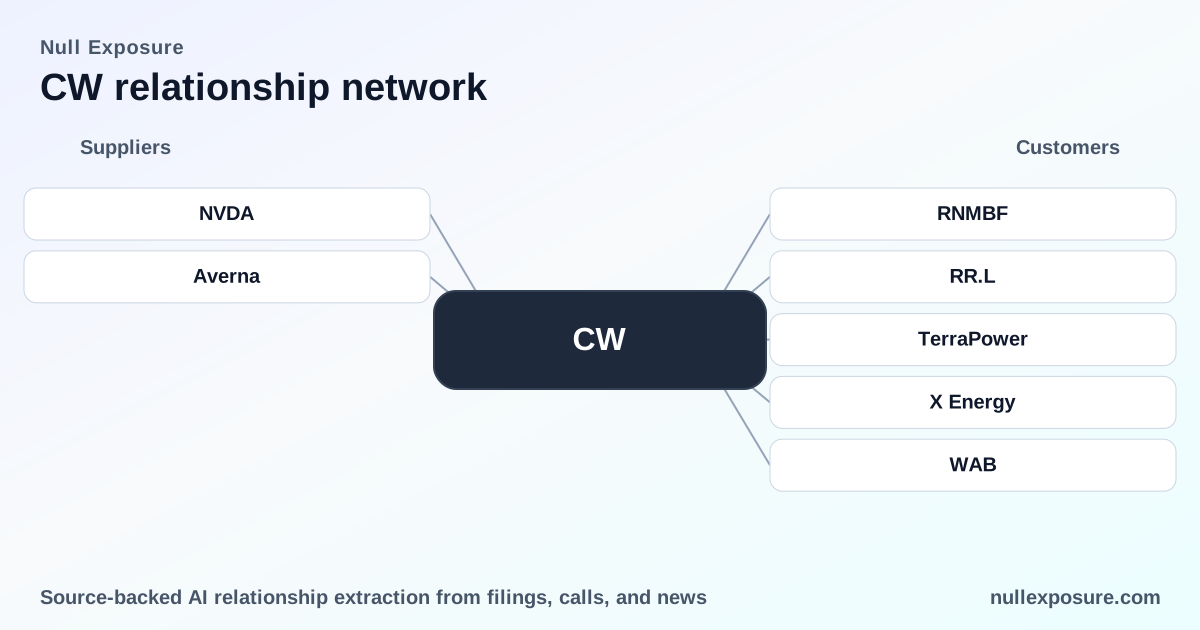
Below is a concise, source‑anchored catalogue of every customer relationship noted in the collected results. Each entry is a plain‑English summary of the relationship and its source.
U.S. Naval Air Warfare Centre
Curtiss‑Wright secured a four‑year award (via CCC) to supply recover assist securing and traversing helicopter handling systems to the U.S. Naval Air Warfare Centre, reinforcing its naval platform content and long‑term defense revenue base. (Source: Sahm Capital, March 3, 2026 — https://www.sahmcapital.com/news/content/a-look-at-curtiss-wright-cw-valuation-after-new-us-naval-rast-contract-2026-03-03)
American Rheinmetall (RHM)
Curtiss‑Wright was selected by American Rheinmetall to supply turret drive stabilization systems for the prototype phase of the U.S. Army XM30 Combat Vehicle program, positioning CW for follow‑on production content. (Source: SimplyWallSt company news aggregation, FY2026 — https://simplywall.st/stocks/us/capital-goods/nyse-cw/curtiss-wright)
Hanwha Ocean Co.
If Hanwha Ocean secures the CPSP contract, Curtiss‑Wright is expected to supply the towed‑array sonar handling system for the Jangbogo‑III Batch‑II submarines, expanding CW’s undersea systems pipeline in Asia. (Source: Pulse Korea, FY2026 — https://pulse.mk.co.kr/news/english/12000022)
Boeing (insidermonkey)
Curtiss‑Wright was selected by Boeing to supply mission computer technology for the Air Force’s C‑17 fleet, indicating high‑value avionics retrofit and refresh opportunities. (Source: InsiderMonkey report on CW, FY2026 — https://www.insidermonkey.com/blog/is-curtiss-wright-corporation-cw-the-best-aerospace-dividend-stock-to-buy-1714768/?amp=1)
Boeing (Sahm Capital)
Analysts and coverage also highlighted a Boeing selection for MOSA‑aligned mission computers for the C‑17 flight deck refresh with an estimated lifetime value above US$400 million, a sizable program that drives multi‑year revenue visibility. (Source: Sahm Capital coverage, April 2026 — https://www.sahmcapital.com/news/content/how-investors-are-reacting-to-curtiss-wright-cw-earnings-beat-and-surging-defense-and-aerospace-demand-2026-04-04)
Rheinmetall (RNMBF)
Management expects increased electro‑mechanical actuation sales supporting U.S. Army programs (IFPC) and higher sales of turret drive stabilization systems through its relationship with Rheinmetall, signaling secular growth in land‑systems content. (Source: Q4 2025 earnings call transcript reported by InsiderMonkey, March 2026 — https://www.insidermonkey.com/blog/curtiss-wright-corporation-nysecw-q4-2025-earnings-call-transcript-1695308/)
RNMBF (duplicate entry)
The business reiterated expectations for elevated actuation and stabilization sales tied to Rheinmetall relationships, underscoring recurring program expectations across multiple disclosure notes. (Source: Q4 2025 earnings call transcript reported by InsiderMonkey, March 2026 — https://www.insidermonkey.com/blog/curtiss-wright-corporation-nysecw-q4-2025-earnings-call-transcript-1695308/)
RR.L (Rolls‑Royce)
Curtiss‑Wright described ongoing partnership activity with Rolls‑Royce that will transition some efforts into early prototyping revenue in 2026, indicating entry into SMR (small modular reactor) and advanced propulsion content. (Source: Q4 2025 earnings call transcript, March 2026 — https://www.insidermonkey.com/blog/curtiss-wright-corporation-nysecw-q4-2025-earnings-call-transcript-1695308/)
Rolls‑Royce (duplicate entry)
Management confirmed continued capability build‑out with Rolls‑Royce and expected prototype‑level revenue flows in 2026, supporting a strategic push into nuclear and power‑systems content. (Source: Q4 2025 earnings call transcript, March 2026 — https://www.insidermonkey.com/blog/curtiss-wright-corporation-nysecw-q4-2025-earnings-call-transcript-1695308/)
X Energy
Investors asked about further SMR content agreements similar to those with Rolls‑Royce; management referenced X Energy as part of the pipeline for SMR equipment and technology partnerships. (Source: Q4 2025 earnings call transcript, March 2026 — https://www.insidermonkey.com/blog/curtiss-wright-corporation-nysecw-q4-2025-earnings-call-transcript-1695308/)
TerraPower
TerraPower is cited alongside other SMR partners as part of Curtiss‑Wright’s strategy to establish content agreements in advanced nuclear markets. (Source: Q4 2025 earnings call transcript, March 2026 — https://www.insidermonkey.com/blog/curtiss-wright-corporation-nysecw-q4-2025-earnings-call-transcript-1695308/)
WAB (Westinghouse)
Curtiss‑Wright specified Westinghouse as a customer and emphasized alignment with its roadmaps, reflecting ongoing supplier status into the nuclear services and components market. (Source: Q4 2025 earnings call transcript, March 2026 — https://www.insidermonkey.com/blog/curtiss-wright-corporation-nysecw-q4-2025-earnings-call-transcript-1695308/)
Westinghouse (duplicate entry)
Management reiterated that Westinghouse is a primary customer for certain nuclear solutions, reinforcing CW’s position in the nuclear supply chain. (Source: Q4 2025 earnings call transcript, March 2026 — https://www.insidermonkey.com/blog/curtiss-wright-corporation-nysecw-q4-2025-earnings-call-transcript-1695308/)
Explore a consolidated view of these relationships and their financial implications at https://nullexposure.com/.
Investment implications: what investors should price in
- Revenue durability is high because of long‑term government and prime contracts; program awards like the Boeing C‑17 MOSA opportunity produce multi‑year revenue visibility and justify premium multiples.
- Execution and working capital risk is real. Long‑duration manufacturing contracts require inventory investment and program execution discipline; investors must underwrite potential seasonal cash demands.
- Customer diversification reduces single‑counterparty risk but increases sensitivity to government budgets and defense procurement cycles; the government channel is material even though no single customer breaches 10% concentration.
- Technology partnerships (Rolls‑Royce, X Energy, TerraPower) expand addressable markets into SMR and nuclear services and create a higher‑margin services runway as prototypes scale to production.
- Geographic mix supports resiliency: U.S. revenue dominates, but international OEM and prime relationships create upside from exportable platforms and land‑systems sales.
Bottom line
Curtiss‑Wright’s customer roster is a strategic asset: programmatic, long‑term contracts with defense primes, government end‑users and nuclear OEMs create durable revenue with identifiable program‑level upside, while execution and working‑capital requirements are the primary operational risks for valuation. For managers and investors evaluating CW, the key questions are execution on program ramps (Boeing, Rheinmetall), conversion of SMR prototype work into production content (Rolls‑Royce, X Energy, TerraPower), and the company’s ability to finance inventory associated with long‑duration contracts.
For a deeper drill into customer‑level exposures and how they map to cash flow and balance‑sheet dynamics, visit https://nullexposure.com/.