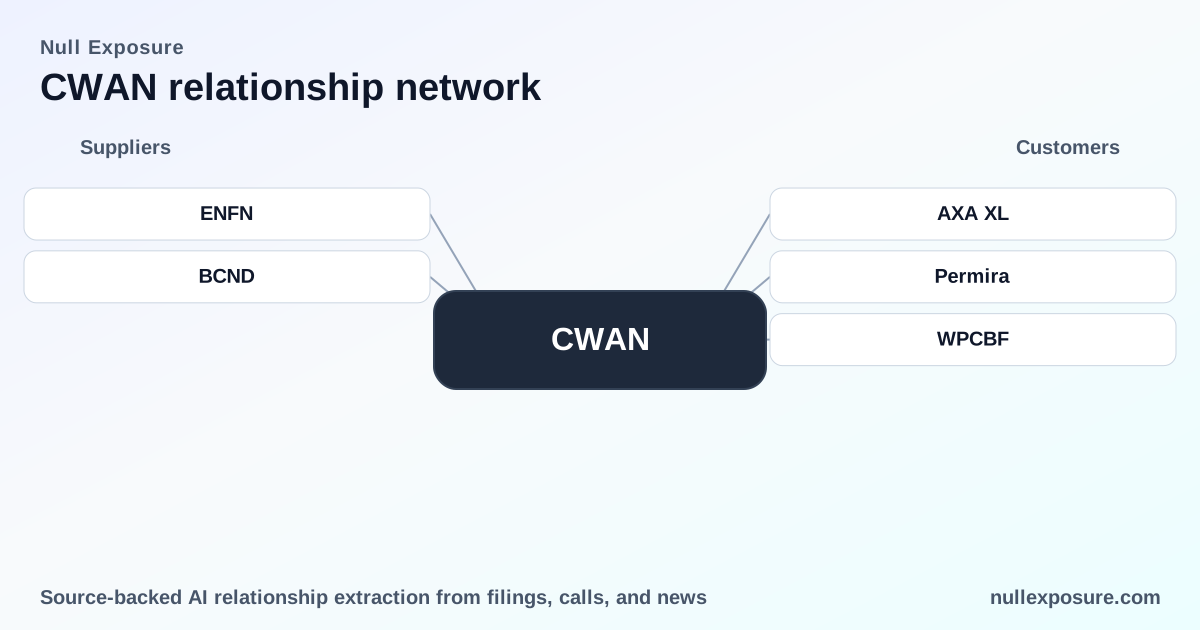
Clearwater Analytics (CWAN) — Customer Relationships and Commercial Profile
Clearwater Analytics operates a cloud-native, modular investment accounting and analytics platform that charges clients primarily on a recurring, usage- and subscription-based fee tied to assets under management and the breadth of services used. The company monetizes through monthly invoices (often a percentage of average daily assets or fixed base fees), supplemented by professional services and selective license revenue following strategic acquisitions. For investors, Clearwater’s model is growth-oriented, highly scalable, and dependent on broad enterprise and institutional adoption rather than concentrated large customers. Learn more at https://nullexposure.com/.
Business model and operating constraints that drive valuation and risk
- Contracting posture: Clearwater transitioned to a Base+ framework for new clients while continuing to invoice monthly; contracts are generally cancellable with 30 days’ notice, which creates low switching friction and higher churn risk despite recurring revenue. This is drawn from the company’s public contracting disclosures for its Prism offering and Base+ framework.
- Revenue mechanics: The company uses a usage-based billing construct (fees tied to asset size and solution breadth) combined with subscription elements, which links revenue growth directly to client assets and product expansion rather than long lock-in terms.
- Customer mix and concentration: Clearwater reports over 1,400 clients across 49 countries with roughly $8.8 trillion of assets on platform as of December 31, 2024, and no single client accounted for more than 10% of revenue; top-10 clients represented under 30% of revenue, signaling diversified commercial exposure.
- Counterparty profile and target markets: The client base skews toward large enterprises, insurance firms, governments, endowments, and non-profits, consistent with an enterprise SaaS vendor focused on mission-critical investment operations.
- Materiality and maturity: The combination of immaterial client concentration and a modular platform positions Clearwater as operationally mature with scalable margins, but the cancellable, usage-tied contracts make revenue more sensitive to macro-driven asset swings.
Customer relationships in the public record Below are the customer or relationship mentions surfaced in the public news stream; each entry is presented in plain English with a concise source citation.
-
Generali Deutschland AG — Clearwater selected for €40 billion unit-linked fund life insurance business.
- Clearwater has been chosen to manage Generali Deutschland AG’s €40 billion unit‑linked fund life insurance portfolio under a multi‑year engagement, with coverage reported across several investing.com insider‑trading news items in early May 2026. Source: Investing.com news items reporting on May 2, 2026 (multiple articles).
-
Generali Deutschland — Strategic selection for unit‑linked life insurance assets (same program referenced under a variant name).
- Multiple headlines identify Generali Deutschland as a client electing Clearwater to consolidate and manage its €40 billion unit‑linked fund business, reflecting the win’s repetition across news feeds and reinforcing its strategic scale. Source: Investing.com (May 2, 2026).
-
AXA XL — Alternative capital team adopts Clearwater for part of its investment portfolio.
- AXA XL’s alternative capital team signed with Clearwater to receive investment accounting, reporting, and analytics support for a portion of its portfolio, demonstrating acceptance among large P&C re/insurers for Clearwater’s SaaS solution. Source: Reinsurance News (March 9, 2026).
-
Permira — Buyer in a proposed cash sale of Clearwater.
- Financial commentary flagged Permira as a purchaser in a reported sale of Clearwater Holdings for $24.55 per share in cash, which speaks to private equity interest in the company’s recurring revenue franchise. Source: SahmCapital analysis (March 2026).
-
Warburg Pincus — Co-investor in reported buyout.
- Warburg Pincus is listed alongside Permira as a buyer in the same reported transaction for Clearwater at $24.55 per share, indicating the deal dynamics and potential change in ownership strategy that would affect customer engagement and product investment. Source: SahmCapital (March 2026).
-
WPCBF (inferred Warburg Pincus symbol) — Ticker-level reference to the Warburg listing.
- The WPCBF ticker appears in commentary tied to Warburg Pincus’s role in the reported purchase, functioning as an alternate identifier in public write‑ups about the transaction. Source: SahmCapital (March 2026).
What these relationships signal for investors and operators
- Insurance incumbency and scale: The Generali Deutschland engagement (€40bn) and AXA XL adoption highlight that Clearwater wins large, complex insurance mandates that demand robust accounting, reporting and compliance functionality — a strong commercial endorsement in a high‑value vertical.
- Revenue sensitivity and contract flexibility: Public disclosures that clients are invoiced monthly and that contracts can be cancelled with 30 days’ notice underscore the trade‑off between rapid commercial expansion and revenue predictability; large wins improve ARR but do not fully eliminate churn exposure.
- Exit and ownership implications: The reported Permira/Warburg Pincus transaction suggests private equity values the recurring, diversified AUM‑linked revenue stream; ownership change could accelerate product investment or alter pricing/contracting posture post‑close. Source: SahmCapital commentary (March 2026).
- Diversification remains a strength: Company disclosures show no single client >10% of revenue and top-10 <30%, which reduces idiosyncratic counterparty risk and supports a valuation premised on scale plus low client concentration.
Investor takeaways and risk checklist
- Upside: Large institutional wins (Generali, AXA XL) validate product-market fit in insurance/reinsurance — a high‑value market where clients pay for accuracy, auditability and regulatory compliance.
- Downside: The short-term cancellable contracts and usage-based billing make revenues exposed to asset price volatility and competitive pressure; monitor retention metrics and net dollar retention closely after any ownership transition.
- Catalysts to watch: Announcements of additional large insurance or government clients, cross-sell into existing enterprise relationships, and post‑transaction strategic investments by new owners (Permira/Warburg Pincus) in product or go‑to‑market.
For a succinct mapping of Clearwater’s commercial footprint and to monitor new client disclosures and ownership developments, visit https://nullexposure.com/.