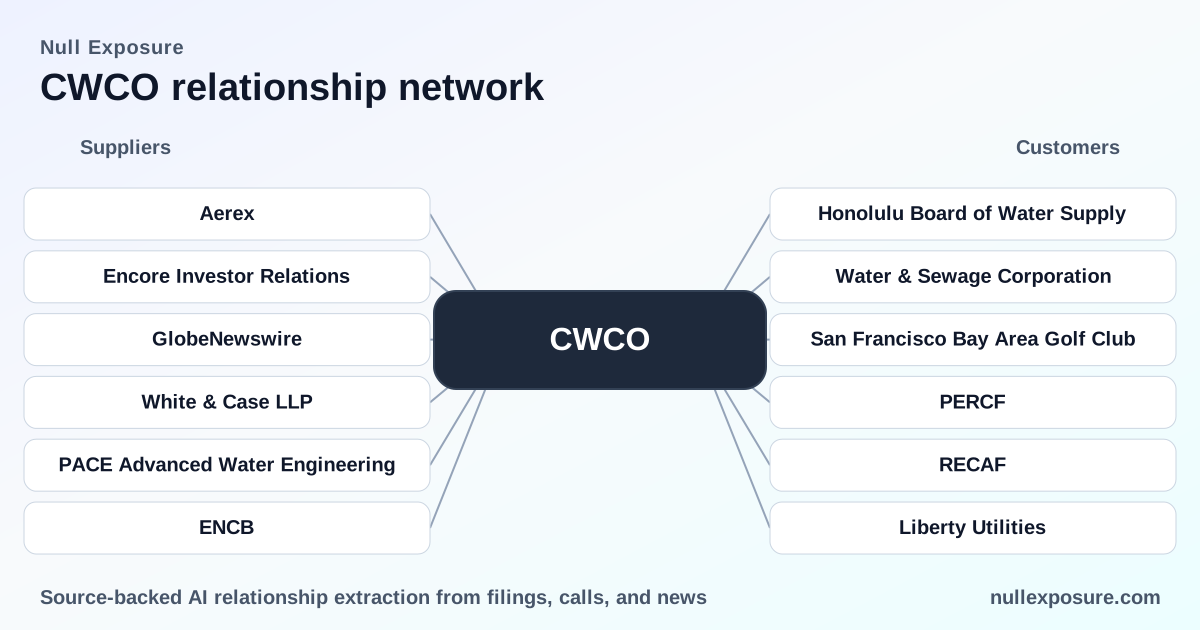
Consolidated Water (CWCO): Customer Relationships that Drive Cashflow and Project Pipeline
Consolidated Water Co. Ltd. designs, builds and operates seawater reverse‑osmosis plants and sells potable water under a mix of long‑term bulk contracts with government utilities and short‑term retail arrangements, while generating project and construction revenue through subsidiaries such as PERC Water. The company monetizes through recurring bulk water sales, fee income from plant management services, and episodic design‑build contracts that generate higher‑margin construction revenue — a dual model that combines regulated-like stability with project upside. For a closer look at how these customer ties translate to cash and risk, visit https://nullexposure.com/.
How CWCO’s customer mix translates into economics
Consolidated Water’s core revenue engine is bulk water supply: CW‑Bahamas and its Cayman operations sell treated seawater under contracts that provide predictable volumes and working capital cadence. Parallel to that stable base, the company’s design‑build and remediation business (PERC/REC) generates lumpy but accretive revenue when projects convert from pilot and design stages to construction. This hybrid model produces steady EBITDA from supply contracts while creating episodic revenue spikes tied to project awards and completions.
- Contracting posture: The company runs long‑term bulk contracts alongside month‑to‑month retail agreements; that structure layers predictability and optionality into revenue streams.
- Concentration and criticality: Government utilities, particularly the Water & Sewage Corporation in The Bahamas, are material payers and operational partners — water is a critical municipal input and therefore high‑priority for counterparties.
- Project maturity: Design approvals and pilot testing are necessary gating items before construction revenues flow — the Kalaeloa/Honolulu program illustrates a multi‑year path from pilot to notice‑to‑proceed.
- Geography: Operations and customers span the Cayman Islands, The Bahamas, the United States (Hawaii and mainland projects) and the BVI, which diversifies sovereign and regulatory exposure.
Customer relationships — line by line
Below are the customer and partner relationships referenced in CWCO’s recent filings and media coverage, with concise, plain‑English summaries and sources.
-
Water & Sewage Corporation (WSC) — CW‑Bahamas reduced delinquent receivables after significant payments from the WSC, with accounts receivable decreasing by $12.5 million to $16.8 million as of September 30, 2025; subsequent reporting shows a receivable balance of $22.6 million as of February 28, 2026. According to CWCO’s Q3 2025 earnings call and subsequent FY2025/FY2026 reporting, the WSC is the long‑term bulk counterparty for CW‑Bahamas and a primary driver of working capital. (CWCO Q3 2025 earnings call; FY2025/FY2026 reports and investing.com coverage)
-
Honolulu Board of Water Supply (BWS) — CWCO’s Kalaeloa Desalco unit completed 100% design for a 1.7 mgd seawater desalination plant, achieved successful pilot testing and received client confirmation that produced water matches existing quality requirements; these approvals are prerequisites to construction and a $204 million project valuation has been reported in press releases. (Company press release via GlobeNewswire May 2025; FY2025/FY2026 results and TradingView/Invesing.com summaries)
-
San Francisco Bay Area Golf Club — PERC Water secured an $11.7 million contract to build a wastewater recycling plant for a private golf club in the San Francisco Bay Area, representing PERC’s commercial project pipeline and regional design‑build activity. (Q4 2025 earnings commentary and company announcements summarized in InsiderMonkey / earnings call transcript)
-
Liberty Utilities — PERC’s contract work with Liberty Utilities generated incremental revenue (reported as $8.2 million of additional revenue), contributing to year‑over‑year project revenue growth and reflecting PERC’s ability to win utility‑scale contracts beyond island markets. (FY2025/FY2026 results; GlobeNewswire and earnings call summaries)
-
OC‑BVI (management services) — CWCO reported modest but recurring revenue from a management services agreement with OC‑BVI (roughly half a million dollars annually in recent reporting), demonstrating fee income diversification beyond water supply and construction. (FY2025/FY2026 results via GlobeNewswire)
-
Red Gate (Grand Cayman) — CWCO recognized revenue from a Red Gate contract in Grand Cayman (reported at approximately $1.3 million in 2024), indicating local contracted work in the Cayman operations. (FY2025/FY2026 results via GlobeNewswire)
-
PERC (PERCF) — The PERC subsidiary (tickers and disclosures referenced in filings) contributed incremental revenue alongside REC, driving growth in the company’s construction and services segment; PERC is a primary vehicle for CWCO’s project execution business. (Company results and press releases summarized via GlobeNewswire FY2025)
-
REC (RECAF) — REC alongside PERC contributed to incremental project revenue in reported quarters, reflecting the combined impact of CWCO’s project subsidiaries on consolidated top line. (GlobeNewswire FY2025 reporting)
-
PDS (Precision Drilling) — A third‑party news excerpt referenced activity on CWC rigs purchased in the Powder River; the mention highlights ancillary interactions between CWCO or its subsidiaries and external rig operators that can influence equipment utilization and segment margins. (Investor media item citing Precision Drilling transcript, Investing.com)
What the constraints reveal about operational risk and optionality
The company‑level constraints give a clear commercial profile:
- Contract mix - stability plus cadence: Retail water is sold on month‑to‑month terms (company signal), while the bulk water business includes long‑term contracts (company disclosures explicitly name the WSC as a long‑term counterparty), creating a stable base revenue stream that mitigates project volatility.
- Counterparty types: CWCO sells to a mix of government utilities, commercial customers, and individual/residential users, which reduces single‑counterparty dependency while preserving the revenue durability of utility contracts.
- Geographic diversification: Operations in the Cayman Islands, The Bahamas, the United States and the British Virgin Islands spread regulatory and sovereign risk.
- Role and cashflow timing: The company is principally a seller of produced water and also a provider of design/build and management services; billing is typically monthly with a 30–45 day collection profile for retail accounts, while project payments follow construction milestones.
- Segment balance: CWCO combines manufacturing-like activities (engineering and equipment) with services (plant operation and management), which produces both recurring margin and episodic higher‑margin project revenue.
Investment implications and risk factors
Consolidated Water’s revenue mix is anchored by long‑term municipal contracts that support predictable cashflow, while PERC/REC deliver cyclical upside when design engagements convert to construction. The primary risk vector is working capital exposure to large utility payers (illustrated by the WSC receivable movements), and project delivery/permitting timelines that govern when sizeable construction revenue is recognized (the Honolulu project is a current example). Key takeaway: investors should balance CWCO’s regulated‑style bulk cashflows against project execution and receivables concentration risk.
For a practical next step, review CWCO’s most recent investor release and transcript summaries on our platform to track receivable trends and milestone timing: https://nullexposure.com/.
Bold, focused customer relationships — particularly the WSC and Honolulu BWS projects — will determine CWCO’s near‑term cash cycles and the pace at which project revenue boosts margins.