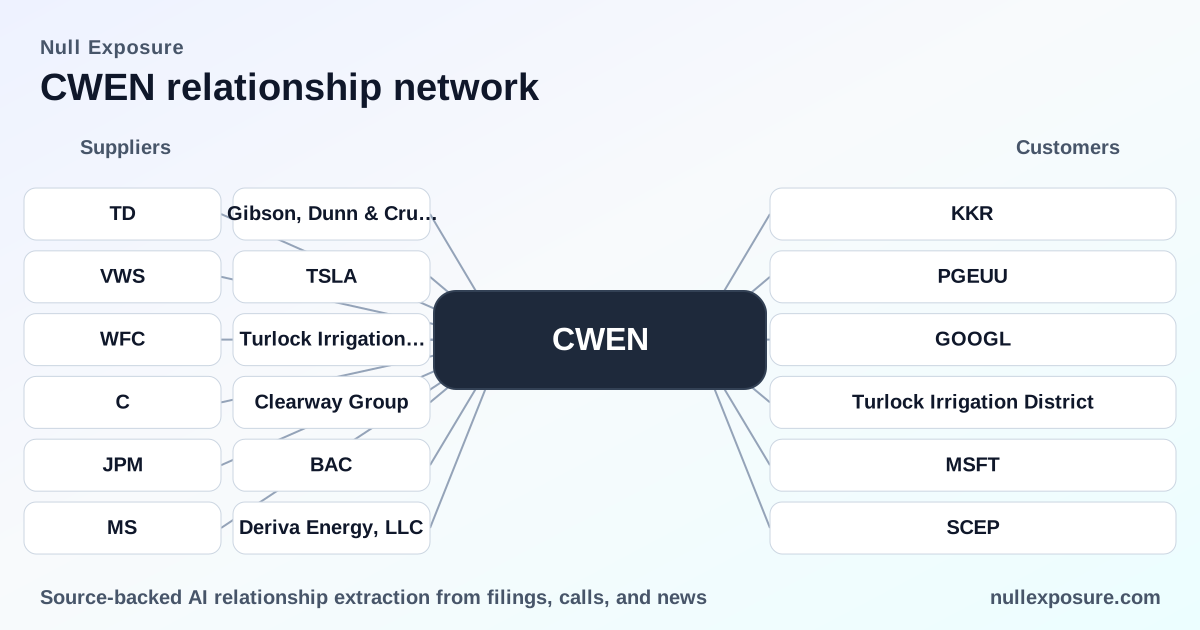
Clearway Energy (CWEN) — Customer Relationships That Drive Predictable Cash Flow
Clearway Energy Inc. operates an owner/operator model in U.S. renewable generation, monetizing through the long-term sale of electricity and environmental attributes under power purchase agreements (PPAs) and capacity contracts. The company converts asset-level generation into contracted cash flows—many with multi-decade tenors—while leaning on a concentrated set of large utility and corporate counterparties to underwrite revenue visibility. For investors and operators, the core thesis is straightforward: Clearway’s value is derived from the durability of long-term offtake contracts and the credit quality of a relatively small group of counterparties that represent a large share of consolidated revenue. Learn more at https://nullexposure.com/.
What the customer mix tells investors about risk and runway
Clearway’s counterparty profile is a mix of regulated utilities and large corporate off-takers. That mix creates predictable, low-volatility cash flow, but also concentration risk: a handful of counterparties account for meaningful portions of revenue. The 2024 Form 10‑K discloses that Southern California Edison (SCE) and Pacific Gas & Electric (PG&E) represented approximately 24% and 17% of consolidated revenue in FY2024, respectively, while the next five largest customers collectively contributed roughly 30%, underscoring a concentrated top line that is nonetheless anchored by long-term contracts.
- Contracting posture: long-term PPAs dominate, with Clearway reporting a weighted-average remaining offtake tenor of about 12 years for its Renewables segment as of December 31, 2024—a structural feature that supports stable CAFD (cash available for distribution).
- Geographic footprint: The company sells electricity and RECs across 26 U.S. states, signaling broad North American geographic exposure even as individual large customers introduce local concentration.
- Relationship stage and maturity: Most relationships are active, contract-backed arrangements rather than spot-market exposure, which preserves predictability but ties performance to contract counterparty credit and regulatory frameworks.
Customer and partner roll call — concise, source-backed summaries
SCE (Southern California Edison / ticker SCEP referenced in filings)
SCE was Clearway’s largest single customer in FY2024, accounting for approximately 24% of consolidated revenue under long-term offtake arrangements disclosed in the company’s 2024 Form 10‑K. According to Clearway’s FY2024 10‑K filing, SCE sits at the top of the revenue concentration table. (Source: Clearway 2024 Form 10‑K)
PG&E
PG&E represented about 17% of Clearway’s consolidated revenue for FY2024, making it the company’s second-largest counterparty and a critical contributor to near-term cash generation under contracted agreements. This figure is documented in Clearway’s 2024 Form 10‑K. (Source: Clearway 2024 Form 10‑K)
Google (GOOGL)
Clearway executed a portfolio of long-term PPAs with Google that aggregate roughly 1.17 GW across multiple states, and management has cited 20‑year PPAs supporting development pipelines such as Swan and Catamount Energy Centers. These agreements extend Clearway’s sponsor-enabled growth runway with a large, creditworthy corporate off‑taker. (Sources: Clearway Q4 2025 earnings call transcript; investingnews report on 2025 PPAs)
Microsoft (MSFT)
Clearway operates at least one facility that is contracted to Microsoft on a 20‑year PPA covering full output, providing fixed long-duration cash flow from a high-credit corporate off-taker and aligning asset cash generation with corporate decarbonization procurement. (Source: TradingView / GuruFocus summarizing PPA details)
Turlock Irrigation District
Clearway holds a 15‑year PPA extending to 2040 with Turlock Irrigation District, an investment-grade public utility, giving the company a stable municipal counterparty for that facility’s output. This type of utility contract supports predictable revenue while reflecting regional municipal credit dynamics. (Source: TradingView / GuruFocus article referencing the PPA)
KKR
In 2021 Clearway sold its Thermal Business to KKR for approximately $1.9 billion, a strategic divestiture that reshaped the company toward renewables and altered its counterparty and asset profile; the transaction was disclosed in a GlobeNewswire press release in October 2021. The KKR sale removed thermal counterparties from Clearway’s portfolio and redeployed proceeds into the renewables platform. (Source: GlobeNewswire press release, Oct 25, 2021)
How these relationships shape business constraints and capital planning
The contract architecture and counterparty roster impose predictable constraints that guide capital allocation:
- Long-term contracting is the operating norm. Clearway’s revenue base is dominated by long-term offtake agreements; management reports a weighted-average remaining PPA life of roughly 12 years for the Renewables segment, which translates into durable CAFD and easier project finance metrics for new builds. (Company-level signal from FY2024 10‑K)
- Concentration is material. With ~41% of revenue tied to SCE and PG&E alone and the next five customers contributing another ~30%, Clearway’s revenue profile is top-heavy—strengthening cash predictability but increasing counterparty concentration risk to a handful of utilities and corporates. (Company-level signal from FY2024 10‑K)
- North American diversification reduces jurisdictional exposure. Contracts span 26 states, which lowers single-state regulatory risk but leaves subsets of generation still dependent on local utility tariffs and interconnection regimes. (Company-level signal from FY2024 10‑K)
- Active, mature contracts support lender and equity confidence. The predominance of active, long-dated PPAs increases certainty for lenders and supports asset-level financing and sponsor-enabled growth strategies.
Investor takeaways and what to watch next
- Predictable cash flow with concentrated counterparty risk. Clearway’s PPA-heavy revenue mix underpins steady EBITDA and CAFD profiles, but investors must monitor credit and regulatory developments involving top customers—especially SCE and PG&E—because those counterparties represent a disproportionate share of revenue.
- Corporate PPAs add scale and optionality. Large technology off‑takers such as Google and Microsoft provide high-credit, long-dated offtake that supports new-build economics and de‑risking of merchant exposure. Recent Google PPAs expand Clearway’s sponsor-enabled growth runway.
- Portfolio evolution matters. The 2021 KKR divestiture signaled a strategic pivot away from thermal generation; future M&A, asset sales, or additional corporate PPAs will materially influence asset mix and counterparty concentration.
If you want a condensed counterparty map or a tailored risk memo for portfolio analysis, visit the Clearway profile at https://nullexposure.com/ for structured investor-grade coverage and tools.