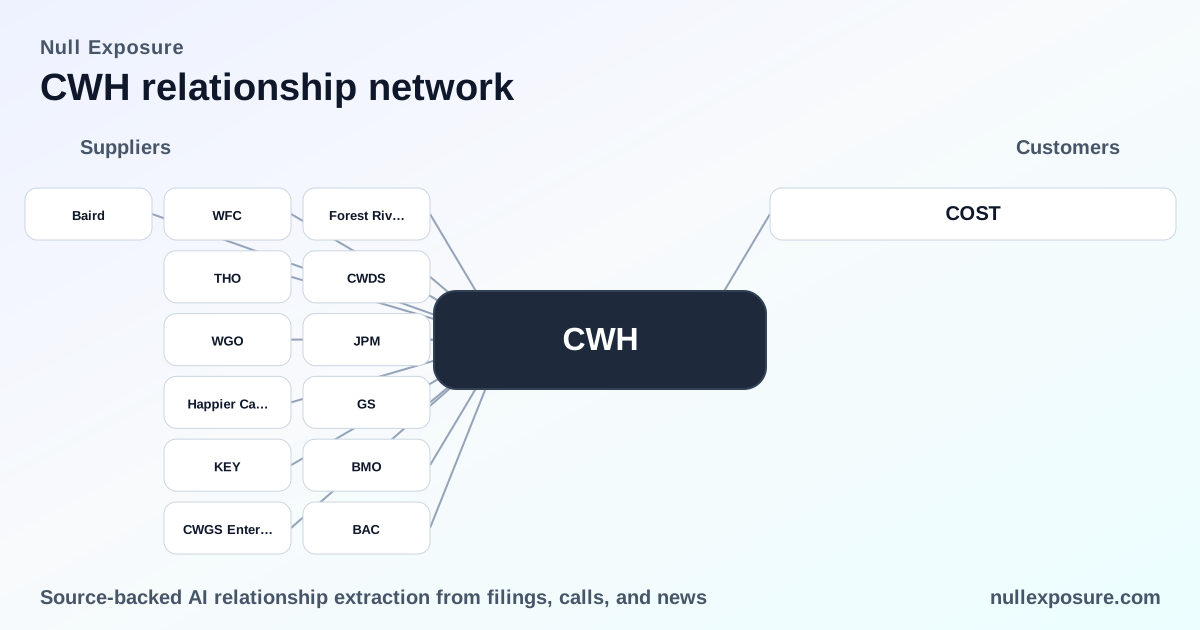
Camping World (CWH): Customer Relationships and Commercial Implications
Camping World monetizes by selling new and used recreational vehicles (RVs), parts and services, arranging lending and insurance on behalf of third-party finance providers, and operating the Good Sam membership and roadside-assistance subscriptions that generate recurring, deferred revenue. The company’s value proposition combines dealership throughput and high-margin services with subscription and F&I economics; investors should evaluate both front-end vehicle sales volatility and back-end annuity characteristics when assessing durability and upside. For a concise commercial-risk lens and relationship mapping, see NullExposure’s coverage at https://nullexposure.com/.
How Camping World actually makes money — the business in plain terms
Camping World is the largest U.S. retailer of RVs and related products and services. Primary monetization vectors are: retail vehicle sales (new and used), finance-and-insurance fee revenues earned as agent for lenders and insurers, parts & service work at dealer locations, and recurring subscription revenue from the Good Sam Club (memberships and roadside assistance). The company reported roughly $6.31 billion in revenue and $278.8 million of EBITDA on a trailing basis; those top-line and margin figures underscore a business with meaningful scale but cyclical sales dynamics and pockets of higher-margin services. Company filings explicitly state that finance and insurance revenue is recorded net because the firm acts as an agent in these transactions, which affects reported margin and cash-flow timing.
Contracts, customer lifecycles and durability signals
Company disclosures identify two contractual patterns that shape revenue durability and credit exposure:
- Long-term retail installment sales contracts are used for financing RV purchases, with terms stated to reach up to 20 years. This structure creates a long tail of receivable-related economics even as front-end sales fluctuate. Company filings describe these arrangements as being entered into on behalf of third-party lenders.
- Subscription economics from the Good Sam Club are a material, recurring revenue stream. The company collects cash in advance for memberships and roadside assistance, deferring recognition and creating predictable revenue recognition over the life of memberships.
These contract patterns indicate a mixed contracting posture: sales are transaction-driven and cyclical, while subscription and financed receivable flows add predictability and extend lifetime revenue capture.
Geography, scale and operational footprint
Camping World’s operations are North America–centric, created through consolidation of dealership businesses and the Good Sam platform. Management reports operating 206 store locations and servicing a base of approximately 4.5 million Active Customers, which signals broad market reach across the U.S. and Canada. Corporate disclosures also flag material operational risks — especially around IT systems and confidentiality — that could cause material adverse effects if compromised, making operational resilience a key investor consideration.
Relationships disclosed in public remarks
The company’s Q4 2025 earnings call referenced partnerships that influence inventory and sales channels. The following entries are taken from that call (recorded March 8, 2026) and are listed exactly as disclosed.
-
COST
Camping World cited partnerships with organizations like Costco as part of a multifaceted strategy to grow new and used RV sales, specifically noting Costco as a partner for procurement and brand expansion efforts. According to the Q4 2025 earnings call (March 8, 2026), management positioned Costco as a channel or organizational partner to improve used-RV procurement and accelerate inventory turnover. -
Costco
Management repeated that partnerships with Costco are being leveraged to expand exclusive RV brands and improve efficiency of used-RV procurement, framing Costco as a key distribution and sourcing collaborator in the company’s growth plan. This was articulated on the Q4 2025 earnings call (March 8, 2026).
Note: The two entries above reflect the same partner mention in the Q4 2025 earnings call; both records are derived from the company’s March 2026 remarks.
What the company-level constraints tell investors
Across filings and call excerpts, several company-level signals emerge that shape commercial risk and opportunity:
- Contracting posture: A hybrid model combining one-off vehicle sales with up-to-20-year installment contracts and deferred subscription revenue creates both short-term volatility and long-term receivable streams.
- Revenue concentration and diversification: The business benefits from diversified revenue by segment — RV & Outdoor Retail and Good Sam Services and Plans — which balances cyclical vehicle sales with subscription and service margins.
- Customer criticality and maturity: With 4.5 million Active Customers and national dealership coverage, Camping World operates as a high-touch seller and service provider; its role as both seller and service provider embeds it deeply in the RV ownership lifecycle.
- Operational risk materiality: Filings explicitly call out that IT or data breaches could cause material adverse effects; given the dependency on finance origination and membership systems, operational resilience is a governance and investment priority.
- Lifecycle stage: The company is an active, mature market participant with scale and ongoing expansion initiatives (exclusive brands, procurement partnerships) designed to shorten inventory turns and raise throughput.
Investor implications — what to watch next
- Revenue mix stability: Monitor the split between vehicle sales and Good Sam subscription/service revenues; growth in subscription revenue reduces headline volatility.
- Inventory turnover and procurement channels: Partnerships like Costco are purposeful levers to accelerate used-vehicle procurement and improve margins; evidence of improved turn and margin lift is a near-term catalyst.
- Credit and receivable performance: Long-term installment structures extend earnings capture but increase exposure to macro-driven delinquency trends; investors should track receivable performance metrics quarterly.
- Operational risk management: Given the materiality of systems failure cited in filings, active oversight of cybersecurity and IT resilience is a value-preservation priority.
For an actionable monitoring framework and deeper counterparty mapping, review our company coverage at https://nullexposure.com/.
Bottom line
Camping World combines transactional retail economics with subscription and long-dated finance arrangements, creating a business that is both cyclical and durable in different ways. Key relationships mentioned publicly — including Costco — are strategic to inventory and distribution execution, while company-level constraints point to subscription durability and material operational risk. Investors should weigh near-term sales cyclicality against the multi-year cash flows embedded in financed contracts and Good Sam memberships when sizing exposures or building operational playbooks.