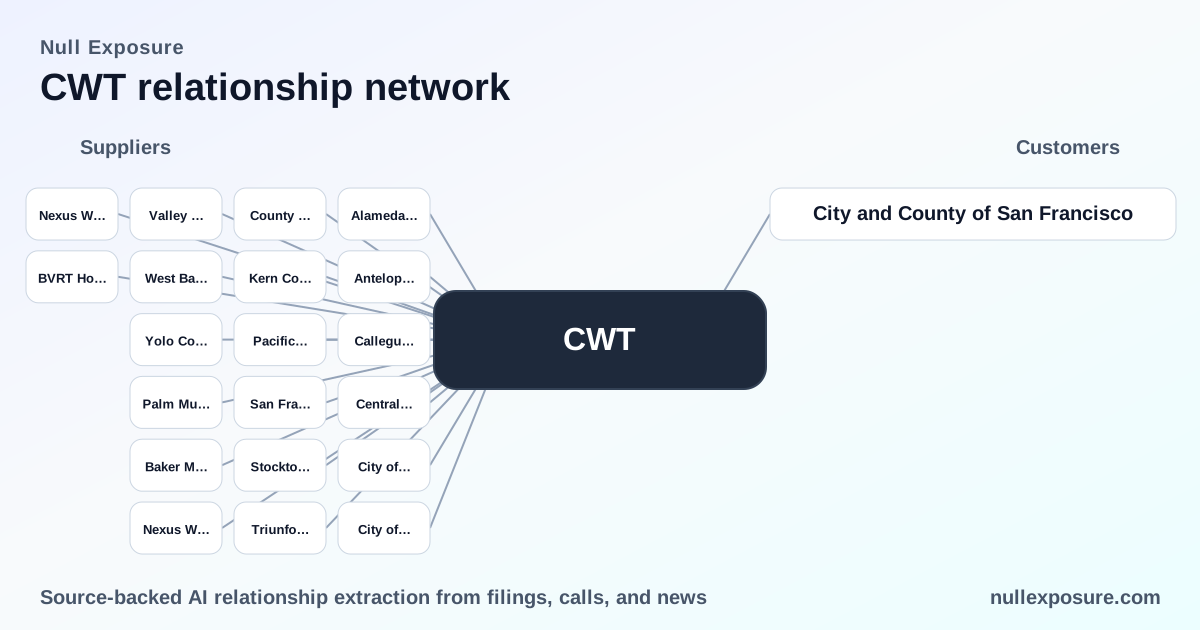
California Water Service Group (CWT): Customer Relationships and Strategic Constraints
California Water Service Group operates as a regulated water utility that monetizes through water sales, regulated tariffs, service charges and selected non‑regulated municipal contracts. The company supplies water and related services to residential, commercial, industrial and municipal customers across several western states—with the vast bulk of revenue and connections in California—generating roughly $1.01 billion in trailing‑twelve‑month revenue and $344 million of EBITDA. For investors assessing counterparty exposure, CWT’s customer profile is a blend of high‑volume enterprise accounts, widespread individual retail customers, and a small number of municipal supply agreements that underpin both steady cash flow and concentration risk. For primary docs and deeper counterparty analytics visit https://nullexposure.com/.
Why customers matter: concentrated, regulated cash flows
CWT is a classical regulated utility: revenue derives from rate base economics and volumetric sales, supplemented by targeted non‑regulated services to municipalities and private entities. The company reports that 92.3% of consolidated operating revenue was generated in California in 2024, and California operations account for approximately 89.2% of customer connections, which makes geographic concentration a primary structural characteristic of the customer book. According to the company’s 2024 filing, approximately $210.4 million (23.2%) of 2024 water utility revenues came from business and industrial customers, signaling meaningful exposure to fluctuations in large‑volume commercial consumption.
These facts create a specific investor checklist: regulatory rate cases and CPUC outcomes drive long‑term cash flow; large enterprise consumption patterns can move near‑term revenue; and municipal contracts, while small in count, carry service continuity and reputational importance.
The explicit municipal counterparty: City and County of San Francisco
A notable municipal relationship in CWT’s filings is with the City and County of San Francisco. CWT’s 2024 Form 10‑K discloses a Water Supply Contract dated July 1, 2009 between the City and County of San Francisco and California Water Service Company to provide water to the Bear Gulch and Bayshore service areas. This is an active supply arrangement documented in the 2024 annual report and represents a municipal supply relationship rather than a large commercial off‑taker. (Source: CWT 2024 Form 10‑K, contract excerpt dated FY2024.)
What the relationship list tells investors (company‑level signals)
Although public filings list individual municipal contracts such as the San Francisco supply agreement, the 10‑K and related disclosures emphasize broader structural characteristics that affect all customer relationships:
- Counterparty mix: The company highlights a mix of large‑volume commercial and industrial customers alongside millions of individual retail connections and municipal customers, indicating a diversified customer base by type but concentrated by geography. (Source: 2024 Form 10‑K excerpts.)
- Materiality and criticality: With nearly a quarter of water utility revenue from business and industrial customers and over 89% of connections and 92.3% of revenue located in California, customer relationships are both material and critical to consolidated results. (Source: 2024 Form 10‑K.)
- Service posture and stage: CWT operates as a service provider through its subsidiaries and reports active operations across roughly 499,400 customer connections in about 100 California communities, organized into 20 regulated districts overseen by the CPUC. These disclosures position relationships as operationally mature and ongoing. (Source: 2024 Form 10‑K.)
- Spend profile signal: Public disclosures reference annual revenue sharing with regulated customers of approximately $2.7–$2.8 million in recent years; taken together with other contract notes, this suggests unit‑level municipal payments are relatively limited while enterprise customers generate disproportionate revenue. (Source: 2024 Form 10‑K.)
These company‑level signals influence underwriting and operational priorities: focus on regulatory outcomes, credit quality of large commercial accounts, and continuity of municipal supply agreements.
Operational and contract risks investors must track
CWT’s customer relationships embed several predictable risk vectors that directly affect valuation and cash flow:
- Regulatory risk: CPUC rate cases dictate allowed returns and recovery of capital expenditures; regulatory timing and outcomes are the primary drivers of long‑term earnings power. (Source: 2024 Form 10‑K.)
- Concentration risk: Heavy California concentration amplifies exposure to state‑level regulatory, environmental and demand shocks (drought policies, conservation mandates, economic cycles). The company’s financials reflect this geographic skew. (Source: 2024 Form 10‑K.)
- Large‑customer exposure: Large‑volume commercial and industrial customers account for a meaningful share of revenue; significant consumption declines among a few large customers can adversely affect operating results. (Source: 2024 Form 10‑K.)
- Municipal contracting dynamics: Municipal contracts such as the San Francisco water supply agreement are operationally important but limited in number; their renewal terms, service level obligations and potential compensation mechanisms require active monitoring. (Source: CWT 2024 Form 10‑K.)
Investors should monitor CPUC docket activity, municipal contract notices, and any public statements from major commercial customers about demand changes.
How to monitor and what to expect from earnings and disclosures
CWT is a regulated utility with stable, foreseeable cash flow, but it is not immune to customer composition shocks. Focus monitoring on:
- Regulatory filings and rate case outcomes in California (timing and allowed ROE).
- Quarterly disclosures on large‑customer consumption and any single‑customer concentration notes.
- Renewals and amendments of municipal supply contracts such as the San Francisco agreement.
- Capex plans and capital recovery mechanisms that feed into the rate base and affect future earnings.
For ongoing counterparty intelligence and primary‑source tracking of municipal and enterprise relationships, detailed public filings and contract excerpts are available at https://nullexposure.com/.
Investment conclusion: steady utility economics with concentrated execution risk
California Water Service Group delivers stable regulated cash flows driven by volumetric sales and regulated rate mechanisms, and it benefits from predictable service demand across many retail accounts. However, the company’s heavy California concentration and meaningful share of revenue coming from large commercial and industrial customers create execution risk that is directly tied to regulatory outcomes and demand patterns. The disclosed supply contract with the City and County of San Francisco is an example of municipal exposure that contributes operational continuity but does not materially offset concentrated enterprise and geographic risk.
Key takeaways for investors: regulatory developments and large‑customer consumption trends are the primary levers for upside or downside; municipal contracts are operationally important but limited in financial scale. Follow rate cases, customer concentration disclosures, and municipal contract renewals closely when modeling CWT’s future cash flows.