CXApp (CXAI) — Customer relationships, commercial posture, and what investors should know
CXApp Inc. operates an AI-first employee experience platform sold primarily as recurring SaaS to large enterprise customers, monetizing through subscription licenses, implementation/professional services, and occasional hardware sales. The business combines enterprise software licensing with recurring maintenance and time-based revenue recognition, while pursuing strategic partnerships to embed its agentic AI into third-party deployments.
For a deeper diligence brief and continual monitoring of CXAI customer signals, visit https://nullexposure.com/.
How CXApp actually sells and where the revenue comes from
CXApp’s commercial model is straightforward: recurring SaaS contracts are the core revenue engine, supplemented by one-time implementation fees and hardware transactions. Company filings describe license fees recognized ratably over the contract term and professional services billed up front for deployment work. The platform is marketed to enterprise customers and deployed as a cloud service with continuous delivery, which drives time‑based revenue recognition.
- Contracting posture: The company sells primarily subscription (SaaS) contracts, often multi-year with recurring billing, but it also uses a mix of short-term (one year or less) contracts, spot hardware sales, and occasional framework-style pre-paid purchase agreements used for financing and tranche-based sales. According to the company SPA disclosed in 2025, it has the capacity to issue up to $20 million of pre‑paid purchase agreements, with an initial $4.2 million tranche that netted $4.0 million.
- Commercial role: CXApp acts as licensor, principal seller, and service provider, delivering software licenses, managing implementations, and in some cases shipping hardware where title transfers at shipment.
- Customer profile and geography: The customer base is enterprise-focused and global, with the majority of revenue coming from the United States and deployments across roughly 50+ countries. CXApp explicitly targets Fortune 1000 clients in regulated industries such as financial services, healthcare, and technology.
- Scale and concentration: Top customers are material: the top three customers accounted for roughly 24–25% of gross revenue in the most recent reporting periods, which creates single-customer sensitivities to retention and contract renewal.
Key financial context: CXApp is generating low revenue scale (Revenue TTM reported under $5 million) and is currently unprofitable on both EBITDA and EPS metrics, which frames customer retention and expansion as critical levers for value creation.
Why contract format and customer mix matter for investors and operators
The predominance of subscription revenue gives CXApp predictable recurring cash flows on renewal, but the coexistence of short-term contracts and meaningful customer concentration creates uneven visibility:
- Revenue visibility is improved by recurring SaaS, but the company’s election of the ASC 606 practical expedient for short contracts indicates meaningful short-duration engagements that reduce the guaranteed backlog.
- Customer concentration amplifies risk — the loss of a major account would be immediately material at current revenue levels.
- Framework financing and pre-paid constructs provide near-term capital and revenue smoothing options, but they also indicate reliance on external financing instruments for growth and working capital.
For investors tracking CXAI relationships and contract signals, monitor renewal announcements, new enterprise wins, and partnership deployments that meaningfully expand addressable endpoints.
For additional corporate relationship intelligence and ongoing monitoring, see https://nullexposure.com/.
Customer relationships and public partnership signals
Below are every customer/partner relationship flagged in the public record for the customer scope. Each entry is a concise, plain‑English summary with its source.
-
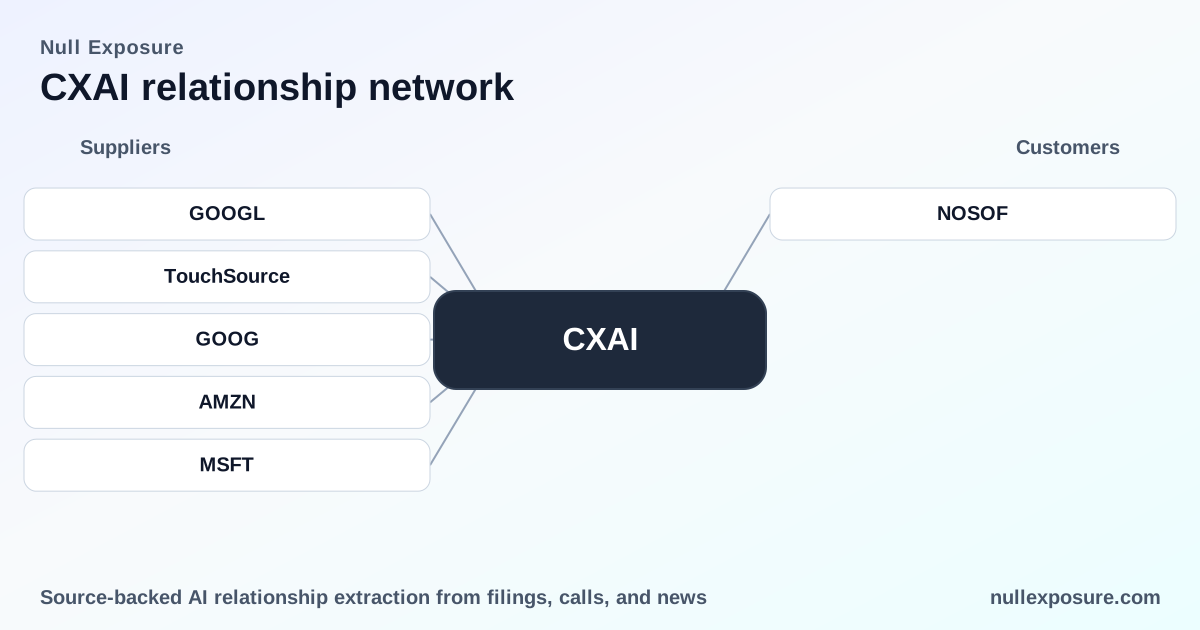
TouchSource — CXApp has a joint marketing, sales, and product partnership with TouchSource that embeds CXApp’s agentic AI as the intelligence layer for TouchSource’s installed base of over 11,000 digital directory deployments, extending CXApp reach into physical building directories and tenant experiences; this relationship was described in a Q4 2025 earnings transcript reported on Investing.com in May 2026.
Source: Investing.com earnings call transcript (Q4 2025 / published May 2026). -
Noro — Management stated during the company’s Q3 2025 earnings call that CXApp announced a strategic collaboration with a company called Noro, indicating a new partnership aimed at joint initiatives; the remark was captured on the CXApp 2025 Q3 earnings call in early March 2026.
Source: CXApp 2025 Q3 earnings call (March 2026). -
NOSOF — The name NOSOF appears as an inferred ticker/symbol tied to the same Q3 2025 earnings call reference to Noro, suggesting CXApp or external trackers assigned an inferred symbol (NOSOF) to the Noro collaboration; the mention originates from the same earnings call.
Source: CXApp 2025 Q3 earnings call (March 2026).
What these relationships imply for commercial strategy and execution
- Partnerships are distribution multipliers. The TouchSource relationship demonstrates CXApp’s strategy to scale via embedding its AI in third-party ecosystems with already-established physical deployments, converting product integration into customer reach. Partnership-led deployment reduces direct sales friction into certain enterprise channels.
- Early-stage collaborations require careful conversion measurement. Mentions of strategic collaborations like Noro/NOSOF are positive signals for pipeline expansion, but investors must track conversion from partnership announcement to contracted recurring revenue to assess commercial impact.
- Enterprise focus amplifies upside and downside. Landing additional Fortune‑level customers or converting top-three accounts into multi-year committed contracts would materially improve economics; conversely, churn at that level would weaken the business materially.
Bottom line for investors and enterprise operators
CXApp runs a software-first, subscription-centric business selling to large enterprises with supplemental services and hardware. The company’s revenue base is small relative to its target market, and it is operating at a loss, so growth and retention of material enterprise accounts are the primary levers for valuation. Partnerships like TouchSource are strategically important because they provide rapid scaling pathways into thousands of endpoints, while collaborations such as Noro are signals of an active commercial outreach program.
Operationally, underwriters and customers should evaluate contract length, renewal cadence, and implementation economics given the mix of short-term and multi-year license models. Investors should prioritize tracking renewal announcements, realized ARR growth from partnerships, and any further framework financing that changes cash runway or revenue recognition.
For a structured view of CXApp’s counterparty signals and continuous coverage, visit our research hub at https://nullexposure.com/.