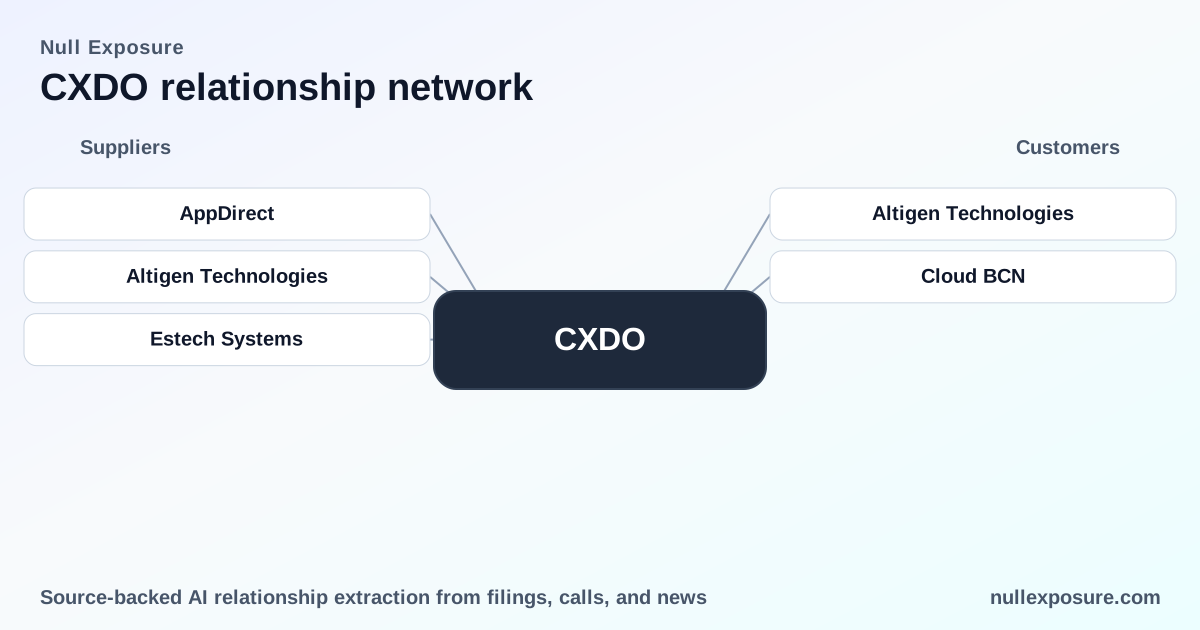
Crexendo (CXDO): Customer Relationships That Drive Recurring Cloud Communications Revenue
Crexendo operates a dual-segment cloud communications business that monetizes through recurring cloud telecommunications services and software licensing/subscriptions, selling UCaaS, contact center and managed IT services to small, mid-market and enterprise customers. Revenue comes from a mix of multi-year service contracts and SaaS-style subscriptions, augmented by perpetual license and professional services fees, creating a predictable cashflow profile centered on service continuity and platform scale. For a concise business-risk briefing, visit https://nullexposure.com/.
Why customers matter: the commercial model behind the headlines
Crexendo’s go-to-market is built on two complementary revenue streams: Cloud Telecommunications Services and Software Solutions. This structure produces a characteristic operating model:
- Contracting posture: Crexendo runs predominantly long-term arrangements (36–60 months) for cloud telecom services, while also selling subscription (monthly SaaS) and licensing products in its software segment. These contract types drive revenue visibility and raise switching costs for customers.
- Customer mix and concentration: Sales target small and mid-market businesses and larger enterprise accounts, but the company reports no single customer accounted for ≥10% of revenue for 2023–2024, signaling low customer concentration and diversified revenue sources.
- Geographic exposure and scale: The business is heavily U.S.-centric (≈94% of revenue) while supporting a global installed user base through partners; this concentrates regulatory and market risk in North America but leaves upside in English-speaking international markets.
- Segment economics: The company’s services and software segments both contribute materially: services deliver recurring connectivity revenue while software (including perpetual licenses and SNAPaccel subscriptions) produces higher-margin, predictable monthly service revenue.
These company-level signals explain why partnerships and channel relationships are central to Crexendo’s commercial strategy rather than dependence on a handful of anchor accounts.
Relationship roll call: public customer and partner announcements
Altigen Technologies — a licensing and collaboration arrangement
Crexendo entered a licensing and collaboration agreement with Altigen to deliver customer and partner solutions powered by Crexendo’s NetSapiens hosted cloud communications platform. This is a strategic go-to-market tie that leverages Crexendo’s software IP to expand partner-led distribution. According to an Accesswire release dated March 9, 2026, the agreement positions Altigen to resell and co-develop solutions built on Crexendo’s NetSapiens platform.
National Association of Basketball Coaches (NABC) — event communications partnership
Crexendo extended its relationship with the NABC to support large-scale event communications for the 2026 convention, illustrating its capability to service event-level voice, video and contact-center needs for associations and live events. The Globe and Mail’s ACCESS Newswire piece published May 2, 2026, describes Crexendo’s role redefining communications for the NABC event.
Pronto Mobile — platform selection for mobile reliability
Pronto Mobile selected Crexendo’s platform as its cloud communications solution, signaling adoption by a mobile-focused innovator that can showcase Crexendo’s mobile and reliability credentials. Multiple press releases from May 2, 2026 — including Accesswire and industry reposts on Bitget — announce Pronto Mobile’s selection of Crexendo for its communications stack.
Cloud BCN — capacity expansion through partnership
Cloud BCN expanded its IP voice capacity through an expanded partnership with Crexendo, doubling platform capacity for voice services and indicating Crexendo’s role in supporting carrier and MSP-scale voice operations. TelecomReseller reported on December 5, 2025, that Cloud BCN increased IP voice platform capacity via the Crexendo relationship.
What these relationships mean for investors
These public customer and partner disclosures collectively reinforce several strategic strengths:
- Partner-led distribution and platform licensing scale. The Altigen licensing deal and Cloud BCN capacity expansion show Crexendo sells not only direct services but also platform capabilities to channel partners that scale end-user reach without equivalent SG&A expansion.
- Recurring revenue and longer duration economics. Public statements and company disclosures confirm a business model dominated by subscriptions and long-term service contracts (36–60 months), which creates predictable top-line renewal streams and elevates the lifetime value of each customer.
- Diverse counterparty profile. Crexendo actively serves SMBs, mid-market, and larger enterprises, and supports both direct retail and a network of cloud communications subscribers; this reduces single-counterparty materiality as the company reports no customer >10% of revenue.
- U.S.-centric operator with global distribution potential. The firm generates the majority of revenue in the U.S. but supports over five million end users globally through partners, indicating scalable international distribution without direct country-level investment.
Measurable financial context and risks
Crexendo’s public financials and market data provide the quantifiable backdrop for relationship-driven growth:
- Revenue TTM roughly $68.2M with gross profit of ~$42.97M, and profit margin near 7.4%, demonstrating positive unit economics at current scale.
- Market capitalization around $260.5M, EV/EBITDA ≈ 24.2, and a trailing P/E of ~48, which reflect a market pricing in growth and operating leverage potential.
- High insider ownership (~42%) and modest institutional ownership (~29%), which concentrates control and can influence strategic decisions and capital allocation.
Key investor risks flow from these facts: high U.S. revenue concentration, the need to continue winning partner deals to scale efficiently, and valuation multiples that leave less margin for execution slip.
For more on how these partnership dynamics translate to commercial value and competitive positioning, see https://nullexposure.com/.
Bottom line — partnership-driven growth with measurable predictability
Crexendo’s public customer relationships — Altigen, NABC, Pronto Mobile and Cloud BCN — together confirm a business model that monetizes via long-duration service contracts and recurring software subscriptions, amplified by partner licensing and capacity deals. The company delivers predictable revenue streams with diversified counterparty exposure and a clear path to scale through channel partnerships, while valuation multiples and U.S. concentration represent the primary investor watchpoints. Investors should view Crexendo as a platform-oriented UCaaS player where partner agreements and renewal economics determine growth durability.