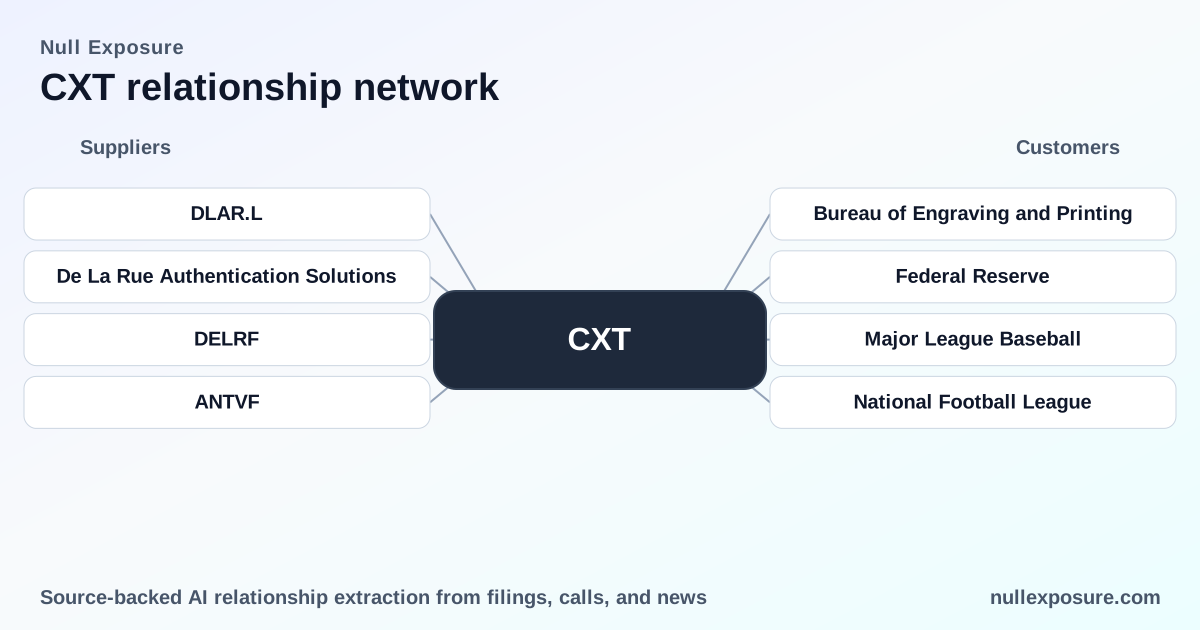
Crane NXT (CXT): Customer Relationships Are the Core of a Security-Driven Revenue Engine
Crane NXT operates a diversified security and payments business that monetizes through the sale of hardware, integrated software, and recurring authentication services to both commercial brands and government entities. Its go-to-market mixes point-in-time product sales with higher-margin services and multiyear brand-protection contracts, producing visible backlog and identifiable counterparty concentration that drive near-term cash flows and medium-term revenue stability. For investors focused on customer quality and contractual posture, the next sections distill what management disclosed on recent calls and the company-level constraints that shape credit and growth outcomes. For a deeper look at counterparty exposures, visit NullExposure.
How Crane NXT’s customer relationships convert into durable revenue
Crane NXT’s business blends three monetization levers: transactional hardware sales, software that is integral to deployed solutions, and services (authentication, brand protection, digital enforcement). Management commentary and company disclosures show a mix of short payment cycles for standard shipments (30–90 days) alongside multiyear and government contracts that generate revenue recognized over time when control transfers continuously. That combination creates both near-term working capital sensitivity and multi-year revenue visibility from backlog and renewed contracts.
- Revenue composition: The Security and Authentication Technologies segment supports sales to governments and large commercial brands; the company disclosed approximately $208 million recognized over time in 2024 for customized or government-delivered products.
- Backlog and spend scale: Backlog stood at about $394.1 million as of December 31, 2024, a signal of contract visibility and a driver of the reported $1.66 billion in trailing revenue.
- Contracting posture: Most product contracts are short-term in nature, with payment and commission mechanics consistent with goods sold at a point in time, but the business also carries longer-term contracts where customization or continuous delivery requires revenue recognition over time.
For an analyst-level breakdown of counterparty exposures and implications for credit and growth, see NullExposure.
What management disclosed about named customers
Bureau of Engraving and Printing — strategic design work on U.S. currency
Management announced progress on a project with the Bureau of Engraving and Printing to design the new $50 bill scheduled for release in 2028; this validates Crane NXT’s role in high-security currency features and positions the company for multiyear deliverables tied to national currency programs — Q3 2025 earnings call.
Federal Reserve — higher print orders incorporating Crane NXT security features
Management reported that the Federal Reserve’s 2026 print order included a significant increase in demand for higher denomination banknotes that incorporate Crane NXT’s advanced security features, which implies near-term volume uplift in the U.S. currency business — Q3 2025 earnings call.
Major League Baseball — new multiyear agreement for consumer-product security
In Q4 2025 Crane NXT signed a multiyear agreement with Major League Baseball to supply security technologies for MLB-branded consumer products, extending the company’s commercial roster of marquee rights-holders and adding recurring service opportunities tied to product authentication — Q4 2025 earnings call.
National Football League — renewed multiyear contract for authentication and online protection
Crane NXT renewed a multiyear contract with the National Football League to provide physical product authentication and online brand protection services, reinforcing a pattern of enterprise renewals with major sports licensors and a stream of recurring service revenue — Q4 2025 earnings call (also reported in Q4 2025 call transcript coverage).
Constraints and what they signal about operating risk and opportunity
The company-level constraints extracted from filings and commentary provide a compact picture of how customer relationships translate into operational and financial behavior:
- Contract length mix: The company operates primarily with short-term commercial contracts (30–90 day payment terms) while also carrying some long-term, over-time recognized contracts—the latter primarily where products are customized or sold directly to government entities. This mix produces both quick cash conversion cycles on commodity sales and longer revenue recognition profiles on government/custom work.
- Government counterparty exposure: Government customers are material and strategic, with explicit programs for currency and authentication. Government work drives higher technical complexity and stronger revenue visibility but also subjects Crane NXT to procurement timing and budget cycles.
- Global footprint with North American concentration: Roughly 48% of net sales originate outside the U.S., but North America remains a large single region with historical concentration; this supports both diversification and regional macro sensitivity.
- Material customer concentration: The Security and Authentication Technologies segment contained at least one individually significant customer with >$200 million in annual net sales over recent years, underlining concentration risk even as marquee relationships enhance revenue quality.
- Segment diversity: The business straddles hardware (devices/electronics), software (integral software licenses), and services (authentication and digital protection)—this breadth dampens single-segment cyclicality but requires cross-disciplinary execution.
- Spend band and backlog signal: The reported backlog (~$394.1 million) and the presence of large government and sports-licensing customers imply large-ticket contracts ($100m+ spend band) are part of current deal flow, giving medium-term revenue visibility.
These constraints collectively frame Crane NXT as a security-technology provider with balanced near-term cash generation and medium-term contractual stability, offset by concentration and procurement timing risks.
Operational and investment implications
- Revenue visibility and margin leverage: Multiyear league contracts and government currency work create recurring service streams and product volumes that support gross margin and operating margin expansion when backlog converts to revenue. Management reported operating margin around 18.4% TTM, supporting the company’s mid-cycle profitability profile.
- Working capital sensitivity: With many product sales settled within 30–90 days, the business remains sensitive to invoice timing and inventory turns; the mix of short-term contracts and longer over-time projects increases complexity for cash forecasting.
- Concentration and procurement risk: Material customers and government procurement cycles expose the company to concentrated counterparty risk; renewals (NFL, MLB) reduce turnover risk but do not eliminate reliance on a handful of large buyers.
- Valuation context: Market capitalization sits around $2.56 billion with trailing revenue of roughly $1.66 billion, a trailing P/E near 17.8 and EV/EBITDA around 10.2, reflecting a premium for recurring, mission-critical security capabilities.
Bottom line for investors and operators
Crane NXT’s disclosed customer relationships—especially government currency programs and multiyear sports-licensing contracts—constitute strategic, revenue-driving assets that elevate visibility and margin potential. The business model blends short-term product economics with longer-term service contracts, producing both cash-generation and backlog-supported growth. Key risks for investors remain customer concentration, procurement timing, and working-capital management, all of which are explicit in company commentary and filings.
For an investor-grade counterparty and customer exposure analysis tailored to portfolio allocation or credit diligence, visit NullExposure for deeper signals and scenario modeling.