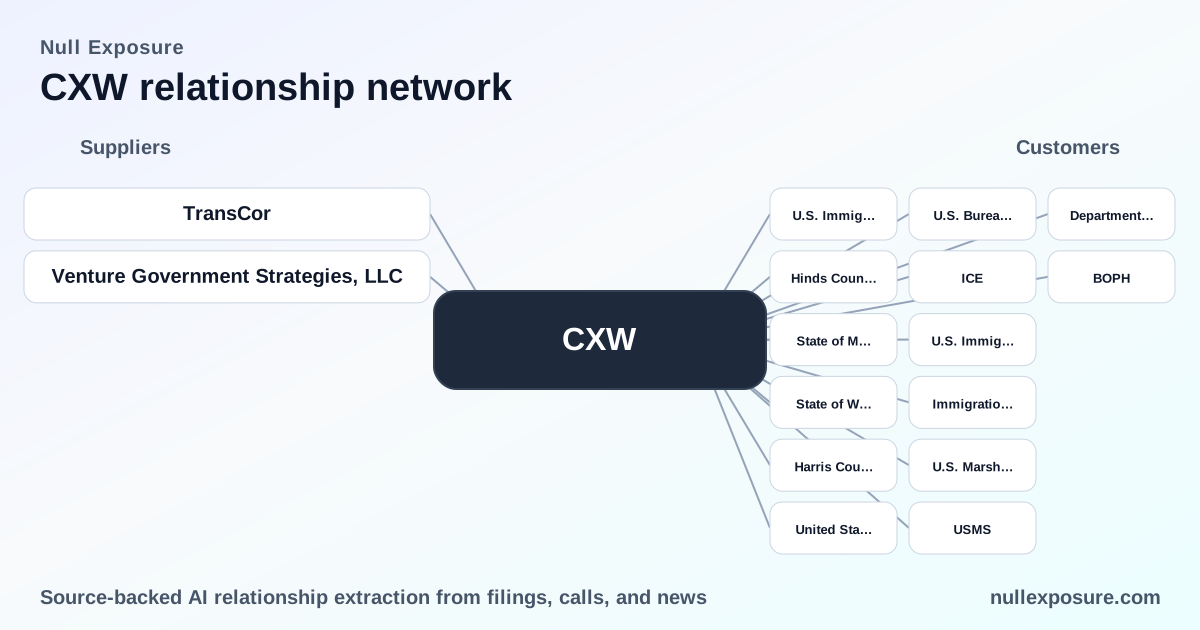
CoreCivic (CXW) — Customer Map and What It Means for Investors
CoreCivic owns and operates correctional, detention and residential reentry facilities and monetizes those assets through a mix of long‑term leases, shorter facility management contracts, and usage‑based per‑diem payments from federal, state and local government clients. Federal customers account for the majority of revenue, with ICE, the U.S. Marshals Service and the Bureau of Prisons driving scale; that concentration shapes cash flow stability, political exposure and capital allocation decisions. For a focused view of counterparties and operational constraints, see more at https://nullexposure.com/.
Why the counterparty roster matters to valuation
CoreCivic’s business converts real estate and operating capacity into predictable government cash flow. When leases are long and guaranteed, balance sheet leverage carries less execution risk; when revenue is per‑diem and occupancy‑sensitive, margins track utilization and government demand. The company historically benefits from scale in federal detention markets, but that same concentration creates policy and counterparty risk that can swing revenue materially quarter-to-quarter.
Contracting posture and revenue mechanics, in plain English
CoreCivic combines a portfolio of long-term property leases (often 5–20 years or longer) with management contracts that commonly run 1–5 years and numerous renewal options. A sizeable portion of Safety and Community revenue is paid on a per‑diem basis tied to actual or guaranteed occupancy, so revenue is both asset‑backed and utilization‑sensitive. These characteristics produce a mix of maturity and variability: real estate cash flows anchor credit metrics while per‑diem contracts drive earnings volatility.
Federal customer dynamics: concentration, recent wins and offsets
Federal agencies drive the business. According to CoreCivic’s filings for the year ended December 31, 2024, ICE, USMS and the BOP together accounted for roughly 51% of total revenue, with ICE representing a large single share. In 2025‑2026 public reports and earnings commentary show a material ramp from ICE contracts, while USMS populations declined and BOP remained a much smaller contributor by percentage. Key published accounts include CoreCivic’s FY2024 10‑K and multiple media reports in late 2025 and early 2026 documenting new ICE contract awards and facility activations (see relationship run‑through below).
Local and state engagements still part of the playbook
CoreCivic continues to secure local and state management contracts that top up federal volumes and activate idled beds. Recent examples include county contracts to house pre‑trial detainees and state‑level IGSA style agreements that augment utilization at specific facilities. These agreements are typically shorter than property leases but expand operating leverage when federal demand softens.
Company‑level constraints that shape investable risk and return
- Contract horizon mix: The business is anchored by long leases and interspersed short‑term management contracts; this combination supports sustained rental cash flow while leaving EBITDA exposed to occupancy shifts.
- Revenue concentration: Federal customers are material; in 2024 federal agencies produced about half of revenue and ICE, USMS, and BOP together generated approximately $1.0 billion for the year (CoreCivic FY2024 10‑K).
- Payment structure: A meaningful share of revenue is usage‑based (per‑diem), creating direct sensitivity of revenue to population dynamics and policy.
- Geographic focus: CoreCivic is predominantly U.S.‑centric and benefits from scale in domestic federal detention markets.
- Spend bands: Large federal relationships exceed $100 million annually in aggregate, making client retention central to earnings stability.
If you want an enterprise perspective built from primary filings and market intelligence, visit our research hub at https://nullexposure.com/ for details and source tracing.
Relationship run‑through — every counterparty flagged in public records
Below are the counterparties identified in CoreCivic’s filings and press coverage, with a concise, plain‑English summary and the source.
Hinds County, Mississippi
CoreCivic signed a management contract announced September 25, 2023 to house up to 250 adult male pre‑trial detainees at the Tallahatchie County Correctional Facility. (Source: CoreCivic Form 10‑K, FY2024)
State of Montana
On November 14, 2023 CoreCivic executed a management agreement to care for up to 120 inmates at the Saguaro Correctional Facility in Eloy, Arizona. (Source: CoreCivic Form 10‑K, FY2024)
State of Wyoming
CoreCivic announced on November 16, 2023 that Wyoming contracted to place up to 240 male inmates at the Tallahatchie facility under a management arrangement. (Source: CoreCivic Form 10‑K, FY2024)
Harris County, Texas
Also announced November 16, 2023, Harris County contracted CoreCivic to care for up to 360 male inmates at Tallahatchie, underscoring county‑level demand for out‑of‑jurisdiction bed capacity. (Source: CoreCivic Form 10‑K, FY2024)
United States Marshals Service (USMS / U.S. Marshals Service)
The USMS is a long‑standing federal customer and accounted for 21% of CoreCivic’s revenue in 2024 (approximately $406.4 million); company filings and earnings commentary note recent declines in USMS populations that partially offset gains from ICE. (Source: CoreCivic Form 10‑K, FY2024; Q4 2025 earnings commentary reported in financial press, Mar 2026)
U.S. Bureau of Prisons (BOP / BOPH)
BOP generated a small but consistent share of revenue — about 2% of total revenue ($30.7 million) in 2024, per CoreCivic reporting. (Source: CoreCivic Form 10‑K, FY2024)
U.S. Immigration and Customs Enforcement (ICE / Immigration and Customs Enforcement)
ICE is CoreCivic’s largest historical customer and the primary driver of recent revenue expansion: company disclosures and multiple media outlets document new ICE contracts, facility activations and a substantial year‑over‑year lift in ICE revenue (Q3 2025–Q4 2025 reporting), with press estimates ranging from hundreds of millions in new contract value to ICE contributing ~35% of 2025 federal revenue. (Sources: CoreCivic Form 10‑K FY2024; Times of San Diego Oct 2025; TradingView, QuiverQuant, Finviz and Q4 2025 earnings coverage, Mar 2026)
TransCoR / TransCor America, LLC
TransCor is CoreCivic’s transportation subsidiary and provides prisoner transport services to government agencies; it is included in the CoreCivic Safety segment and supports logistics for federal and state customers. (Source: CoreCivic Form 10‑K FY2024; TradingView coverage)
Department of Homeland Security (DHS)
Public reporting highlights DHS policy choices that permitted ICE (an agency of DHS) to continue outsourcing detention, even as DOJ’s BOP faced restrictions — a policy environment that benefits CoreCivic’s ICE exposure. (Source: Salon reporting, Jan 28, 2026; broader media coverage)
Bottom line for investors
- CoreCivic’s revenue is asset‑backed but politically sensitive: long leases provide downside protection for real estate cash flow, while per‑diem contracts create earnings leverage to government demand.
- Federal concentration is a structural advantage and a headline risk — ICE-driven growth materially improved top‑line momentum in 2025, but client mix shifts (USMS declines, any ICE contract changes) directly move earnings.
- Monitor three vectors: ICE contract awards and utilization; USMS population trends; and local/state management wins that fill idled capacity.
For an integrated dataset and primary‑source traces that underlie this summary, see our research portal at https://nullexposure.com/.