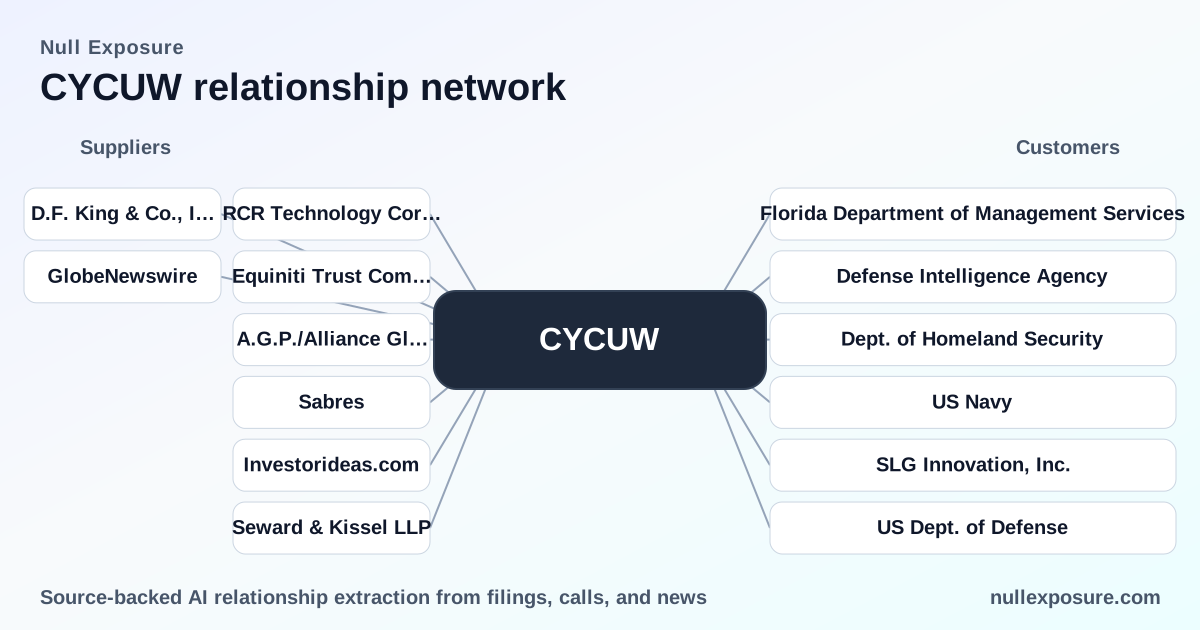
Cycurion (CYCUW) — Customer Relationships that Drive Revenue Concentration and Contracted Backlog
Cycurion provides cybersecurity and network communications solutions to a predominantly government client base and monetizes through a mix of multi-year services contracts, task-order frameworks, and subscription-style managed services tied to its Cycurion Security Platform. Revenue is concentrated into a small number of high-value government and enterprise customers, with a material contracted backlog and recurring services economics. For a compact view of the company’s customer intelligence and relationship mapping, visit https://nullexposure.com/.
Investment thesis in one paragraph
Cycurion sells a combination of professional services and SaaS security tools into federal, state and large enterprise buyers, capturing value through multi-year contracts and task-order driven master service agreements that produce outsized revenue concentration. The commercial model is skewed to services delivery (program management, cybersecurity, disaster recovery) backed by a SaaS security product, producing a backlog-driven revenue profile and elevated counterparty concentration that directly influences cash flow visibility and enterprise risk.
How Cycurion contracts, collects, and where concentration matters
Cycurion operates primarily as a government contractor and managed security services provider. The company executes framework MSAs and long-term multi-year awards that are task-order driven, which creates predictable billing cadence but also binds growth to a handful of large contracts. Company-level signals indicate:
- Contracting posture: Framework and task-order models dominate; the firm disclosed Master Services Agreement activity and multi-year awards that underpin backlog and revenue recognition.
- Customer mix and concentration: Federal government clients drive the majority of revenue; one large customer represented approximately 83% of revenue in 2024 and accounts receivable concentration exceeded 85% at year-end — a critical fiscal exposure.
- Service/software mix: Revenue is delivered as services-first with a complementary SaaS security offering, producing both project and recurring revenue streams.
- Geography and go-to-market: Primary activity is North America with stated intent to pursue international opportunities. These characteristics create high revenue visibility from backlog and contract terms but elevated counterparty concentration risk.
Customers and partners that appear in public reporting
Below are every customer relationship identified in the available reporting, each summarized plainly with source attribution.
-
US Navy — Cycurion lists the US Navy among its federal clients and partners, reflecting defense contracting relationships that feed the company’s government services revenue stream (source: FinancialContent press release, Jan 23, 2026).
-
US Department of Defense — The Department of Defense is named as a client, positioning Cycurion within core federal defense spending categories that typically support multi-year cybersecurity work (source: FinancialContent press release, Jan 23, 2026).
-
Defense Intelligence Agency — Cycurion cites the Defense Intelligence Agency among its customers, anchoring its footprint in sensitive defense contracting and classified-support services (source: FinancialContent press release, Jan 23, 2026).
-
Department of Homeland Security — The Department of Homeland Security appears as a customer, adding continuity to the company’s Homeland Security and civilian agency service lanes (source: FinancialContent press release, Jan 23, 2026).
-
Florida Department of Management Services — Cycurion reports an award of a statewide management consulting services term contract by the Florida Department of Management Services, demonstrating state-level public-sector penetration beyond federal accounts (source: FinancialContent press release, Jan 23, 2026).
-
SLG Innovation, Inc. — SLG Innovation is both a customer and an entity linked to Cycurion through a variable interest entity structure; Cycurion disclosed a new data modernization contract for SLG and material revenue flows tied to SLG, which the company controls through the VIE arrangement (sources: FinancialContent press release, Jan 23, 2026; Wedbush/Dec 30, 2025; company disclosure Dec 30, 2025).
What the relationships imply about Cycurion’s operating model
-
Critical government dependency. The company explicitly derives substantially all revenue from federal clients in recent years; federal contracts drive both top-line scale and timing of collections. This creates high revenue concentration and elevated counterparty risk when single customers account for the majority of revenue and receivables. Evidence indicates a very small number of end-customers accounted for roughly 90% of revenue in recent years (company reporting, FY2024 and FY2023).
-
Framework and task-order delivery are the backbone. The presence of MSAs and task-order driven engagements means growth and utilization depend on winning discrete task orders under existing frameworks — a model that produces steady backlog but requires ongoing proposal and capture investment.
-
Service-led with software tailwinds. The business sells managed services and professional cybersecurity engagements while cross-selling its Cycurion Security Platform (MDP SaaS), which introduces recurring revenue potential and improves lifetime value when adoption scales.
-
Multi-tier counterparty profile. While government clients dominate, the company signals capabilities to serve large enterprises, mid-market and small businesses, indicating a diversified go-to-market strategy if federal concentration declines over time.
Risk profile and valuation levers investors should track
-
Revenue concentration risk is immediate and quantifiable. A single customer accounted for 83% of 2024 revenue and a single accounts receivable item represented 87% at year-end; any adverse change in procurement posture or payment cadence at that counterparty materially affects cash flow and working capital needs (company filings, FY2024).
-
Backlog versus convertibility. Cycurion reports an $80 million contracted backlog, which supports near-term revenue forecasts, but conversion depends on task-order awards and program funding cycles — track awarded task orders and pipeline closure rates for cadence confirmation (corporate releases, Dec 2025–Jan 2026).
-
Contract duration and renewal dynamics. Multi-year awards and MSAs provide durability; however, renewal loss or non-renewal of a few large contracts would disproportionately impact revenue. Monitor announced renewals, new multi-year award wins, and state/federal procurement schedules.
-
Credit and receivables concentration. High accounts receivable concentration adds financing risk; investors should monitor days-sales-outstanding, collections trends, and any use of receivable financing that could affect margins.
Practical takeaways for operators and investors
- Ops focus should be on diversifying top customers and expanding platform SaaS adoption inside existing large accounts to convert concentrated services revenue into multi-year recurring streams.
- Business development must prioritize incremental task-order wins under existing MSAs while pushing for blanket purchase agreements or broader enterprise-level commitments to reduce single-customer dependency.
- Financial diligence should emphasize receivable concentration and backlog convertibility as primary drivers of near-term liquidity and valuation.
For an integrated look at customer-level signals and contract footprints, explore the full intelligence available at https://nullexposure.com/.
Bottom line
Cycurion operates a high-leverage government-focused cybersecurity services business with a nascent SaaS product, characterized by strong contracted backlog but critical customer concentration. That profile creates both clear upside from backlog conversion and pronounced downside from customer or procurement shifts — a binary risk/return setup that demands active monitoring of task-order awards, receivable health, and the pace at which platform revenue displaces one-off services work.