Cyngn’s customer map: enterprise deployments, recurring contracts, and what investors should price in
Cyngn develops autonomy software (Enterprise Autonomy Service, or EAS) and packages that software into commercial solutions branded DriveMod — sold as a mix of SaaS subscriptions, licensed software, professional services, and hardware-integrated offerings for industrial tuggers and forklifts. The company monetizes through multi-year subscription contracts, licensing fees, NRE and integration services, and equipment sales through OEM and dealer channels; early commercial wins in food & beverage, agriculture and manufacturing are the primary evidence of revenue traction. For a concise view of Cyngn’s customer signals and public relationship evidence, see https://nullexposure.com/.
Why the customer roster matters now
Cyngn’s value proposition to customers is operational: reduce routine forklift and tugger labor, reallocate workers to higher-value tasks, and deploy autonomy without major facility overhaul. That positioning drives a sales mix where recurring subscription revenue and multi-vehicle purchase orders are as important as one-time hardware or integration fees. Investors should evaluate two axes: the scale and concentration of enterprise accounts, and the contractual posture (subscription vs. licensing vs. one-off sales) that will determine revenue predictability.
For deeper context on Cyngn customer signals, visit https://nullexposure.com/.
How Cyngn contracts and where risk clusters
The company’s public disclosures and press coverage together frame a hybrid commercial model with the following company-level characteristics:
- Contracting posture: Cyngn sells long-duration SaaS-style subscriptions for EAS (one to five years) while also licensing software for production release; it complements recurring contracts with NRE professional services and hardware sales. This mix creates a balance of predictable recurring revenue and lumpy project income.
- Concentration and counterparty profile: Public statements identify Global 500 and Fortune 100-level customers, signaling enterprise-level counterparty concentration rather than a pure SMB base.
- Criticality to operations: Deployments are targeted at routine material movement — a discrete but mission-critical use case that supports measurable labor and efficiency ROI for customers.
- Maturity: The DriveMod MT160 Tugger was commercially released in 2024 and Cyngn began commercial licensing of EAS in 2023; the company is in an early commercial stage with active customer rollouts and pilot conversions.
These signals come from Cyngn’s FY2024 Form 10‑K and a sequence of 2025–2026 press releases and news reports describing deployments and purchase orders.
Customer relationships and what each one implies
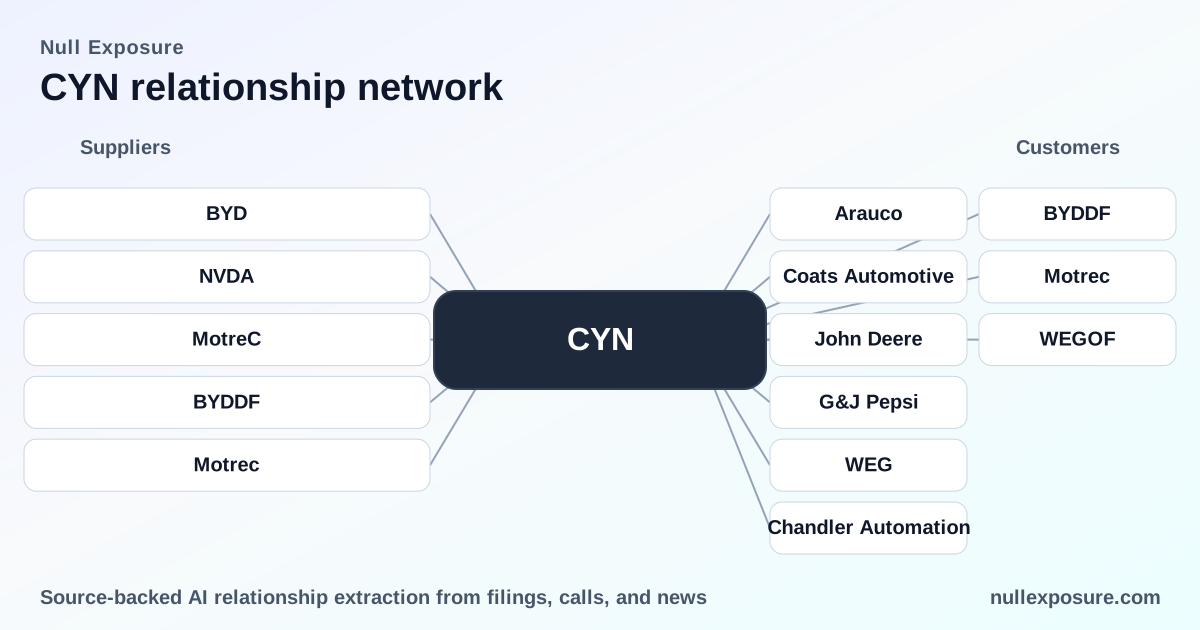
John Deere
Cyngn lists John Deere among its named commercial deployments at the end of 2024, indicating enterprise-level validation in agriculture and equipment OEM contexts; that inclusion supports Cyngn’s claim of Global 500 customer traction. (Source: Cyngn FY2024 Form 10‑K)
Coats Automotive
Coats Automotive is cited alongside other named accounts in Cyngn’s FY2024 disclosure, reflecting engagement with large industrial customers in vehicle or material-handling environments. (Source: Cyngn FY2024 Form 10‑K)
USC
Cyngn’s FY2024 filing names USC as a commercial deployment, signaling university or institutional pilot programs and another reference point for multi-sector interest. (Source: Cyngn FY2024 Form 10‑K)
Arauco
Cyngn states it secured paid projects with Arauco, and later press coverage ties Arauco to a pre-order of 100 autonomous forklifts, which demonstrates both order intent and scale in large industrial logistics. (Source: Cyngn FY2024 Form 10‑K; coverage at GTC/InvestingNews, 2026)
WEG (WEG Electric Motor Facility / WEGOF references)
Cyngn announced a commercial contract to deploy its DriveMod Tugger at a WEG manufacturing facility in Bluffton, Indiana, a deployment framed as contributing to efficiency and labor reallocation at a major industrial site. Multiple press releases and news outlets carried the March 2026 announcement. (Source: PR Newswire and related March 2026 coverage)
G&J Pepsi
Cyngn publicly reported a multi-vehicle purchase order and expansion of its DriveMod Tugger program with G&J Pepsi, the largest independent Pepsi bottler in the U.S.; repeated press reports in March 2026 cite order growth and program expansion in food & beverage. (Source: Finviz, Marketscreener, AsianetNews, March 2026)
Chandler Automation
Chandler Automation joined Cyngn’s dealer network to offer DriveMod Tugger solutions to food processors and packers in agriculture, signaling channel-based distribution and go-to-market scale via third-party dealers. (Source: Sahm Capital press release, December 23, 2025)
Vann Family Orchards
Cyngn deployed four DriveMod Tuggers at Vann Family Orchards, a large-scale agricultural processor in northern California, which illustrates traction in specialty processing and seasonal agricultural throughput environments. (Source: PR Newswire and Sahm Capital coverage, March 2026)
Motrec
Industry press and company releases note that the DriveMod platform currently powers Motrec MT-160 Tuggers, underscoring a vehicle-level OEM integration that enables broader hardware availability for customers. (Source: Globe and Mail press release coverage, March 2026)
BYD / BYDDF
Press coverage references BYD forklifts as part of DriveMod-capable platforms, with BYD/BYDDF named in March 2026 releases; this indicates Cyngn’s software is being positioned to integrate with multiple OEM chassis beyond Motrec. (Source: Globe and Mail / press release coverage, March 2026)
What the relationship map means for revenue quality and growth
- Recurring revenue potential is real: public language about SaaS subscriptions and one-to-five year contract terms implies growing revenue predictability as pilots convert and multi-vehicle orders expand.
- Channel and OEM partnerships de-risk scale: dealer relationships (Chandler Automation) and OEM integrations (Motrec, BYD) reduce the need for direct hardware distribution and support quicker geographic and vertical scaling.
- Concentration risk is present but strategic: wins with Global 500 and Fortune 100 accounts validate product-market fit for enterprise operations, yet reliance on several large customers and a handful of major deployment types creates downside exposure if orders slow.
Investment implications and key risks
Investors should price Cyngn as an early commercial autonomy software company with evidence of enterprise adoption but significant execution and scale risk. Key points:
- Upside drivers: conversion of pilots to subscriptions, multi-vehicle expansions (G&J Pepsi, Vann Family Orchards), and OEM/dealer scaling can materially expand recurring revenue.
- Downside risks: lumpy hardware orders, limited current revenue base and negative operating margins create sensitivity to capital markets and working capital; concentration among large customers increases revenue volatility.
- Operational cadence: Cyngn’s mix of licensing, subscription and professional services produces both recurring and one-time revenue flows, so investors must monitor renewal rates, average contract length, and the cadence of multi-vehicle orders.
Cyngn’s public filings and a string of 2025–2026 press announcements document the transition from pilot to active enterprise deployments; investors should track quarterly disclosures for customer counts, ARR-like metrics, and the split between subscription vs. hardware/integration revenue to assess whether early momentum converts into predictable growth.
For a consolidated view of customer signals and to monitor updates, visit https://nullexposure.com/.