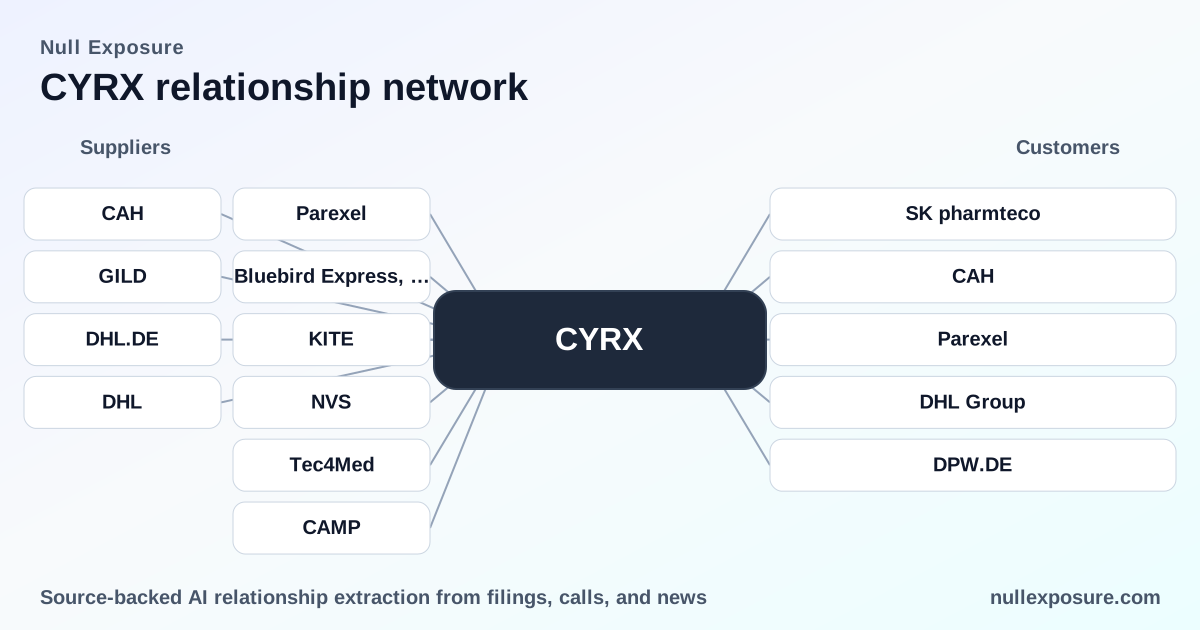
Cryoport (CYRX) — Customer Relationships and Commercial Footprint
Cryoport operates a vertically integrated, temperature-controlled logistics and cryogenic systems business serving the cell and gene therapy ecosystem and broader life‑sciences market. The company monetizes through recurring service contracts for Cryoport Express® shippers and temperature-controlled logistics, one‑time and recurring product sales of cryogenic hardware, and strategic partnerships that embed Cryoport’s supply‑chain solutions into third‑party offerings. Investors should value Cryoport as a mission‑critical service provider with a global footprint, modest customer concentration, and revenue streams weighted toward services and recurring logistics fees.
Learn more about our coverage at Null Exposure.
How Cryoport makes money and why customers stick
Cryoport’s commercial model combines hardware sales (cryogenic freezers, dewars) with a dominant services franchise: long‑term use agreements for Cryoport Express® shippers and temperature‑controlled logistics and biostorage services. The company’s go‑to‑market mixes direct sales, distributors, and strategic partnerships that embed Cryoport into larger life‑sciences workflows. Cryoport’s client base spans over 3,000 customers globally, and management reports that no single customer contributed more than 10% of revenue in 2024, which reduces counterparty concentration risk while reinforcing the recurring nature of the business.
Operating model constraints and what they imply for investors
- Contracting posture: Cryoport sells Cryoport Express® Shippers under long‑term service agreements, creating predictable recurring revenue for shipping and fleet management rather than one‑off hardware sales. This contract structure favors revenue visibility and customer stickiness.
- Global footprint with regional balance: Revenue disclosure shows meaningful contributions from Americas, EMEA, and APAC, reflecting a geographically diversified revenue base that supports multinational clinical trial logistics and commercial distribution.
- Role mix and go‑to‑market: The company functions as service provider, manufacturer, seller, and distributor, producing cryogenic hardware while operating logistics and biostorage services that it sells directly or via distributors and partners.
- Materiality and criticality: While no customer is revenue‑dominant, Cryoport’s services are described as mission‑critical for clinical trials and cell/gene therapies—this creates high customer dependency and low tolerance for service disruption.
- Maturity and stage: The business shows active, growing clinical trial penetration (701 trials supported as of year‑end 2024, 81 in Phase 3), indicating a mid‑mature, growth‑oriented services platform rather than an early‑stage play.
Collectively these signals support a valuation framework that weights recurring logistics and service margins more heavily than volatile hardware sales and values strategic customer/partner embeds as growth multipliers.
Relationship roll‑call: every customer/partner mention in the record
Below are concise, plain‑English takeaways for each relationship mentioned in the source results, with source citations.
-
CAH — Cryoport announced a strategic collaboration to embed Cryoport Systems into Cardinal Health’s cell and gene therapy offerings as part of broader partnership expansion in the company’s Q4 2025 commentary. This positions Cardinal Health to offer complementary logistics solutions while Cryoport gains distribution reach. Source: InsiderMonkey transcript of Cryoport Q4 2025 earnings call (published Mar 9, 2026) — https://www.insidermonkey.com/blog/cryoport-inc-nasdaqcyrx-q4-2025-earnings-call-transcript-1709603/.
-
Parexel — Cryoport expanded global partnerships by entering a strategic collaboration with Parexel to leverage Cryoport Systems within Parexel’s clinical services for cell and gene therapy customers, increasing Cryoport’s visibility in outsourced clinical supply chains. Source: InsiderMonkey transcript of Cryoport Q4 2025 earnings call (published Mar 9, 2026) — https://www.insidermonkey.com/blog/cryoport-inc-nasdaqcyrx-q4-2025-earnings-call-transcript-1709603/.
-
DHL Group (PR Newswire) — Cryoport completed the divestiture of its specialty courier business CRYOPDP to DHL Group in a transaction that included approximately $200 million in cash to Cryoport, while commencing a strategic supply‑chain partnership with DHL. The deal monetized a specialty asset and converted a competitor unit into a strategic partner for global logistics coverage. Source: PR Newswire press release (FY2025) — https://www.prnewswire.com/news-releases/cryoport-completes-cryopdp-divestiture-and-commences-strategic-partnership-with-dhl-group-302480137.html.
-
Cardinal Health (alternate mention) — Management reiterated that Cardinal Health is leveraging Cryoport Systems in its cell and gene therapy stack, underscoring a bilateral commercial arrangement that embeds Cryoport technology inside a major health‑services distributor’s offering. This strengthens Cryoport’s channel access into large health‑system and biopharma customers. Source: InsiderMonkey transcript of Cryoport Q4 2025 earnings call (published Mar 9, 2026) — https://www.insidermonkey.com/blog/cryoport-inc-nasdaqcyrx-q4-2025-earnings-call-transcript-1709603/.
-
SK pharmteco — Cryoport agreed to support SK pharmteco’s manufacturing of APIs, intermediates, biopharmaceuticals, and cell and gene therapies, indicating Cryoport’s extension into manufacturing‑adjacent logistics and bioservices for a contract development and manufacturing organization (CDMO). This demonstrates increasing integration with upstream manufacturing supply chains. Source: ContractPharma report (FY2024) — https://www.contractpharma.com/breaking-news/sk-pharmteco-cryoport-partner-for-cell-and-gene-therapy-logistics-and-bioservices/.
-
DHL Group (InsiderMonkey mention) — In earnings commentary management described the 2025 strategic partnership with DHL, including the CRYOPDP sale; this second listing emphasizes the transaction’s strategic and fiscal importance to Cryoport’s corporate repositioning. Source: InsiderMonkey transcript of Cryoport Q4 2025 earnings call (published Mar 9, 2026) — https://www.insidermonkey.com/blog/cryoport-inc-nasdaqcyrx-q4-2025-earnings-call-transcript-1709603/.
-
DHL Group (AirCargoNews) — Trade press coverage reported DHL’s acquisition of 100% of CRYOPDP from Cryoport and a supply‑chain service partnership, highlighting the market reception and logistics industry framing of the transaction. This external validation underscores the commercial logic of the divestiture. Source: AirCargoNews (Mar 2025 coverage) — https://www.aircargonews.net/acquisitions/2025/03/dhl-boosts-pharma-logistics-with-cryopdp-acquisition/.
-
DPW.DE — European market references used Cryoport’s disclosure that the DHL Group partnership included DHL’s acquisition of CRYOPDP; DPW.DE is the exchange ticker associated with Deutsche Post DHL in European filings, and the mention reiterates cross‑market reporting of the same strategic transaction. Source: InsiderMonkey transcript of Cryoport Q4 2025 earnings call (published Mar 9, 2026) — https://www.insidermonkey.com/blog/cryoport-inc-nasdaqcyrx-q4-2025-earnings-call-transcript-1709603/.
What these relationships mean for revenue, risk and growth
- Revenue diversification and channel scale: Partnerships with Cardinal Health and Parexel embed Cryoport within large commercial and clinical services channels, accelerating adoption without Cryoport needing to originate every client relationship.
- Strategic capital realization: The CRYOPDP sale to DHL delivered near‑term cash and converted an operational arm into an externalized partner, improving Cryoport’s capital flexibility while preserving logistics reach. PR Newswire and trade coverage confirm the material cash inflow from that transaction.
- Upstream integration: The SK pharmteco association signals forward integration into CDMO logistics and bioservices, broadening addressable market beyond end‑customer shipping to manufacturing logistics and support.
- Low counterparty concentration, high criticality: With no customer exceeding 10% of revenue but services classed as mission‑critical, Cryoport’s revenue base is insulated from single‑client shocks while operational uptime remains essential for customers.
Risks investors should weigh
- Execution risk on partner integration: Converting partnerships into sustainable, high‑margin revenue requires operational harmonization and commercial alignment with large partners like DHL and Cardinal Health.
- Capital allocation profile: The CRYOPDP divestiture materially changed Cryoport’s asset mix and cash profile; investors must watch how proceeds are deployed (debt reduction, capex, tuck‑ins).
- Competitive and regulatory pressures: The cell and gene therapy logistics market is fast evolving; Cryoport’s advantage depends on scaling global operations and regulatory compliance across jurisdictions.
Conclusion and next steps
Cryoport’s customer and partner relationships show a deliberate shift from captive courier operations toward strategic partnerships and embedded logistics solutions that prioritize recurring, long‑term service revenue. The business now presents a lower concentration, higher‑stickiness revenue base paired with improved capital flexibility after the CRYOPDP divestiture. For investors evaluating growth versus execution risk, monitor partner revenue conversion metrics, Cryoport’s use of divestiture proceeds, and clinical‑trial volume growth. Explore our broader coverage and company briefs at Null Exposure.