Citizens Financial Services (CZFS): What the customer list tells investors about the bank’s consumer-finance push
Citizens Financial Services (CZFS) operates as a regional bank and bank holding company that earns net interest margin on a loan portfolio heavily weighted toward real estate, generates fee income from deposit and trust services, and increasingly monetizes point-of-sale consumer financing through branded partnerships (Citizens Pay). The company leverages its balance-sheet lending capabilities to provide both longer-term, fixed-rate residential and commercial loans and shorter-term retail financing products integrated at large merchants — a dual posture that creates both steady spread income and higher-growth fee opportunities. Learn more about our coverage at https://nullexposure.com/.
Why the partner roster matters to the investment case
Citizens’ public partner mentions highlight a strategic move to embed financing at the point of sale. Partnerships with consumer retailers and large technology platforms expand origination channels without costly branch expansion, shifting some incremental volume into unsecured or near-secured retail credits that carry different risk and margin profiles than traditional CRE and mortgage lending. For investors, that mix affects credit concentration, deposit stickiness, and fee diversification.
The retail and tech partners — where Citizens leverages consumer finance
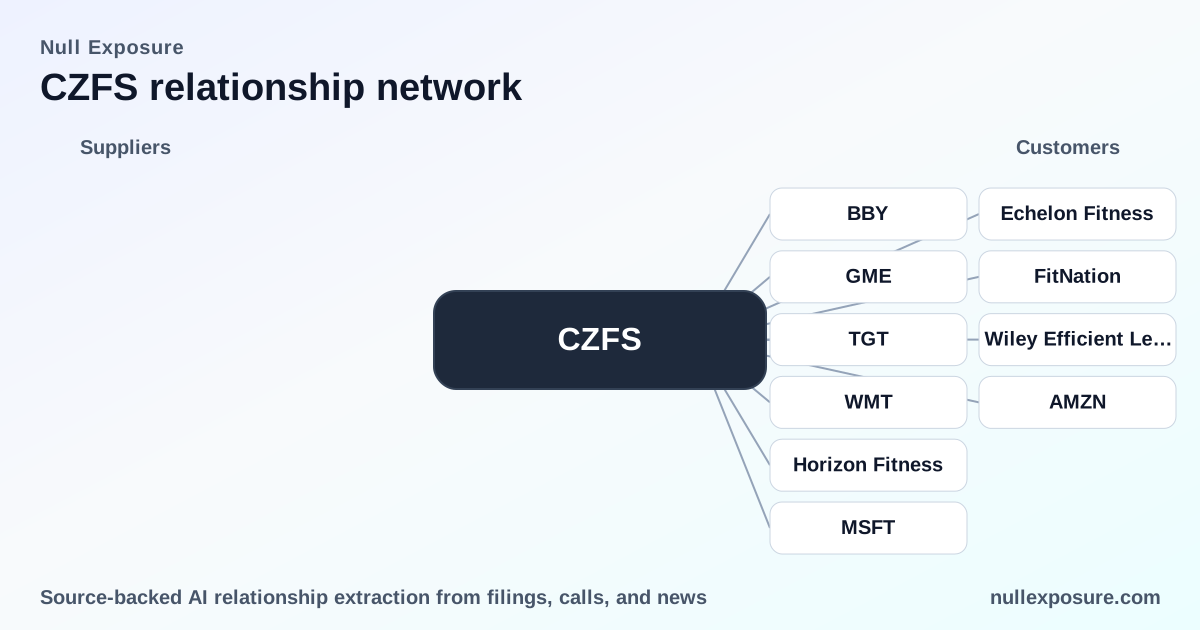
- Best Buy — Citizens financed purchases of Microsoft’s Xbox All Access at brick-and-mortar retailers including Best Buy under its Citizens Pay program, showing Citizens’ use of retail channels to distribute consumer finance products. Source: IBS Intelligence coverage of Citizens’ Citizens Pay launch (March 2026, FY2021 context).
- GameStop — GameStop was listed among retailers selling Xbox All Access using integrated Citizens financing, indicating Citizens’ distribution into specialty electronics channels. Source: IBS Intelligence (March 2026, FY2021 context).
- Target — Target is named as a participating retailer for the integrated Xbox All Access financing via Citizens, signaling scale distribution opportunities through large-format national retailers. Source: IBS Intelligence (March 2026, FY2021 context).
- WalMart — WalMart is cited as a retailer where Citizens integrated financing for Microsoft’s consumer offering, demonstrating reach into mass-market retail. Source: IBS Intelligence (March 2026, FY2021 context).
- WMT — A separate mention of WMT reiterates Citizens’ presence at Walmart channels for Microsoft Xbox financing and confirms multiple source references to the same mass retail relationship. Source: IBS Intelligence (March 2026, FY2021 context).
- Microsoft — Citizens provided consumer finance for Microsoft’s Xbox All Access program for customers buying through major retailers and online channels, reflecting a strategic fintech partnership to underwrite bundled hardware-subscription sales. Source: Euromoney reporting on Citizens’ Microsoft package (FY2019).
- MSFT — An additional reference to MSFT in the Euromoney piece reiterates Citizens’ role in Microsoft’s consumer-finance package and the program’s delivery through platforms such as Amazon. Source: Euromoney (FY2019).
- Amazon — Euromoney reported that Citizens’ Microsoft financing package was delivered to customers buying through Amazon, indicating Citizens’ use of e-commerce platforms as a distribution node for branded finance offers. Source: Euromoney (FY2019).
Fitness, education and contractors — diversification within Citizens Pay
- Echelon Fitness — Citizens Pay expanded into health-and-fitness retailers, including Echelon Fitness, showing the product’s application beyond electronics to higher-ticket consumer fitness equipment. Source: IBS Intelligence (March 2026, FY2021 context).
- Horizon Fitness — Horizon Fitness, a Johnson Health Tech subsidiary, is listed among retailers adopting Citizens Pay financing options, suggesting partnerships with established fitness manufacturers and their retail channels. Source: IBS Intelligence (March 2026, FY2021 context).
- FitNation — FitNation, an Echelon subsidiary, is also cited, indicating Citizens’ outreach to vertically integrated manufacturers/retailers in the fitness category. Source: IBS Intelligence (March 2026, FY2021 context).
- Wiley Efficient Learning — Citizens Pay extended into educational products and services via a partnership with Wiley Efficient Learning, showing the financing product is being positioned for professional-education purchases as well as durable goods. Source: IBS Intelligence (March 2026, FY2021 context).
How these relationships fit into CZFS’s business model
Citizens blends traditional banking with targeted consumer-finance distribution. Retail and platform partnerships represent a scalable origination channel that generates fee income and interest spread while keeping origination costs lower than branch-based growth. The arrangement also exposes the bank to different credit and operational risks (point-of-sale underwriting, merchant integration, and platform settlement flows) than its core mortgage and CRE lending.
What the company-level constraints tell investors about operational risk and concentration
The filings and excerpts produce a clear set of operating constraints that shape CZFS’s customer-facing business:
- Contracting posture is mixed: Citizens operates both long-term and short-term contracts. The bank offers long-term fixed-rate residential and multi-year CRE loans, often hedged with derivatives, while also running short-term instruments such as interest rate locks (IRLCs) and deposit fee arrangements that can be canceled. This combination creates steady duration in assets alongside high-turnover retail financing flows. (Company filing references as of Dec 31, 2024.)
- Counterparty mix is concentrated on individuals and local governments. Individuals dominate loan counts and balances, while municipal/state relationships are material in the portfolio; small-business distribution exists via SBA-guaranteed programs. This mix anchors deposit and loan activity to regional economic cycles. (Company disclosures, FY2024 data.)
- Geographic concentration is regional and domestic. Operations and loan origination focus on north-central/central/south-central Pennsylvania, southern New York, Wilmington/Dover Delaware and pockets of New Jersey — a geographically concentrated footprint that heightens sensitivity to local economic trends. (Company filings.)
- Materiality and criticality skew toward CRE and deposits. The bank discloses significant CRE exposure relative to capital and that a limited set of loan relationships account for a disproportionate share of non-performing loans; customer deposits are the primary funding source and are described as critical. These are key concentration risks for investors. (Company disclosures.)
- Relationships are primarily active, service-oriented and mature. Citizens operates as a full-service retail and commercial bank with trust and wealth services, plus an active branch and mortgage center network. The bank’s role is predominately service provider rather than passive creditor, which implies ongoing operational and compliance obligations. (Company filing, branch counts as of Dec 31, 2024.)
- Spend bands suggest the bank manages mid-to-large commercial exposures. Internal review thresholds call out portfolios and relationships over $500k-$1m for enhanced oversight, signaling material individual exposures within a regional franchise.
Explore in-depth relationship analytics at https://nullexposure.com/.
Investment takeaways and what to monitor
- Positive: Citizens is diversifying origination channels via Citizens Pay, which can lower marginal customer acquisition cost and add higher-yield retail originations. Retail, platform, and manufacturer partnerships extend the bank’s reach beyond its branch footprint.
- Risk: The bank’s balance sheet still carries concentrated CRE risk and regional economic exposure, and merchant-finance growth brings distinct underwriting and operations risk. Investors should monitor non-performing loan trends, CRE concentration ratios, and how Citizens underwrites and provisions for point-of-sale loans.
- Catalysts to watch: growth of Citizens Pay partnerships, quarter-to-quarter loan mix shifts, and deposit stability across branches in the bank’s regional footprint. Changes in these items will move forward valuation and credit metrics.
Bottom line: Citizens is a regional bank executing a sensible hybrid strategy—traditional lending and deposit gathering supplemented by point-of-sale consumer finance distribution—but the combination raises both diversification upside and concentration risk that merit close monitoring.