Citizens & Northern (CZNC): Community bank with mortgage distribution as a predictable revenue leg
Citizens & Northern Corporation operates as a classic regional bank: it originates loans, takes deposits, and monetizes credit spread and fee income from community banking services and mortgage origination and sales. The company leverages long-term fixed-rate loan origination plus secondary-market sales—principally through conforming channels—to convert originated mortgage production into immediate fee and yield income while managing interest‑rate exposure on its loan and investment book. For a deeper look at customer relationships and material counterparties, see the full research hub at https://nullexposure.com/.
Snapshot investors need now
Citizens & Northern is a modestly sized, profitable regional bank with concentrated geography and a traditional balance-sheet profile. Key operating figures from the latest reporting: market capitalization ~$386m, fiscal-year revenue ~$113m, net loans ~$1.88bn and deposits ~$2.11bn (Dec 31, 2024). The bank shows positive return on equity (~5.6%) and pays a meaningful dividend (~4.98% yield based on the stated figures), supporting an investor thesis of stable, cash-yielding regional-bank exposure with modest growth. Analysts’ consensus target sits at $25 per share while the stock trades near its 50/200-day moving averages, underlining investor interest in yield and valuation re-rating.
Operating model and business-model constraints that drive outcomes
Citizens & Northern’s disclosures highlight several structural characteristics that govern revenue durability, risk profile, and counterparty strategy:
- Contracting posture (long-term assets): The bank’s core assets are predominantly long‑term, fixed‑rate loans and debt securities, embedding interest‑rate sensitivity into earnings and capital planning.
- Counterparty mix (individuals and government exposures): Primary counterparties include retail and commercial customers, plus lending to political subdivisions; the business serves individuals, corporates and local government borrowers.
- Geographic concentration (domestic, regional footprint): Operations are concentrated in the Northern tier/Northcentral Pennsylvania, southern New York, and selected Pennsylvania counties—an inherently regional market with correlated economic drivers.
- Materiality (diversified customer base): Management states the bank is not dependent on any small group of customers or single industry, signaling limited single-counterparty concentration risk.
- Role and segment (service provider; community banking services): The company is a service-provider offering deposit, lending and fiduciary services; banking operations are the single reportable segment.
- Relationship maturity (active, established book): The balance sheet size and asset mix reflect an established, ongoing lending franchise rather than a transient or start-up operation.
These signals translate into a banking model that monetizes net interest margin across a largely fixed‑rate asset base while using mortgage sales and fee income to accelerate revenue recognition and manage duration on origination. Concentrated geography creates both efficiency in customer acquisition and localized macro sensitivity.
The one customer relationship that matters in public filings
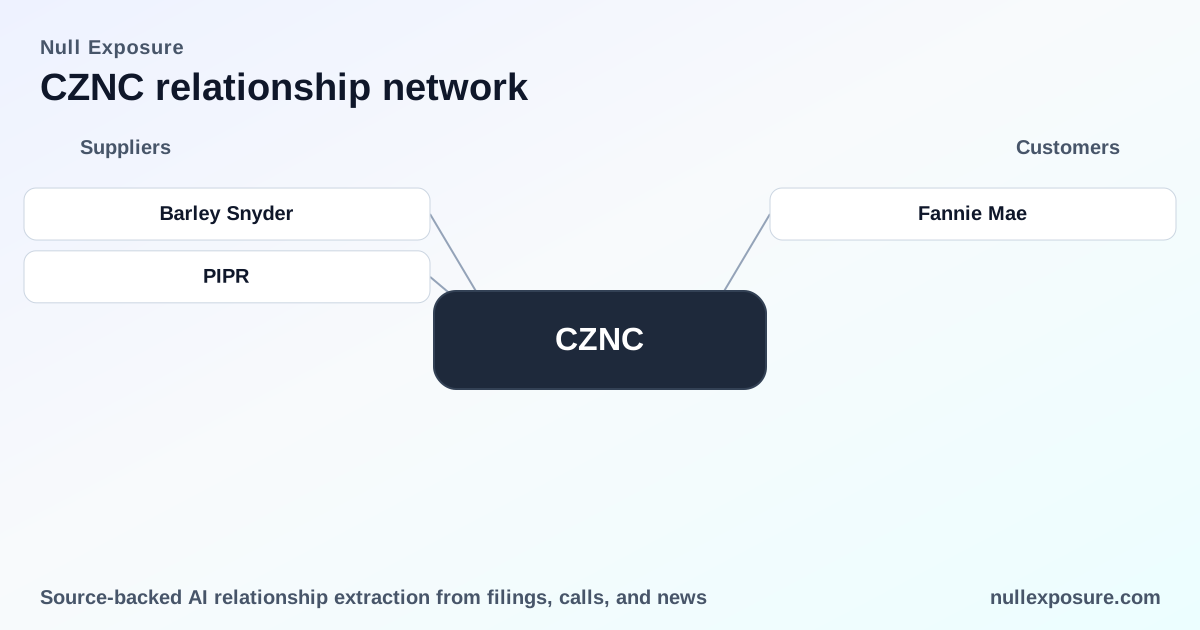
Fannie Mae — conduit for conforming mortgage sales
Citizens & Northern sells conforming, prime mortgage loans through the MPF Xtra program into the secondary market, with Fannie Mae as a buyer of those loans under program terms. According to Citizens & Northern’s FY2024 10‑K, mortgages originated and sold through MPF Xtra consist primarily of conforming, prime loans sold to the Federal National Mortgage Association (Fannie Mae), which provides immediate liquidity and reduces on‑balance-sheet interest‑rate and credit concentration. (Source: FY2024 10‑K filing, referenced in company disclosures.)
Why this relationship matters: sale through Fannie Mae converts origination flow into fee and liquidity, reducing hold‑period duration and enabling repeatable mortgage production economics.
What the relationship set tells investors about risk and optionality
Fannie Mae as a buyer of conforming loans is a standard, high-volume channel for community banks. That channel supplies several strategic advantages and attendant risks for CZNC:
- Liquidity and capital efficiency: Selling through Fannie Mae shortens the funding cycle on mortgages and reduces duration exposure, improving return on capital for the origination business.
- Price and program dependence: Loan sale economics depend on program pricing and Fannie Mae’s eligibility criteria—changes in guarantee fees, underwriting rules, or program availability would alter mortgage profitability.
- Interest‑rate and balance-sheet dynamics: While mortgage sales reduce on‑balance-sheet interest‑rate risk, the bank’s broader asset base remains long-term fixed-rate loans; net interest margin and economic value remain sensitive to rate movements.
- Local-credit concentration: The bank’s regional footprint ties credit outcomes to local economic conditions; loan performance is therefore more correlated to regional employment, housing and municipal finances than to national averages.
Investment implications and risk checklist
For investors and operators evaluating CZNC customer relationships and business durability, the following are the primary implications:
- Stable fee stream from mortgage sales complements funding-dependent net interest income. Mortgage distribution via Fannie Mae turns production into near‑term fee revenue and mitigates some duration exposure.
- Interest-rate exposure is embedded in the loan/investment portfolio. Long-term fixed-rate assets require active asset‑liability management; rising rates compress margins on legacy holdings unless offset by repricing or balance-sheet hedging.
- Geographic concentration creates both advantage and cyclicality. The close-knit regional footprint permits market knowledge and distribution efficiency but concentrates downside in local recessions.
- Counterparty concentration is low by design. Management’s disclosure that no small customer group drives the business supports loss-absorption capacity, though municipal lending and local industry weakness remain watch items.
- Operational reliance on program infrastructure. Dependence on standardized sale channels (Fannie Mae/MPF Xtra) ties economics to national program rules and counterparty underwriting standards.
Bottom line: what investors should do next
Citizens & Northern combines a traditional community banking core with mortgage distribution via Fannie Mae, a pairing that delivers predictable fee generation while keeping a large, interest‑rate‑sensitive loan portfolio on its balance sheet. For investors focused on yield and steady regional exposure, the bank offers dependable dividends and conservative asset size; for value investors, sensitivity to local credit cycles and national mortgage program changes are the principal risk vectors.
For more granular customer and counterparty mapping—down to program-level relationships and contract posture—visit our research home at https://nullexposure.com/. If you want tailored reporting on regional-bank counterparty exposure or comparative maps across peers, explore options at https://nullexposure.com/.