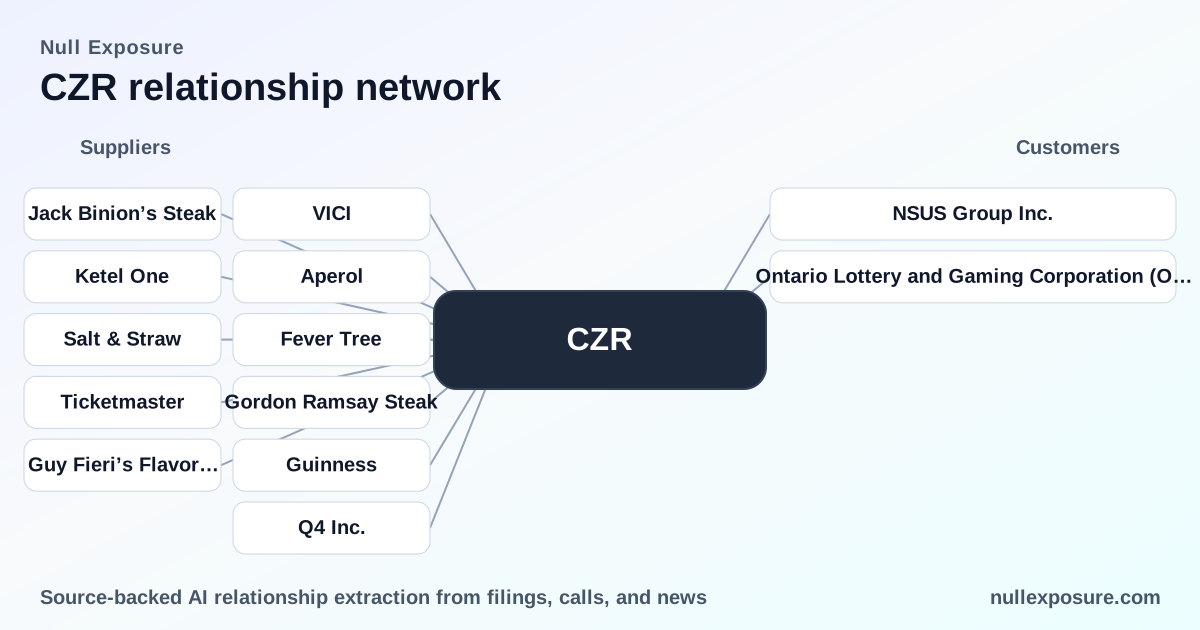
Caesars Entertainment (CZR): Customer Relationships that Drive the Business
Thesis: Caesars Entertainment monetizes a diversified set of customer relationships through gaming operations, hotel and F&B services, long-term management agreements and intellectual-property licensing; gaming and branded services are the core profit engines, while management contracts and IP monetization provide recurring fee income and balance-sheet flexibility. For a concise supplier- and customer-oriented view of Caesars’ partnerships and operating constraints, see https://nullexposure.com/.
How Caesars turns customers and partners into cash
Caesars generates primary revenue from gaming — retail and online sports betting and iGaming — and supplements that with hotel, food & beverage, entertainment and management-fee revenue from properties it operates or manages. The company uses brand licensing (e.g., Caesars Slots), property management contracts, and long-term operating agreements to convert third-party relationships into fee streams or to extend distribution for digital gaming products. This hybrid model gives Caesars both high-margin gaming upside and steadier, fee-like income from management and licensing arrangements.
If you want a quick reference to how these relationships are tracked and analyzed, visit https://nullexposure.com/ for a consolidated view.
Operating model signals and business constraints
The public disclosures provide signals about Caesars’ contracting posture, concentration and maturity of engagements:
- Customer base is individual-focused and North America-centric. Caesars runs retail and online wagering across 32 North American jurisdictions and recognizes that its operating results depend on the volume and quality of individual customers using its apps and properties (company filings, FY2024).
- Revenue mix balances transactional gaming with services. Gaming is the primary revenue driver, while hotel, F&B and other services are recognized as service revenue—supporting repeat visitation and cross-sell.
- Contracts include long-term operating and management agreements. Caesars operates managed properties and earns management fees; reward-credit obligations are treated as part of mature loyalty-performance obligations (company disclosures).
- Relationship maturity is high for loyalty and management contracts. The company explicitly treats reward credits as performance obligations tied to customer history, indicating mature, recurring revenue mechanics rather than one-off transactions.
Taken together, these constraints describe a company with concentrated North American exposure, a heavy consumer-facing retail footprint, and durable contractual relationships that generate both volatile gaming revenue and steadier service or fee income.
Relationship-by-relationship: what matters to investors and operators
Below are concise, plain‑English summaries of every named relationship in the public results.
NSUS Group Inc.
Caesars sold the WSOP trademark to NSUS Group Inc. for total consideration of $500 million, consisting of $250 million in cash at closing and a $250 million note receivable, reflecting a clear monetization of valuable IP to de-risk balance-sheet exposure and extract capital from a branded asset (Caesars’ FY2024 10‑K disclosure).
Westgate Las Vegas
Westgate Las Vegas’ SuperBook will be operated by Caesars Entertainment, extending Caesars’ on‑property sportsbook operations into a high-profile third‑party venue and reinforcing its retail betting footprint in Las Vegas (LasVegasMagazine report, April 22, 2026).
Playtika (PLTK)
Caesars licenses the Caesars Slots trademarks to Playtika Ltd., enabling Caesars’ brand to monetize digital slot engagement without direct operation of those games, and providing Playtika with premium IP for its free‑to‑play products (InvestingNews, March 10, 2026).
Bakkt (BKKT‑WS)
Caesars has a sponsorship agreement under which the theater at Planet Hollywood in Las Vegas is branded as the Bakkt Theater, demonstrating Caesars’ commercial approach to venue sponsorships and third‑party promotional partnerships (Bakkt SEC filing, FY2024 referenced).
Ontario Lottery and Gaming Corporation (OLG)
Caesars acquired the operations of Caesars Windsor for roughly $54 million and entered into a 20‑year operating agreement with OLG, indicating a long‑term operator role and stable fee/management revenue profile for this property (company earnings call commentary and news coverage, March 3, 2026; Casino.org, March 2026).
Century Casinos (CNTY)
A Century Casinos executive noted involvement in transactions where Century acquired assets from Caesars—including a past 2019 deal—highlighting Caesars’ active portfolio management and occasional disposition of regional properties to third parties (PR Newswire, March 2026).
LifeVantage Corporation (LFVN)
LifeVantage staged its three‑day Momentum Academy event at Planet Hollywood Resort & Casino, signaling continued demand from corporate-event customers for Caesars’ large-scale conference and convention facilities, which support non‑gaming revenue streams (GlobeNewswire, April 20, 2026).
Investment implications: what partners reveal about the business
- Diversified monetization: Caesars extracts value from IP (WSOP sale), branded licensing (Playtika), sponsorships (Bakkt) and long-term operating contracts (OLG), reducing pure exposure to gaming table volatility and enhancing cash flow predictability.
- Contract-oriented capital strategy: The WSOP sale structure (cash plus note receivable) illustrates strategic monetization of intangible assets to bolster liquidity while retaining potential upside through financing arrangements (FY2024 10‑K).
- North American concentration and consumer sensitivity: With operations across 32 North American jurisdictions and dependency on individual customers for wagering revenue, Caesars is exposed to regional regulatory shifts and consumer-spend cyclicality (company filings).
- Management/operations as recurring revenue: Long-term operating agreements like the 20‑year OLG deal convert property control into multi-decade fee economies, improving mid-term revenue visibility and reducing capex intensity for those properties.
- Event and venue monetization matters: Corporate events and sponsored venues (LifeVantage, Bakkt Theater) reinforce the importance of non-gaming income lines and sponsorships for stabilizing EBITDA through low-variance revenue sources.
Risks to monitor
- Regulatory concentration: Heavy North American footprint concentrates regulatory and political risk.
- Consumer demand cyclicality: Gaming revenue remains cyclical and sensitive to discretionary-spend volatility.
- IP monetization trade-offs: Selling high-value IP (WSOP) improves liquidity but reduces direct control over brand monetization.
Bottom line
Caesars’ customer relationships are a mix of high‑return gaming activity and steady, contractually backed service and licensing revenue. The company's strategy to monetize IP while expanding long-term operating agreements offers improved cash-flow visibility, but North American concentration and consumer cyclical exposure remain key risk factors for investors. For a consolidated view of how these relationships map to supplier and customer exposure, visit https://nullexposure.com/.