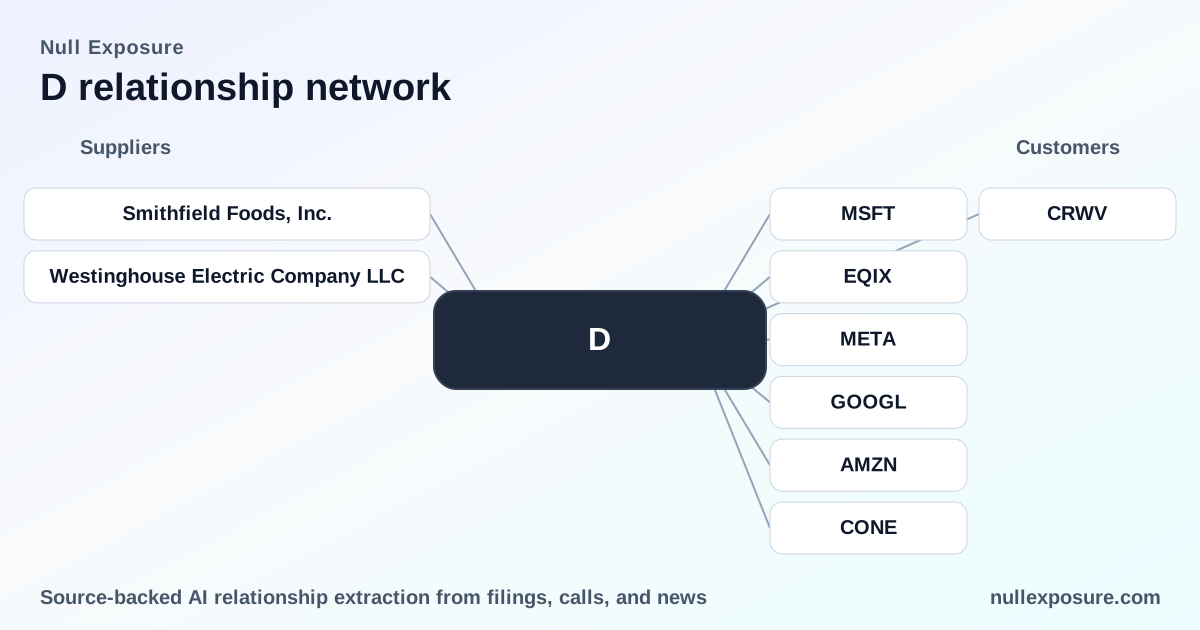
Dominion Energy’s customer map: hyperscalers, colo operators and what that means for investors
Dominion Energy operates as a regulated electric and gas utility that monetizes through a blend of regulated rate-based returns, long-term power purchase agreements (PPAs) and infrastructure services that support large data center customers. The company captures stable cash flow from its utility franchises and augments growth by selling energy and interconnection services into the world’s largest data‑center markets—a commercial pivot that links regulated earnings to large enterprise counterparties. For investors, the mix delivers predictable regulated margins alongside growth optionality tied to hyperscaler and colocation demand. Learn more at https://nullexposure.com/.
The business model in plain English: regulated seller, infrastructure partner, and contract mix
Dominion’s core revenue engine is traditional regulated utility economics: rate-regulated electricity and gas delivery with permitted returns on invested capital. Complementing that are project-level contracts: the company reports that the output of certain generation facilities is sold under long-term PPAs (typically 15–25 years), while other engagements are structured as stand‑ready contracts with a fixed reservation fee plus variable usage charges. Dominion also performs construction and transition services for third parties, indicating a service-provider posture in addition to acting as a seller.
- Contracting posture: Predominantly long-dated PPAs and reservation-style agreements that lock in base revenue streams, with isolated short‑term transition services (e.g., limited-duration TSAs) used in divestitures or handoffs.
- Counterparty mix and criticality: The company serves governments, residential customers and large enterprises; that mix preserves regulatory insulation while exposing Dominion to concentrated enterprise demand where data‑center off‑takers are critical.
- Geographic focus: Heavy North American concentration—principally Virginia, the mid‑Atlantic, Northeast and Southeast—making Dominion’s growth and risk profile regionally concentrated.
- Credit and counterparty exposure: Reported credit exposure was modest in aggregate (circa $173m at year‑end 2024) with the large majority investment grade and no single counterparty exceeding ~$55m—useful context for counterparty credit risk modelling.
These operating characteristics imply stable baseline cash flows with incremental earnings leverage when large enterprise customers (hyperscalers and colos) expand capacity in Dominion’s footprint.
Why hyperscalers and colo operators matter to the equity story
Dominion’s recent capital plan emphasizes regulated infrastructure to serve the world’s largest data center market; public commentary around a $65 billion capex program through 2030 explicitly ties growth to servicing Alphabet, Amazon, Microsoft and Meta. That strategic alignment converts data‑center power demand into rate base and contracted revenue streams, raising long‑term earnings potential while increasing capital intensity and execution risk. (Tikr commentary, March 2026).
Customer relationships called out in FY2026 coverage
Below are the customer names surfaced in FY2026 media coverage and the plain‑English relationship takeaway for each, with source attributions.
-
Alphabet (GOOGL): Dominion is identified as a supplier to Alphabet through its position in the region’s data‑center power market, making Alphabet a strategic high‑demand off‑taker in Dominion’s growth narrative. Source: InsiderMonkey / Finviz reporting (Mar 9, 2026) and Tikr analysis (Mar 9–10, 2026).
-
Amazon (AMZN): Amazon is listed among the major technology customers using the mid‑Atlantic data‑center capacity that Dominion is building to serve; Amazon’s scale reinforces predictable load growth for Dominion’s projects. Source: InsiderMonkey / Finviz (Mar 9, 2026) and Tikr (Mar 9, 2026).
-
Microsoft (MSFT): Microsoft is cited as a primary hyperscaler served by Dominion’s infrastructure expansion, anchoring the utility’s data‑center strategy and supporting long‑term contracted or rate‑based revenue. Source: InsiderMonkey / Finviz (Mar 9, 2026) and Tikr (Mar 9, 2026).
-
Meta Platforms (META): Meta (Meta Platforms) is named repeatedly alongside other hyperscalers as a demand anchor in Dominion’s target market, reinforcing the company’s position as a strategic power provider for social‑media and AI compute loads. Source: Bitget and InsiderMonkey reporting (Mar 9–10, 2026).
-
Equinix (EQIX): The global colocation provider Equinix appears as a named customer, signaling Dominion’s relevance not just to hyperscalers but to third‑party data‑center operators that broker capacity to multiple enterprise tenants. Source: InsiderMonkey / Bitget / Finviz (Mar 9, 2026).
-
CyrusOne (CONE): CyrusOne, a major colocation operator, is listed among private firm customers that rely on Dominion’s regional power supply and infrastructure, representing another channel to capture enterprise compute demand. Source: InsiderMonkey / Finviz (Mar 9, 2026).
-
CoreWeave (CRWV): CoreWeave, a privately focused GPU and cloud provider, is referenced as a customer, illustrating Dominion’s exposure to specialized, high‑usage compute tenants beyond the hyperscalers. Source: Bitget / Finviz / InsiderMonkey (Mar 9, 2026).
Each company above was mentioned in multiple FY2026 news items discussing Dominion’s strategy and expansion into data‑center power markets (InsiderMonkey, Bitget, Finviz, Tikr — March 9–10, 2026).
What the contract and exposure signals tell investors
Treat the constraints below as company‑level operating signals that illuminate Dominion’s risk/return architecture:
- Long‑term contracts dominate revenue stability. The firm explicitly uses PPAs with 15–25 year terms for generation output, which supports predictable cash flows and debt service capacity.
- Some short‑term operational services exist. Transition services agreements of limited duration (about two years in disclosed cases) are used in divestitures or operational handoffs, which creates short‑term service fee revenue but also execution obligations.
- Reservation + usage pricing profile. Many commercial contracts are structured as stand‑ready arrangements with fixed reservation fees and variable usage charges, yielding steady base revenue with upside when utilization increases.
- Concentration and regional exposure. North American regional concentration increases sensitivity to localized regulatory and market shifts, but regulated status mitigates topline volatility.
- Credit exposure is manageable in aggregate. Reported counterparty credit exposure totals and contingent collateral figures suggest no outsized single‑counterparty credit risk, though enterprise growth could change exposure bands over time.
Risks, returns and the investor checklist
- Risk: Large capital program to serve hyperscalers increases execution and regulatory risk even as it converts private demand into rate base and contracted earnings.
- Return: Successful customer onboarding and high utilization convert reservation fees into durable cash flow and justify higher rate base valuation multiples.
- Monitoring triggers: Watch contract signatures with hyperscalers/colos, regulatory approvals to recover project costs, and changes to reported counterparty exposure bands.
For a concise, investor‑grade dossier of Dominion’s customer signals and how they map to valuation drivers, visit https://nullexposure.com/.
Bottom line
Dominion’s customer footprint—anchored by hyperscalers and major colocation operators—reframes the company from a pure steady‑income utility into a regulated infrastructure growth story. The combination of long‑term PPAs, reservation‑style commercial contracts, and regional data‑center demand produces a distinctive risk/return profile: stable regulated cash flows today with material upside from enterprise-driven load growth, subject to capex execution and regulatory outcomes. Investors should focus on contract confirmations, regulatory cost recovery mechanics, and counterparty exposure evolution when sizing Dominion in a portfolio.