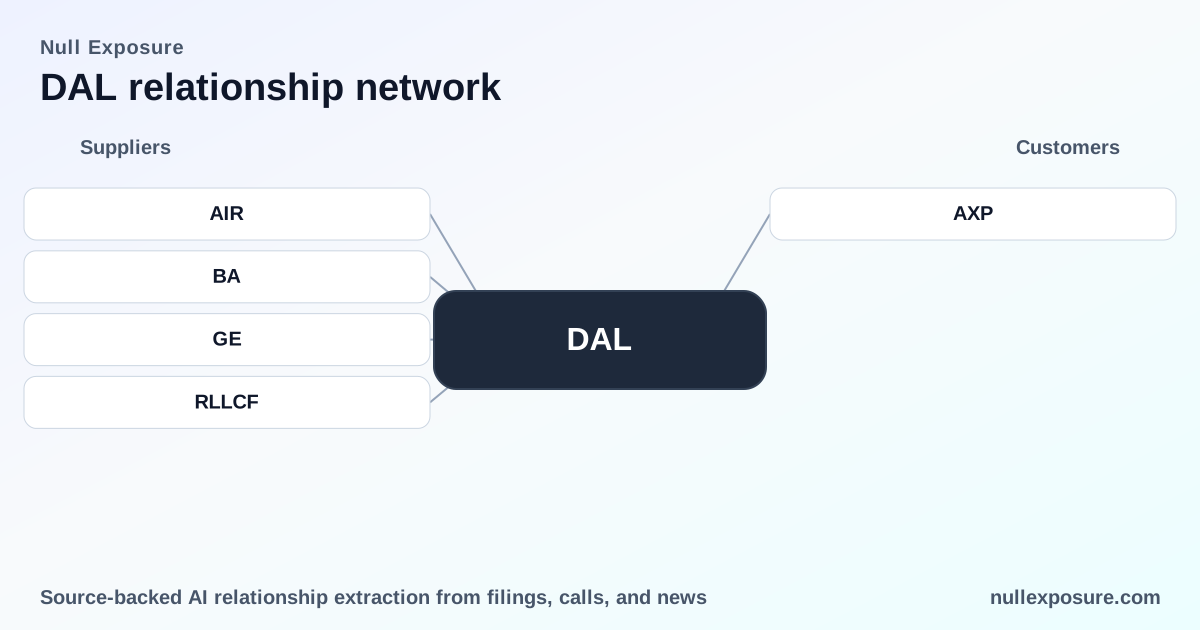
Delta Air Lines (DAL): Customer Ecosystem and Strategic Relationships
Delta Air Lines operates and monetizes as a vertically integrated travel platform: it sells air transportation tickets as its core product, sells loyalty currency (SkyMiles) to corporate and commercial partners, and leverages ancillary services — from co‑branded credit cards to MRO (Delta TechOps) — to convert travel demand into high-margin, recurring revenue streams. Delta’s economics rely on ticketing volume, large deferred revenue in the SkyMiles program, and diversification into services that capture cash beyond seat sales. For a concise view of Delta’s partner exposures and what they imply for revenue, capital access, and operational risk, read on. If you want a consolidated view of relationship signals and source links, visit https://nullexposure.com/.
Business model at a glance
- Core monetization: ticket sales (advance bookings) and associated passenger revenue, which remains Delta’s principal cash engine.
- Loyalty monetization: selling and deferring value through SkyMiles, which produces a large deferred revenue liability and recurring cash from non‑airline partners.
- Service monetization: Delta TechOps and other services generate incremental margins and diversify operational exposure away from pure passenger ticket risk.
- Geographic focus: North America is the dominant region for passenger revenue, reinforcing concentration risks tied to domestic travel patterns.
Key constraints and what they imply for investors
- SkyMiles scale is material: Delta reported an aggregate deferred revenue balance associated with SkyMiles of $9.3 billion at December 31, 2025 — a structural liability that also represents a durable cash stream from partners and card programs. This makes the loyalty program a critical and mature revenue source rather than a peripheral marketing cost.
- Customer base skews individual and domestic: Delta sells travel principally to individual travelers in North America, indicating high-volume, consumer‑facing contracting posture with exposure to macro consumer demand and travel cycles.
- Delta performs both as seller and buyer in commercial partnerships: the company sells miles to non‑airline businesses, a buyer/supplier duality that supports cross-selling but concentrates counterparty credit and brand risk into a few large partners.
- Services line maturity: Delta TechOps operates as a mature third‑party MRO provider, supporting fleet uptime and creating commercial revenue beyond ticketing.
What these constraints mean for operators and portfolio managers
- Contracting posture: expect standardized, high-frequency retail contracts for ticket sales and larger bespoke commercial agreements for loyalty and MRO; negotiation leverage skews to partners with scale (card issuers, large corporate customers).
- Concentration: material exposure to SkyMiles counterparties and North American passenger flows creates sensitivity to domestic economic cycles and to the performance of a small number of commercial partners.
- Criticality: SkyMiles and payment partnerships are critical revenue engines whose disruption would materially affect cash flow dynamics.
- Maturity: the SkyMiles and TechOps lines are established, sizable, and contractually embedded, providing predictable cash inflows but also carrying deferred liabilities.
Relationship map: every customer relationship in the public results
Wheels Up Experience Inc. (UP)
Wheels Up is a strategic private aviation partner that integrates membership and charter offerings with Delta commercial benefits — Wheels Up members can earn Delta Medallion status, accrue SkyMiles, and use Wheels Up fund balances toward Delta flights; Delta has provided financing and credit support to Wheels Up in connection with fleet and financing transactions. A PR Newswire release documenting the combination of Delta Private Jets with Wheels Up outlined the cross‑platform customer benefits (FY2020). (Source: PR Newswire press release on the Wheels Up–Delta transaction, FY2020 — https://www.prnewswire.com/news-releases/wheels-up-and-delta-close-groundbreaking-transaction-combining-delta-private-jets-with-wheels-up-and-introducing-cross-platform-customer-benefits-300995349.html)
Aeroméxico (AERO)
Aeroméxico uses a commercial alliance with Delta to expand transborder and international routes; the alliance is operationally significant for Mexico‑US connectivity and drives reciprocal traffic flows and codeshare revenues. (Source: Expansion.mx article on Aeroméxico and Delta commercial cooperation, FY2021 — https://expansion.mx/empresas/2021/05/14/el-nuevo-capitulo-de-aeromexico)
Joby Aviation, Inc. (JOBY)
Joby has a partnership that grants access to Delta’s New York and Los Angeles facilities in exchange for providing Delta clients a differentiated urban air mobility service, positioning Joby as a distributor for select customer segments. (Source: TradingView commentary referencing the DAL‑JOBY partnership, FY2026 — https://www.tradingview.com/symbols/SWB-8TQ/ideas/page-3/)
IndiGo (INDIGO)
Delta announced an eight‑year TechOps engine maintenance agreement with IndiGo, underlining Delta TechOps’ role in selling MRO services to large international carriers and generating services revenue outside Delta’s own flight operations. (Source: TiKR / Trading commentary on Delta’s TechOps deal with IndiGo, FY2026 — https://tikr.com/blog/delta-stock-fell-4-this-week-as-fuel-costs-hit-airline-margins-can-it-reach-106-by-2027)
American Express (AXP)
Delta’s long‑standing co‑branded card and marketing agreements with American Express drive joint customer acquisition and loyalty economics; the 2025 Form 10‑K explicitly documents joint marketing, cardholder benefits, and Membership Rewards integration as a structured commercial relationship supporting SkyMiles monetization. (Source: Delta 2025 Form 10‑K, filed FY2025 — dal-2025-12-31)
Investor implications by relationship
- Wheels Up (UP): strategic and multifaceted — commercial integration, customer benefits, and financing support tie Delta to private aviation demand; this increases Delta’s reach into higher‑margin customers but also links Delta to Wheels Up’s capital profile and operational execution. (Source: PR Newswire and multiple 2024–2026 press items)
- Aeroméxico (AERO): route expansion engine — codeshare and alliance terms drive cross‑border traffic, reinforcing international connectivity without full asset exposure. (Source: Expansion.mx, 2021–2022)
- Joby (JOBY): innovation partnership — access to airport facilities for urban air mobility is a distribution play that tests new demand channels for Delta’s premium customers. (Source: TradingView, 2026)
- IndiGo: services revenue and TechOps scale — long‑term maintenance contracts diversify revenue and demonstrate TechOps’ third‑party commercial maturity. (Source: TiKR, 2026)
- American Express (AXP): highly material loyalty monetization partner — the co‑branding and joint marketing structure converts card volumes into SkyMiles sales and deferred revenue, underpinning a significant portion of non‑fare cash flow. (Source: Delta 2025 Form 10‑K)
Risk and concentration summary
- Loyalty concentration: with $9.3 billion in SkyMiles deferred revenue, the program is a critical cash engine whose economics depend on a few large commercial partners and continued consumer engagement. (Company 10‑K disclosure, FY2025)
- Domestic demand exposure: the North American passenger revenue concentration means macro shocks to U.S. travel materially affect Delta’s top line and utilization of partner capacity.
- Partner credit and financing linkages: Delta’s extension of credit support and financing to partners such as Wheels Up creates interdependent capital risk that translates into off‑airline balance sheet exposure.
Conclusion and action points Delta’s customer relationships reflect a deliberate strategy to transform a legacy carrier into a services‑laden, loyalty‑driven platform: core ticket sales provide scale, SkyMiles provides durable commercial cash, and TechOps plus strategic partnerships extend Delta’s reach into private aviation and new mobility. For portfolio managers evaluating Delta’s counterparty exposures, focus on the health of large loyalty partners, the stability of deferred revenue recognition, and the credit relationships Delta provides to strategic partners.
For detailed relationship evidence and continuous monitoring, visit https://nullexposure.com/ for consolidated signal pages and source links.