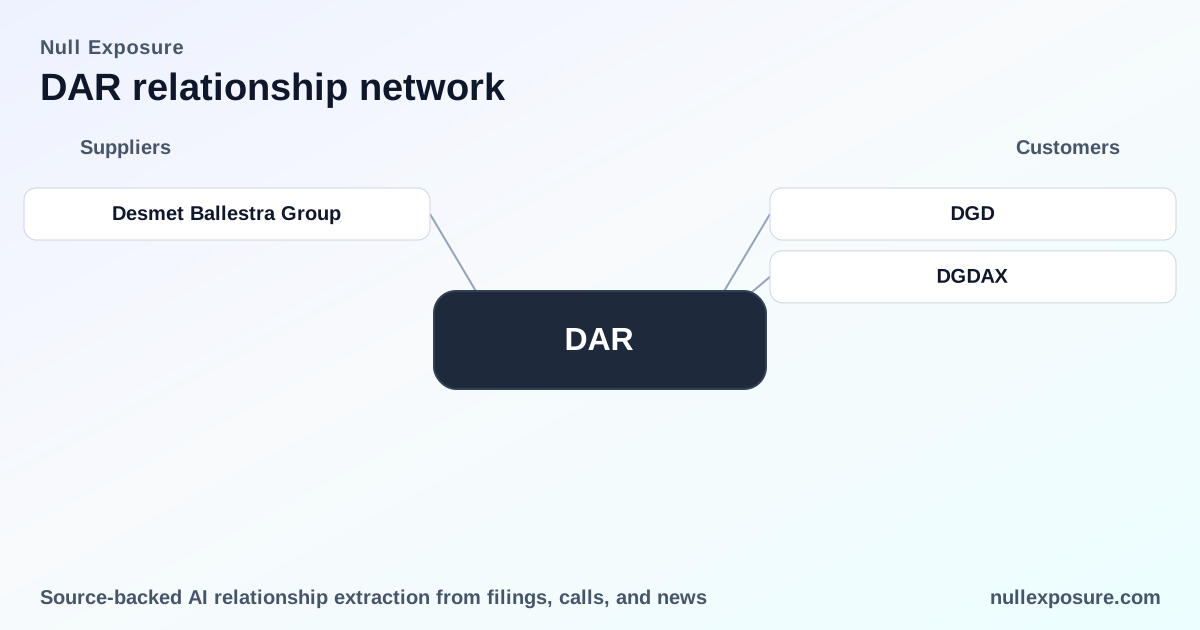
Darling Ingredients (DAR): Customer Relationships that Drive the Feedstock-to-Fuel Franchise
Darling Ingredients monetizes a vertically integrated portfolio of biological processing businesses by collecting and converting edible and inedible bio‑nutrients into feed, food and fuel ingredients, and by selling those outputs into industrial customers and joint ventures. The company's economics are driven by feedstock collection scale, global sourcing and large, concentrated commercial relationships — most notably with the Diamond Green Diesel joint venture — which convert Darling’s commodity outputs into higher‑value renewable diesel and SAF feedstock sales. For more consolidated relationship intelligence, see https://nullexposure.com/.
Why investors should care: concentration with commercial optionality
Darling is not a pure commodity aggregator; it both processes and sells finished fats and oils and also provides environmental and collection services. That unique positioning creates both scale advantages in procurement and concentrated revenue exposure to a handful of large industrial buyers. Those buyers convert Darling‑supplied feedstocks into finished fuels (renewable diesel/SAF) or resell into other ingredient markets, anchoring recurring demand but increasing customer and geographic concentration risk.
Explore Darling relationship signals on NullExposure
The customer roster: who matters and what they buy
Diamond Green Diesel
Diamond Green Diesel (DGD) is Darling’s largest finished product customer by net sales, historically taking large volumes of finished fats for renewable diesel and SAF feedstock. In Darling’s 2024 Form 10‑K the company reported DGD as its largest finished product customer, with sales to DGD of approximately $968.9 million in 2024 (and $1.3 billion in 2023). (Source: Darling 2024 Form 10‑K, filed Dec. 28, 2024.)
DGD (ticker/inferred: DGD / DGDAX)
The joint venture commonly referenced as DGD (and indexed in Darling’s filings as DGDAX) is both a major buyer of finished fats and a strategic outlet for U.S. fat volumes; Darling recorded material net sales to that JV across multiple years. The 10‑K lists DGD as the company's largest finished product customer in 2022–2024, and the company has a raw material offer arrangement tied to that relationship. (Source: Darling 2024 Form 10‑K, filed Dec. 28, 2024.)
DGD (market commentary)
Operational commentary in recent earnings transcripts underscores the trade flows that feed DGD’s plants, including imported and Brazil‑sourced fats moving into DGD facilities — a market dynamic that affects where Darling routes feedstocks and the price leverage for exporters. (Source: InsiderMonkey transcription of Darling/DGD discussion, March 9, 2026.)
Diamond Green Diesel (capital markets discussion on feedstock and RINs)
In Q1 2026 conference call transcripts, analysts asked about RIN pricing and its sufficiency to attract international feedstocks into the U.S. for DGD, highlighting how policy and RIN economics directly influence the volumes Darling can sell into DGD facilities. That exchange indicates a close commercial linkage between Darling’s feedstock sourcing/inventory decisions and renewable fuel market incentives. (Source: Benzinga transcript of DAR Q1 2026 earnings call, May 2, 2026.)
VLO (Valero reference to raw material agreement)
Valero’s public filing references a raw material supply agreement between Darling and the DGD joint venture under which Darling offers portions of its feedstock requirements at market pricing, while DGD is not obligated to purchase those offered volumes — a key contractual posture that preserves DGD purchasing discretion and limits guaranteed offtake. (Source: Valero 2024 Form 10‑K, filed Dec. 31, 2024.)
Operating constraints and what they mean for revenue durability
-
Long‑term supply commitments exist, but they are limited in scope. Darling discloses long‑term performance obligations and supply contracts: revenue under long‑term supply contracts was roughly $156.3 million in 2024 with about $610.7 million of remaining performance obligations (generally over three years). This signals durable contracted flows, but not full revenue insulation. (Company‑level signal from Darling 2024 10‑K.)
-
Global footprint with North America concentration. Darling operates across five continents and sells globally, supporting diversified sourcing and offtake channels; however, U.S. sales to DGD facilities represented a meaningful share of finished fats volumes in recent years, concentrating risk within the North American renewables complex. (Company‑level global signal; DGD‑specific NA concentration cited in the 10‑K.)
-
Material customer concentration is real. DGD accounted for approximately 17% of Darling’s net sales in 2024 (20% in 2023), establishing DGD as a material customer whose purchasing decisions have outsized influence on Darling’s top‑line. (Source: Darling 2024 Form 10‑K.)
-
Contracting posture is seller‑led with limited guaranteed offtake. The raw material agreement with the DGD JV requires Darling to offer feedstocks at market prices, but it does not obligate DGD to buy them; this preserves market pricing discipline for Darling but creates demand uncertainty when DGD elects alternate suppliers or when market incentives shift. (Source: Valero 2024 Form 10‑K; Darling 2024 10‑K.)
-
Company provides services beyond commodity sales. Darling also offers environmental and grease‑trap collection services, anchoring recurring service revenue and reinforcing local collection networks that feed its processing plants — a complementary revenue stream that supports feedstock access. (Company 10‑K service description.)
-
Spend band and materiality indicate scale. Sales to the DGD JV fall in the $100M+ spend band historically, underscoring that these relationships are not marginal but central to Darling’s commercial scale. (Company signal from the 10‑K reporting.)
Investment implications: drivers, risks and where to focus
-
Drivers: Scale of collection and global sourcing gives Darling cost advantages in feedstock access; the DGD JV converts Darling’s commodity outputs into higher‑value fuel markets, anchoring demand and enabling margin capture up‑chain. If renewable diesel/SAF economics and RIN incentives remain favorable, Darling benefits materially through recurring large‑ticket sales into DGD.
-
Risks: Customer concentration with DGD is a principal risk — a significant portion of finished fat volumes are sold to the JV and its purchasing discretion is high. Policy and commodity cycles (RINs, feedstock export flows) have direct revenue impact, and the raw material agreement structure leaves Darling exposed to demand variability when DGD sources elsewhere.
-
What to monitor: Quarterly volumes to DGD, RIN price trajectories and regulatory developments impacting renewable fuels, and any evolution of contractual terms around guaranteed offtake or price floors. Also monitor Darling’s expansion of non‑fuel channels and growth in environmental services as diversification levers.
Bottom line
Darling’s business model benefits from integrated feedstock collection and global sales channels, while its financial profile is tightly coupled to a small number of very large customers — most prominently the DGD joint venture. That concentration creates powerful upside when renewable fuels economics are strong and clear downside when buyers exercise discretion or policy incentives shift. For an organized, relationship‑level view of Darling’s customer exposures and the underlying source documents, visit https://nullexposure.com/.