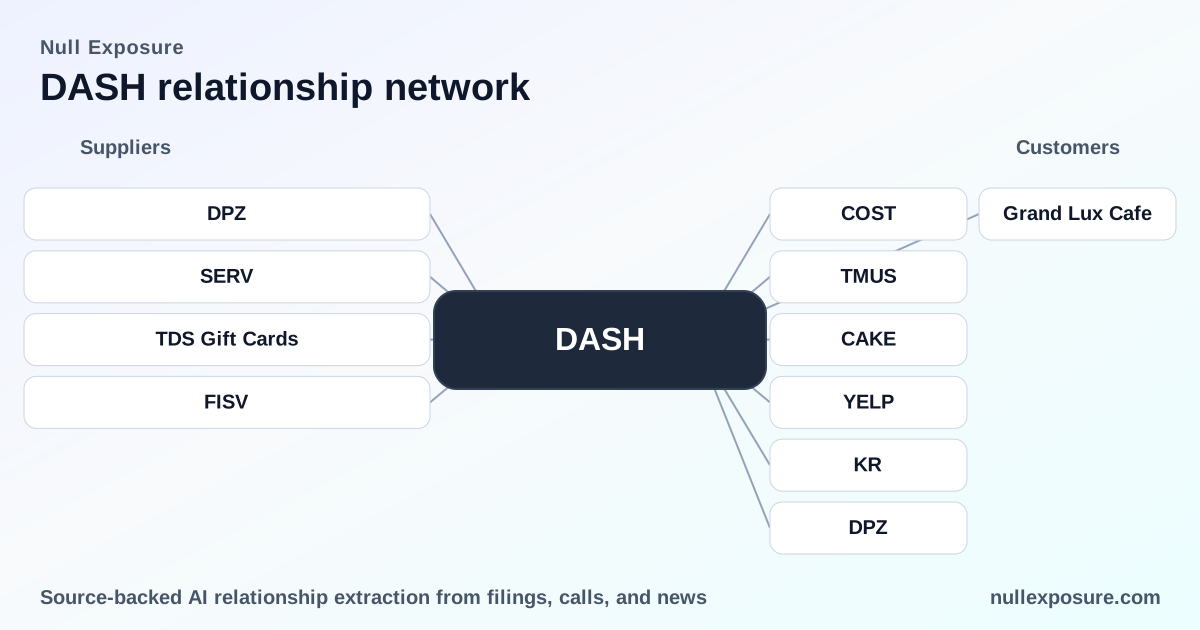
DoorDash Customer Map: Partnerships, Economics, and Where Revenue Comes From
DoorDash operates a multi-sided logistics marketplace that connects restaurants, retailers and national brands with consumers and independent delivery providers, monetizing through transaction fees, fulfillment surcharges and membership revenue (DashPass). The business combines per-order marketplace economics with subscription income recognized ratably over contractual periods, and it drives growth through large national retailer rollouts and third‑party integrations that extend reach beyond restaurants into groceries, pharmacies and big‑box retail.
For a concise partner risk/benefit read on this page, visit https://nullexposure.com/.
How DoorDash monetizes and how that shapes partner relationships
DoorDash’s revenue model blends three durable levers: take rates on orders, consumer-facing subscriptions, and merchant services (marketplace merchandising, fulfillment, payment processing). The constraints in recent filings point to a company-level operating posture that is:
- Subscription-anchored: membership fees from DashPass are a recognized and recurring revenue stream, typically ratable over one month to a year.
- Global in scope: marketplaces operate across 30+ countries, making partner relationships strategically global rather than purely local.
- Service-centric: merchant offerings extend beyond delivery into order fulfillment, payments and customer support, increasing platform stickiness.
These characteristics produce a contracting mix that favors recurring commercial terms with large retail partners, while preserving per‑order flexibility with restaurants and local merchants.
Catalog of customer relationships — what each partnership means for investors
The following list covers every partnership or customer mention surfaced in the results. Each entry is a plain-English take with a concise source reference.
T-Mobile US, Inc. (TMUS)
T‑Mobile uses DoorDash for same‑day delivery of devices in consumer promotions that promise rapid handset delivery (e.g., iPhone launches), indicating DoorDash’s role in logistics beyond food. Source: aijourn reporting on T‑Mobile promotions (FY2026).
Albertsons Companies, Inc. (ACI)
Albertsons lists DoorDash among the third‑party providers powering its curbside pickup and delivery services across thousands of stores, positioning DoorDash as a core last‑mile option in grocery omnichannel strategy. Source: TradingView summary of Albertsons’ SEC 10‑K (FY2025).
Costco Wholesale Corporation (COST)
Costco’s same‑day delivery network uses DoorDash internationally (and Instacart in the U.S.), demonstrating DoorDash’s participation in high‑volume, membership‑adjacent grocery distribution. Source: The Globe and Mail coverage of Costco logistics (FY2026).
Western Union (WU)
Western Union completed an acquisition of a Singapore‑based digital wallet named Dash (formerly owned by Singtel); this transaction concerns a separate fintech called Dash and is not a DoorDash corporate transaction. Source: Incrypted report on Western Union (FY2026).
Foot Locker (FL)
DoorDash struck a national delivery agreement to serve nearly 1,300 Foot Locker, Kids Foot Locker and Champs Sports locations, expanding DoorDash’s retail footprint into footwear and apparel retail fulfillment. Source: multiple press reports including MEXC and Investing.com (FY2026).
Yelp Inc. (YELP)
Yelp designated DoorDash as its preferred food‑ordering partner, integrating DoorDash to enable ordering from hundreds of thousands of restaurants and linking discovery to action on Yelp’s platform. Source: Yelp press release and multiple news transcripts (FY2026).
Kroger (KR)
Kroger expanded a partnership with DoorDash to provide nationwide grocery delivery from roughly 2,700 stores, including a SNAP/EBT integration to accept federal benefits online—an example of DoorDash enabling access to essential grocery demand. Source: TradingView and ChainstoreAge reporting on the Kroger expansion (FY2026).
Mitre 10
DoorDash expanded retail fulfillment in Australia through a strategic deal with Mitre 10, signaling targeted international expansions in home improvement retail channels. Source: MEXC coverage of Australian retail deals (FY2026).
Office Depot (ODP)
Office Depot made over 10,000 items available through DoorDash’s marketplace, extending DoorDash’s corporate and B2B delivery use cases for office supplies and business essentials. Source: DoorDash corporate announcement (FY2022 posting reposted FY2026).
The Cheesecake Factory / Grand Lux Cafe (CAKE)
The Cheesecake Factory reports that off‑premises sales—substantially driven by DoorDash—now account for a material portion of revenue (~21%), underscoring DoorDash’s importance to restaurant off‑premise economics; Grand Lux Cafe was noted as part of initial restaurant agreements. Source: earnings call transcripts and analyst writeups (FY2025–FY2026).
Domino’s Pizza (DPZ)
Domino’s expects continued growth on aggregator platforms with DoorDash contributing to revenues after a mid‑2025 roll‑out, illustrating DoorDash’s role even for large vertically integrated chains. Source: Benzinga and company earnings commentary (FY2026).
Starbucks (SBUX)
Starbucks credited delivery partnerships including DoorDash with helping offset softer in‑store traffic, reflecting DoorDash’s role in supporting high‑frequency beverage and convenience categories. Source: International Business Times Australia reporting (FY2026).
Rocky Mountain Chocolate Factory (RMCF)
RMCF reports DoorDash storefronts and third‑party integrations as part of a strategy to standardize listings and improve unit economics, including a white‑labeled, zero‑commission storefront pilot. Source: earnings transcripts and TradingView coverage (FY2025–FY2026).
Sprouts Farmers Market (SFM)
Sprouts highlighted working with DoorDash (and Instacart) to break into new markets and find customers on those platforms, showing DoorDash’s role in market entry for regional grocers. Source: Sprouts earnings call transcript (FY2026).
Dollar General (DG)
Dollar General cites partnerships with platforms like DoorDash to extend reach, increase basket sizes and drive customer engagement—DoorDash functions as incremental traffic and fulfillment partner. Source: Yahoo Finance / Finviz summaries (FY2026).
Papa John’s (PZZA) and Pizza Inn (RAVE)
Industry commentary notes that major pizza chains—including Papa John’s and franchise brands like Pizza Inn—are active on aggregator platforms such as DoorDash, reflecting the category’s full adoption of third‑party fulfillment. Source: Restaurant Business Online and PizzaMarketplace (FY2026 and FY2022 references).
Champs Sports and Kids Foot Locker
These Foot Locker banners are explicitly included in DoorDash’s national delivery deal, reinforcing DoorDash’s coverage across retail banners within a single merchant family. Source: Investing.com and MEXC reports on the Foot Locker partnership (FY2026).
Woolworths Group (WOW)
Woolworths entered a partnership with DoorDash to increase grocery fulfillment options in Australia, highlighting DoorDash’s expansion into major southern hemisphere grocery ecosystems. Source: Retail Insight Network (FY2026).
The Coca‑Cola Company (KO)
Coca‑Cola rolled out parts of a cross‑channel campaign tied to food delivery platforms that include DoorDash, demonstrating DoorDash’s value as a distribution channel for brand promotions. Source: Coca‑Cola corporate media release (FY2026).
Ace Hardware (ACEHF)
Ace launched a delivery partnership with DoorDash in September 2025, becoming the largest hardware co‑op on the on‑demand platform and signaling adoption in non‑food retail categories. Source: ChainstoreAge coverage (FY2026).
Investment implications and risk checklist
- Diversified partner base reduces concentration risk: relationships span national grocers, quick‑service restaurants, retail chains and discovery platforms, lowering dependence on any single merchant vertical.
- Recurring revenue from subscriptions strengthens predictability, but per‑order take rates preserve variable upside tied to order growth.
- Criticality to merchant economics is real: several restaurant and grocery clients explicitly attribute a material share of off‑premise volume to DoorDash, making retention and competitive positioning essential.
- International expansion increases opportunity and regulatory complexity, given operations across 30+ countries and new retail categories in Australia and Canada.
Bold headline takeaway: DoorDash is a marketplace with both recurring subscription revenue and deep merchant integration across food, grocery and retail—its partner contracts drive both scale and strategic stickiness.
For a deeper, databacked partner risk assessment and tracking of incremental rollouts, explore more at https://nullexposure.com/.
Concluding view: investors should value DoorDash as a platform business whose merchant relationships are simultaneously the primary demand driver and the core execution risk — monitor national rollouts, subscription growth and cross‑channel integrations as the principal lead indicators.