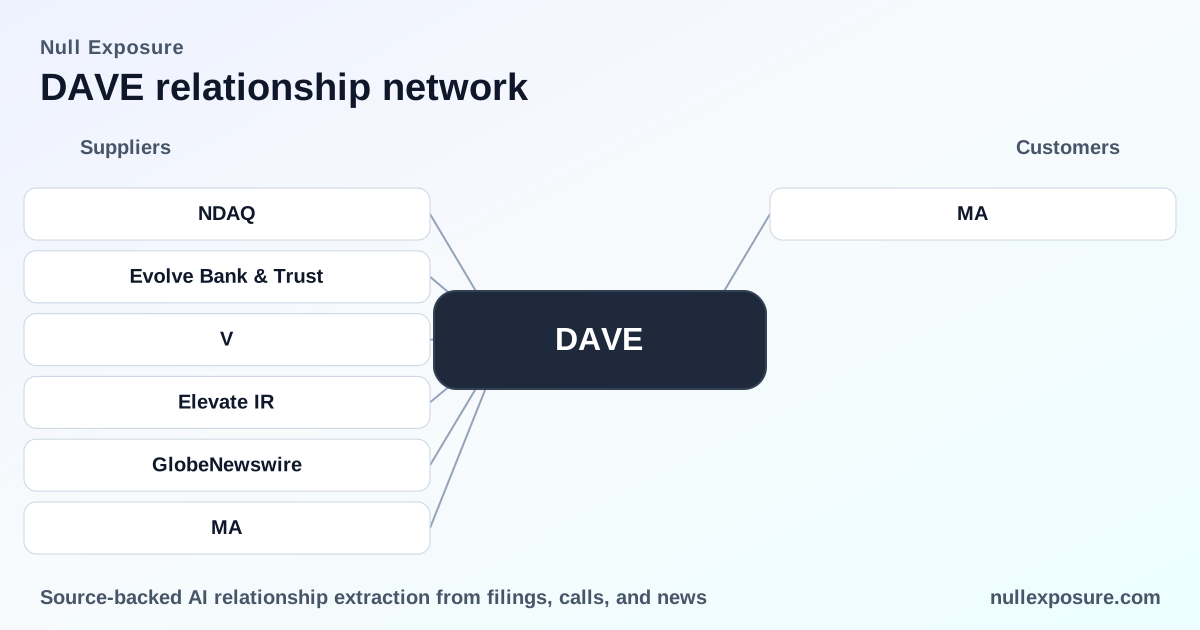
DAVE’s customer relationships: how card economics and subscription revenue drive the business
Thesis: Dave Inc. operates a consumer-focused mobile banking and fintech platform that monetizes through recurring subscription fees and payment-network economics, with a complementary short-term credit product, ExtraCash, that generates transactional revenue and keeps engagement high. Investors should value Dave as a hybrid subscription services company that also extracts per-swipe income via card processing and underwrites small, short-duration credit exposures to a large base of individual U.S. customers. For a concise view of upstream research and relationship mapping, visit https://nullexposure.com/.
Mastercard swipe fees: a clear revenue channel
Dave collects roughly 1.5% on every debit-card swipe, a direct gross-margin contributor that is paid by the card network partner identified as Mastercard. This relationship converts customer transaction volume into stable fee revenue and aligns Dave’s profitability with payments activity on its card product.
According to a Sherwood News profile published March 9, 2026, CEO commentary described the economics explicitly: “We make money off debit card swipes on our debit card, about 1.5% on every swipe, paid by Mastercard.” (Sherwood News, March 9, 2026).
MA (FY2025) — duplicate listing with standardized tag
Dave’s management reported that Mastercard pays the company approximately 1.5% per debit swipe, establishing Mastercard as a direct commercial partner in the payments stack and a material distribution route for non-interest revenue. (Sherwood News, March 9, 2026).
Mastercard (FY2025) — vendor entry
The same reporting appears under the full vendor name, confirming that Mastercard is the card network paying swipe fees and that card-transaction economics are an explicit line-item in Dave’s go-to-market economics. (Sherwood News, March 9, 2026).
What the relationship set and company disclosures collectively reveal
The consolidated evidence creates a coherent operating profile for Dave. The company-level signals in filings and commentary describe a mixed revenue model and operational posture with several defining characteristics:
- Contracting posture — recurring and transactional: Company disclosures list monthly subscription revenue from Members as a foundational revenue stream, while the Mastercard relationship supplies transactional per-swipe economics. Together, these deliver both predictable recurring cash flow and volume-linked upside.
- Product mix and credit cadence: ExtraCash is a short-term, 0% overdraft product that is underwritten at the time of each use via the company’s underwriting engine. That product creates frequent, small-duration credit exposures rather than long-term lending assets, which changes liquidity and provisioning dynamics relative to traditional installment lending.
- Counterparty and market concentration: Dave’s customer base is individual consumers concentrated in North America; management estimates a total addressable market of roughly 180 million Americans lacking affordable banking solutions. Company disclosures state no single Member accounted for 10% or more of ExtraCash receivables as of December 31, 2024, which signals low per-customer concentration risk.
- Materiality and criticality: At the customer level, receivable concentration is immaterial, but at the partner level, the card network relationship is strategically important because it turns consumer transactions into high-margin revenue.
- Maturity and stage: The company reports active subscription relationships and an installed base exceeding 16 million Members, indicating scale and an engaged user pool that supports both subscription churn economics and card-transaction volume.
- Revenue recognition posture: Dave recognizes revenue as services are rendered under Topic 606 frameworks; the company treats subscription fees as recurring service revenue and transactional swipe income as earned at the point of sale.
These attributes define an operating model that is predictable on the subscription front and variable on transaction volume, with underwriting velocity determining short-term credit risk.
Implications for investors and operators
- Revenue diversification is real but asymmetric. Subscription income provides recurring coverage of fixed costs, while Mastercard swipe fees provide margin expansion tied to consumer spending. Investors should model both streams rather than assuming one dominant source.
- Payments partnerships are strategic assets. The Mastercard channel directly monetizes transaction volume; any change in interchange arrangements, product rollout, or routing could move a meaningful portion of non-interest revenue.
- Credit risk is episodic and small-ticket. ExtraCash’s short underwriting windows reduce single-exposure severity but increase operational demands for real-time risk management and collections.
- Geographic concentration concentrates macro exposure. With the core TAM and user base focused on the U.S., macro labor and payment-cycle dynamics will influence both subscription retention and swipe volumes.
For further context and a mapped view of partner exposures, visit https://nullexposure.com/.
Relationship-by-relationship log (all entries from the dataset)
- MA — In the FY2025 coverage, management states that Dave receives about 1.5% on every debit-card swipe, paid by Mastercard, turning card activity into a direct revenue stream. (Sherwood News, March 9, 2026).
- Mastercard — A second FY2025 entry recorded under the full vendor name repeats that Mastercard pays approximately 1.5% per swipe on Dave’s debit card, confirming the payment-network economics as a disclosed income source. (Sherwood News, March 9, 2026).
Key risk factors and monitoring checklist
- Card-network economics sensitivity: Track interchange rates and any renegotiation or routing changes with Mastercard that could alter the 1.5% per-swipe baseline.
- Subscription engagement and churn: Monitor monthly active user trends and conversion of free users to paying Members, which drives stable recurring revenue.
- ExtraCash credit performance: Watch delinquency rates and loss severities on short-duration advances; given the product’s underwriting cadence, deterioration can emerge quickly and compress margins.
- Regulatory and product risk: Payments and short-term credit products are subject to evolving regulation; maintain surveillance on state and federal consumer credit actions that could affect product economics.
Bottom line for investors
Dave combines a subscription services backbone with high-margin payment economics via Mastercard and a high-velocity short-term credit product. That blend delivers recurring revenue stability plus volume-linked upside, but it elevates dependency on payments partnerships and requires continuous credit operations excellence. Investors should underwrite both subscription retention and card-transaction trends when valuing future earnings.
For direct access to relationship maps, partner-level intelligence, and ongoing monitoring tools, visit https://nullexposure.com/.