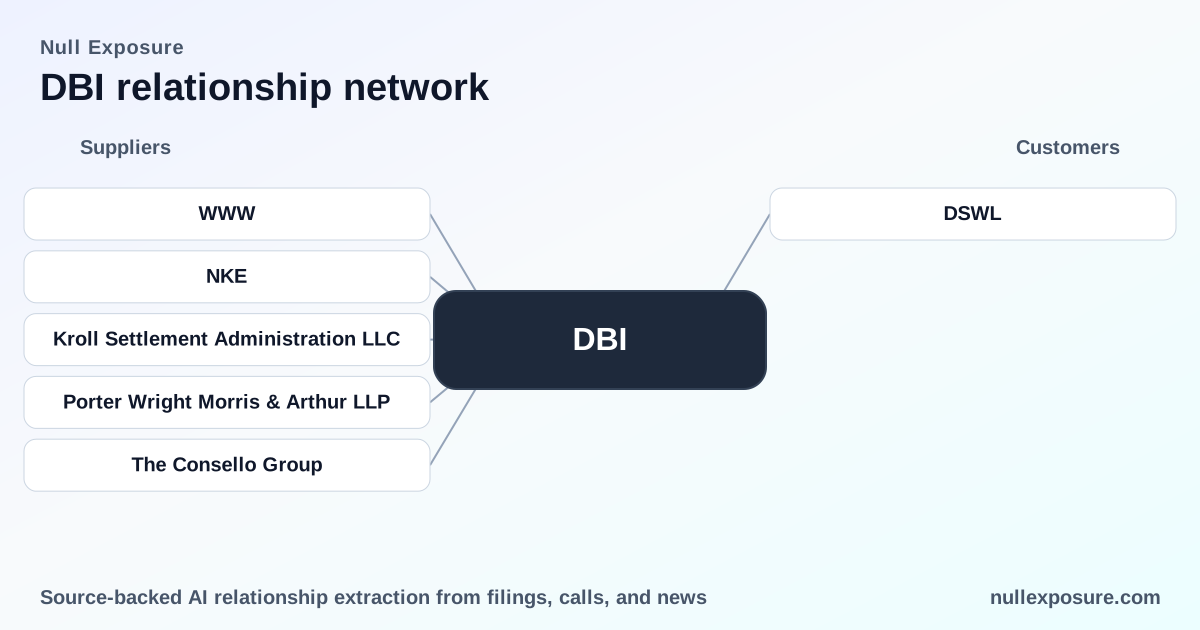
Designer Brands (DBI): Customer Relationships and Commercial Embedment
Designer Brands monetizes through a three-pronged retail and brand model: direct-to-consumer retail (DSW and Canadian banners), a Brand Portfolio that designs and wholesales footwear and accessories, and commission income from acting as design and buying agent for private labels. Its revenue mix skews heavily to North America, with a concentrated Brand Portfolio customer base and a large loyalty program that drives repeat sales and pricing power. For investors evaluating customer risk, the critical vectors are geographic concentration, customer concentration in the Brand Portfolio, and the company’s dual role as both seller and service provider. Explore more company-level signals at the Null Exposure homepage: https://nullexposure.com/
Why customers matter to the DBI story
Designer Brands operates both as a retailer (through DSW and Canadian banners) and as a branded supplier/agent. This hybrid posture gives the company multiple monetization levers—retail margin, owned-brand gross margin, and commission or agency fees—but also concentrates counterparty risk where large wholesale customers exist. The Brand Portfolio’s revenue concentration and the retail segments’ reliance on VIP members are the structural facts shaping customer risk and negotiating leverage.
Snapshot: what the filings and coverage tell us about scale and geography
Designer Brands reported roughly $2.89 billion in revenue TTM, with the retail segments focused on the United States and Canada and international sales described as immaterial. The company reported 30.8 million VIP members as of February 1, 2025, generating 86% of retail net sales, which demonstrates a mature, loyalty-driven retail operation that is critical to same-store performance and omnichannel economics. These are company-level signals drawn from Designer Brands’ public disclosures and segment commentary in recent filings.
All customer relationships in the data — concise, sourced summaries
-
DSW — Designer Shoe Warehouse
Designer Brands sells product into the DSW retail channel and DSW serves as the primary retail partner for footwear collections designed by Pensole Lewis students and manufactured at a New Hampshire facility. This relationship positions DSW as an important retail outlet for specialized collections produced under the Brand Portfolio. (Andscape feature, March 9, 2026 — https://andscape.com/features/a-reborn-hbcu-in-detroit-is-opening-a-black-owned-footwear-factory/) -
DSWL (inferred symbol DSWL)
The same coverage records DSWL as the inferred ticker for the DSW retail partnership, repeating that DSW will act as the primary retail partner for Pensole Lewis student-designed collections produced at the New Hampshire site; the duplicate entry signals that retail partnerships are tracked both by corporate name and inferred market symbol in external reporting. (Andscape feature, March 9, 2026 — https://andscape.com/features/a-reborn-hbcu-in-detroit-is-opening-a-black-owned-footwear-factory/)
Operating model constraints and what they imply for customer risk
Designer Brands’ public disclosures and extracted constraints reveal four company-level operating characteristics that directly affect customer dynamics and contractual posture:
-
Geographic concentration (North America dominant). The company states net sales are primarily to U.S. customers with a separate Canada Retail segment; sales outside the U.S. and Canada are immaterial. This concentration simplifies distribution strategy but exposes DBI to U.S./Canada retail cycles and regional consumer sentiment (company filings; geographic sales commentary).
-
Customer concentration within Brand Portfolio (material exposure). The Brand Portfolio had five customers accounting for 38.0% of segment net sales in 2024, a level described by the company as potentially material. That concentration increases bargaining risk and creates earnings sensitivity to the loss or renegotiation of one or more large customers (Designer Brands 2024 segment disclosure).
-
Dual relationship role: seller and service provider. Designer Brands operates as a seller of national and Owned Brands in its retail segments and also earns commission-based income as a design and buying agent for private labels. This dual role expands revenue channels but creates mixed contracting dynamics—wholesale/retail terms on one side and agency/commission terms on the other, which can complicate margin predictability (company segment commentary).
-
Maturity and activation of retail relationships. The loyalty program (30.8 million VIP members; 86% of retail net sales from VIP members) indicates mature, high-retention retail operations that are currently active drivers of revenue. That maturity reduces churn risk in the retail channel but concentrates revenue dependency on an engaged customer base within the U.S. and Canada (Designer Brands disclosures as of February 1, 2025).
These constraints are presented as company-level signals; none of the constraint excerpts explicitly attribute any of these characteristics to a named retail partner beyond the segment descriptions.
Investment implications — how customer relationships translate to returns and risk
-
Revenue resilience via VIP economics: The loyalty program provides stable demand and higher spend per customer, enhancing predictability in retail margins. This is a structural advantage for investors looking for durable retail cash flow.
-
Earnings sensitivity from Brand Portfolio concentration: With five customers representing 38% of Brand Portfolio net sales, a single contract loss would have material earnings implications, and investors should model outsized downside scenarios in the Brand Portfolio line.
-
Negotiating power and contracting posture: As both seller and service provider, Designer Brands can capture multiple value pools, but that posture depends on tight coordination between retail and brand channels. Contract risk is elevated where large wholesale partners possess counterparty leverage.
-
Geographic risk concentration: The near-exclusive North American focus simplifies forecasting but amplifies exposure to regional consumer cycles and currency-neutral retail shocks.
Practical investor checklist
- Monitor Brand Portfolio client disclosures and any contract renewals or terminations—these are the highest concentration risks.
- Track VIP membership trends and the percent of sales from VIP members quarterly to assess retail resilience.
- Watch margin splits between retail and brand segments to detect shifts in negotiating leverage or mix.
For deeper, structured monitoring and alerts on customer counterparty events, visit our research hub: https://nullexposure.com/
Bottom line
Designer Brands combines a mature, loyalty-driven retail engine with a concentration-prone Brand Portfolio and a mixed seller/service-provider contracting posture. The company’s customer relationships provide both a durable retail moat and a concentrated counterparty risk that requires active monitoring. Investors should weigh the stability of VIP-driven retail revenue against the material concentration in branded wholesaling when setting valuation and downside scenarios.