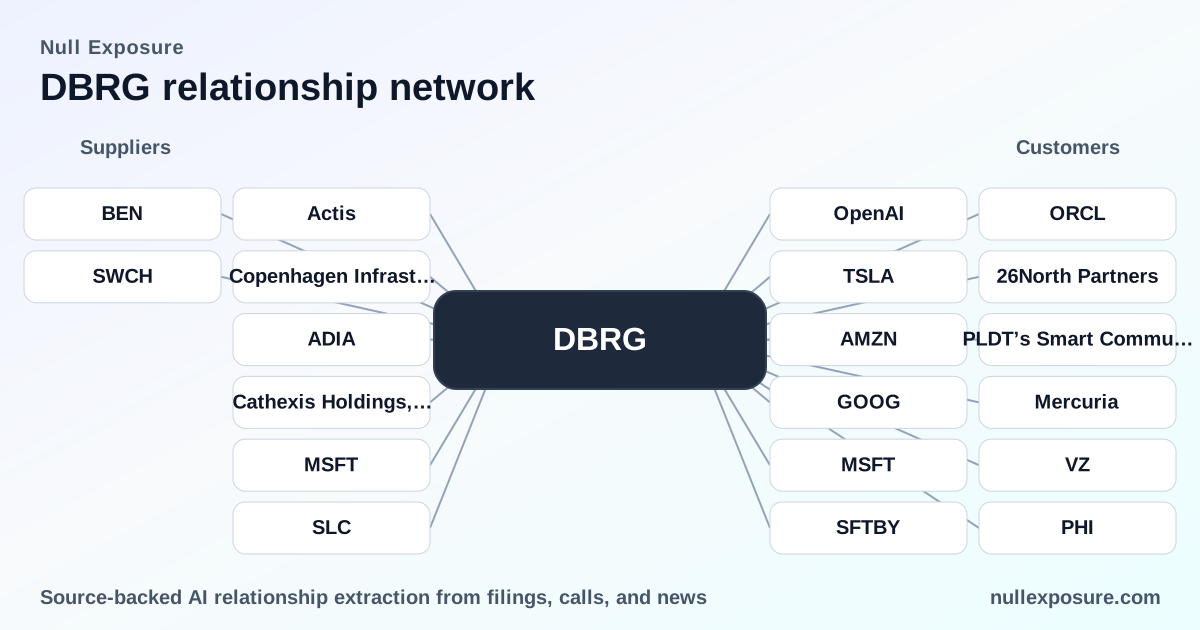
DigitalBridge (DBRG): Customer relationships that underwrite an AI-infrastructure narrative
DigitalBridge is a specialist digital-infrastructure investment manager that monetizes via recurring management fees, performance fees (carry) and capital deployment across data centers, towers, fiber, edge and power assets; it also extracts value by sponsoring and funding operating platforms and portfolio companies that sign long-term commercial commitments with hyperscalers and carriers. This mix of fee-bearing asset management and owner/operator exposure creates highly visible revenue from long-duration commercial relationships while concentrating execution risk around a handful of hyperscale and strategic customers. For more context on relationship mapping and source documents, visit https://nullexposure.com/.
What matters to investors: scale, concentration and contractual posture
DigitalBridge’s revenue model is driven by two vectors: fee recurrence from managed capital and contracted revenue from infrastructure customers (hyperscalers, carriers, and large strategic industrials). The company signals a global investor base (including pensions, sovereign wealth funds and insurance companies) and reports management fees recognized over the life of investment vehicles, establishing long-term revenue visibility. At the same time, the business is concentrated: a small set of hyperscalers and strategic customers account for a disproportionate share of demand, so execution on large projects and M&A outcomes materially affect valuation.
- Contracting posture: Management fees and many tenant commitments are structured over extended periods, supporting predictable cash flows. (Company disclosures on fee recognition; long-term contract excerpts from filings.)
- Counterparty mix: Investor base includes public/private pensions, sovereign wealth, asset managers and governments — a global, institutional clientele that reduces credit risk while elevating process scrutiny.
- Geography: Global operating footprint with meaningful North American and EMEA revenue components — the business competes where hyperscalers and carriers demand capacity.
- Segments: Core focus on digital infrastructure (data centers, cell towers, fiber, edge) plus services via investment management.
These constraints and signals are company-level and shape how to interpret each customer relationship described below.
Relationship-by-relationship readout (what investors and operators need to know)
OpenAI
DigitalBridge highlights long-term commitments supporting the OpenAI buildout, notably the Lighthouse Wisconsin project expected to serve OpenAI and partners. Source: DBRG Q3 2025 earnings call transcript (earnings call excerpt, first seen March 7, 2026).
Oracle
Oracle is named as a committed hyperscaler tenant tied to large-scale developments such as the Lighthouse Wisconsin / Stargate initiative, reflecting infrastructure demand from cloud vendors. Source: DBRG Q3 2025 earnings call transcript (2025Q3; March 2026).
Oracle (Stargate project reference)
Management specifically referenced Oracle’s Stargate collaboration at Lighthouse Wisconsin — a development described as a $15 billion-plus initiative to support OpenAI and Oracle-related capacity. Source: DBRG Q3 2025 earnings call (2025Q3; March 2026).
SoftBank Group Corp. (SFTBY)
SoftBank is the announced acquirer of DigitalBridge under an agreed cash transaction of $16.00 per share; that process has spawned multiple shareholder investigations into process and price. Source: press releases and coverage of the December 29, 2025 agreement (Newsfile / GlobeNewswire / TradingView / MarketScreener; FY2025–FY2026).
Tesla
DigitalBridge management lists Tesla among strategic commercial users of portfolio services — alongside SpaceX, Starlink and xAI — indicating cross-portfolio customer activity that includes energy storage and data‑center services. Source: DBRG Q3 2025 earnings call transcript (2025Q3; March 2026).
Tesla (TSLA symbol entry)
The transcript entries for TSLA reiterate that Tesla and related businesses use DigitalBridge portfolio company offerings, underlining diversified industrial demand for storage and capacity. Source: DBRG Q3 2025 earnings call (2025Q3; March 2026).
Amazon (AMZN)
Analyst and media coverage describe DigitalBridge as offering comprehensive solutions that suit hyperscale tenants such as Amazon, reflecting targeting of the largest cloud customers. Source: Market commentary in PredictStreet / FinancialContent (FY2025 commentary; cited December 2025).
Amazon (AMZN duplicate)
Independent write-ups echo the same hypothesis that DigitalBridge’s ecosystem serves Amazon as a hyperscale tenant. Source: PredictStreet / FinancialContent (FY2025).
Coverage groups Google with Amazon and Microsoft as hyperscalers for whom DigitalBridge constructs capacity and integrated offers, reinforcing the company’s positioning in hyperscale demand. Source: PredictStreet market commentary (FY2025).
Microsoft (MSFT)
Management remarks and transcripts confirm Microsoft as a focal hyperscaler customer; DigitalBridge states it builds where Microsoft and others require capacity and then executes delivery. Source: Q3 2025 earnings call transcript and investing.com transcript (2025Q3; March–May 2026).
Oracle (ORCL symbol entry)
Oracle appears repeatedly in earnings materials as a committed long‑term hyperscaler partner, including explicit project references that tie Oracle to major campus developments. Source: DBRG Q3 2025 earnings call (2025Q3).
SpaceX
DigitalBridge management cites SpaceX as a user of multiple portfolio company services, evidencing crossover execution with aerospace-related energy and connectivity customers. Source: Investing.com transcript of the company’s Q3 2025 earnings call (FY2025).
Starlink
Starlink is mentioned alongside SpaceX and Tesla as a tenant of DigitalBridge’s portfolio services, reflecting connectivity and edge use cases. Source: Investing.com Q3 2025 earnings transcript (FY2025).
xAI (XAIL)
xAI is named among strategic technology customers using DigitalBridge portfolio companies, illustrating exposure to emerging AI platform providers. Source: Investing.com Q3 2025 earnings transcript (FY2025).
Oracle & OpenAI commitments (long-term)
Management stated explicit long-term commitments from Oracle, OpenAI and leading cloud providers, supporting the company’s thesis of multi-year contracted demand. Source: Investing.com transcript of Q3 2025 earnings (FY2025).
26North Partners
Market reports link 26North Partners to advanced acquisition talks for DigitalBridge, highlighting potential buyer interest from alternative investment specialists during 2025–2026 M&A chatter. Source: WirelessEstimator coverage of acquisition buzz (FY2025).
Mercuria
Media briefings reported energy trader Mercuria as a potential participant in bidding interest around DigitalBridge, reflecting the deal market activity. Source: WirelessEstimator / IJGlobal reporting (FY2025).
ArcLight
DigitalBridge’s InfraBridge business agreed to divest a 50% stake in an Invenergy power portfolio to ArcLight MT, signaling partnership activity in power assets supporting digital infrastructure. Source: MarketScreener (FY2026).
PLDT’s Smart Communications, Inc.
A Philippines tower transaction left PLDT’s Smart as the anchor tenant following an EdgePoint/Comworks sale-leaseback; press coverage notes DigitalBridge ownership links through EdgePoint. Source: DataCenterDynamics reporting (FY2022 retrospective).
PLDT
PLDT is the telco involved in the sale-leaseback that transferred towers to EdgePoint (a DigitalBridge-owned entity), with Smart remaining the primary tenant. Source: DataCenterDynamics (FY2022).
PHI (symbol entry)
PHI appears in the coverage tied to the Philippines tower transactions; the article references PLDT/Smart and the broader transaction that implicated DigitalBridge-owned EdgePoint. Source: DataCenterDynamics article (FY2022).
Vertical Bridge REIT, LLC
DigitalBridge provided funding support to Vertical Bridge — the business received $1.5 billion in capital commitments from DigitalBridge, KKR and La Caisse, reinforcing DBRG’s role as a capital sponsor in tower infrastructure. Source: MarketScreener press coverage of funding (FY2026).
Verizon (VZ)
Vertical Bridge’s 2024 tower transaction with Verizon (approximately $3.3 billion) is cited as an example of DigitalBridge and partners supporting telecom-scale deployments and carrier relationships. Source: SiliconCanals reporting on the Yondr/Vertical Bridge transactions (FY2025).
Verizon (VZ duplicate)
Additional press mentions place Verizon at the center of Vertical Bridge partnership activity backed by DigitalBridge and La Caisse, evidencing carrier-level strategic relationships. Source: SiliconCanals (FY2025).
BEN
Corporate filings for partner firms reference a multi‑firm infrastructure partnership that included DigitalBridge, emphasizing collaborative sponsor relationships in private investing. Source: Berkshire/partner earnings call excerpt (ben-2025q4 earnings call; FY2025).
Key takeaways for investors and operators
- Hyperscaler exposure is the core commercial thesis: OpenAI, Oracle, Microsoft, Google and Amazon are explicit targets or tenants — large, multi-year commitments underpin future cash flows. (Earnings call and market commentary, Q3 2025 / FY2025.)
- M&A process risk is material to valuation: The announced SoftBank transaction ($16.00 per share) and attendant shareholder litigation create execution and timing risk that can change liquidity and strategic options. (News releases and law-firm alerts, Dec 2025–Apr 2026.)
- Sponsorship and funding activity amplifies operational leverage: Capital injections into platform companies like Vertical Bridge show how DBRG monetizes both fees and asset-level returns; successful asset monetization is critical to realizing total-return economics. (MarketScreener reporting, FY2026.)
- Global investor base and long-term fee recognition provide revenue stability, but concentration on a small set of hyperscalers and large projects concentrates downside if project timelines slip. (Company disclosures on fee recognition and investor composition.)
For a structured relationships briefing and the original source links used to compile this readout, visit https://nullexposure.com/ — the gateway to document-level sourcing and timeline context.