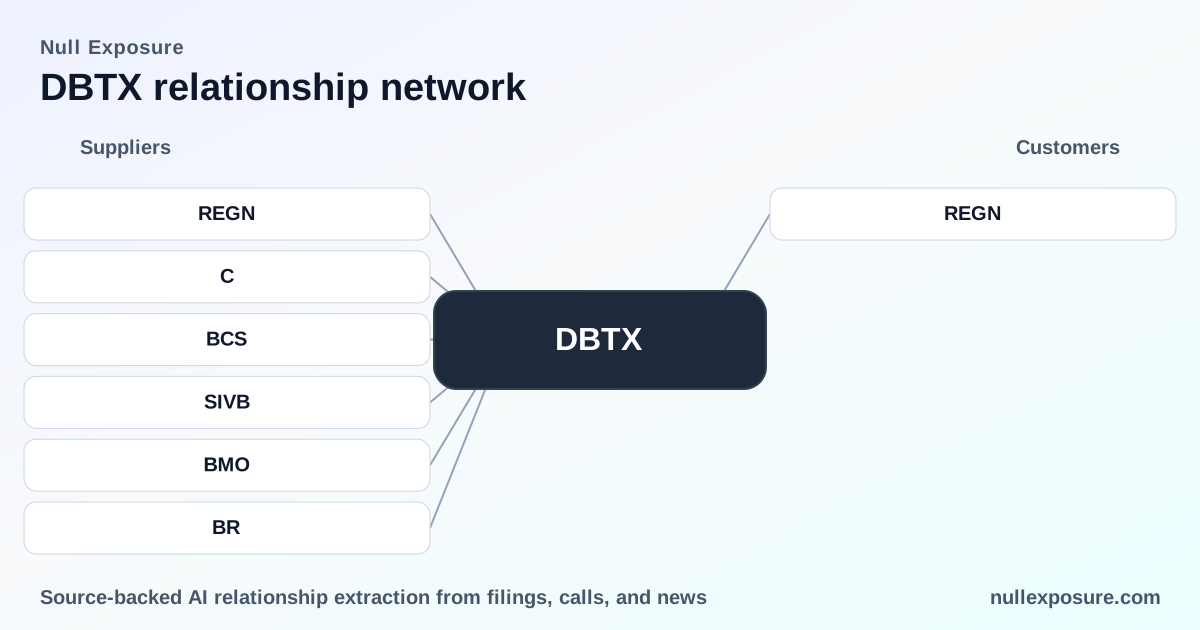
Decibel Therapeutics (DBTX) — Customer relationships review after the Regeneron deal
Decibel Therapeutics develops gene-therapy and biologic candidates targeting hearing loss and related inner-ear disorders; its commercial pathway is asset-driven — generating value through strategic collaborations, licensing or outright acquisition of its clinical-stage programs. The company monetizes primarily by selling or partnering high-value assets rather than building a broad commercial franchise, and the public record in 2026 shows that dynamic playing out with Regeneron’s purchase of Decibel’s lead assets. For a concise vendor view and monitoring of counterparty flow, see https://nullexposure.com/.
Transactional clarity: Regeneron bought Decibel’s hearing-therapy asset suite
The market moved decisively in March 2026: multiple reports document Regeneron’s acquisition of Decibel Therapeutics with various price disclosures — the deal is framed as an asset / company purchase that transfers Decibel’s lead hearing-loss program (DB-OTO) into Regeneron’s portfolio. This is a value-capture exit for DBTX and a strategic asset transfer to a large pharma buyer. Sources reported different headline numbers — up to $213 million in potential value in one article and a $109 million upfront figure in another — while market notices referenced the per-share acquisition price that was paid out to public holders. For ongoing research and to track similar counterparty events, visit https://nullexposure.com/.
Itemized relationship log — each record in the data stream
PMLive report on the definitive agreement (March 9, 2026)
Regeneron entered a definitive agreement to acquire Decibel Therapeutics in a transaction described as worth up to $213 million, reflecting contingent and structured consideration tied to the asset. According to PMLive (March 9, 2026): https://pmlive.com/pharma_news/regeneron_to_acquire_decibel_therapeutics_in_deal_worth_up_to_213m_1496074/
Duplicate PMLive index entry (same article, alternate entity tag) (March 9, 2026)
This indexed entry mirrors the PMLive notice and reinforces that the market source categorized the counterparty with the Regeneron ticker (REGN) for the March 9, 2026 announcement, confirming that Regeneron is the counterparty named in public coverage. Source: PMLive (March 9, 2026): https://pmlive.com/pharma_news/regeneron_to_acquire_decibel_therapeutics_in_deal_worth_up_to_213m_1496074/
MMM-Online coverage on the asset pickup and DB-OTO (March 9, 2026)
Regeneron’s purchase explicitly captures Decibel’s lead hearing-loss candidate DB-OTO, signaling the buyer’s intent to integrate the program into its therapeutic pipeline. MMM-Online reported the acquisition and highlighted DB-OTO as the principal asset acquired. Source: MMM-Online (March 9, 2026): https://www.mmm-online.com/home/channel/regeneron-buys-decibel-therapeutics-for-109m-in-hearing-loss-play/
Duplicate MMM-Online index entry (same article, alternate entity tag) (March 9, 2026)
An additional index hit repeats the MMM-Online coverage while tagging the buyer under the REGN symbol, corroborating the buyer-recipient mapping in news aggregation. Source: MMM-Online (March 9, 2026): https://www.mmm-online.com/home/channel/regeneron-buys-decibel-therapeutics-for-109m-in-hearing-loss-play/
RTTNews on the per-share consideration (March 9, 2026)
RTTNews reported that Regeneron agreed to acquire Decibel at $4.00 per share, providing a specific per-share payout figure that underpins the transaction valuation paid to public shareholders. Source: RTTNews (March 9, 2026): https://www.rttnews.com/3383302/decibel-up-78-on-being-acquired-by-regeneron.aspx
Duplicate RTTNews index entry (same article, alternate entity tag) (March 9, 2026)
A duplicated index record repeats the RTTNews piece and confirms the REGN ticker mapping in aggregator outputs. Source: RTTNews (March 9, 2026): https://www.rttnews.com/3383302/decibel-up-78-on-being-acquired-by-regeneron.aspx
SahmCapital mention of the $109 million headline (reported April 24, 2026)
A later market commentary recapped the deal with a headline figure of $109 million, describing that Regeneron added Decibel’s hearing-loss gene therapy via the transaction at that price point; this provides an alternate public framing of the deal economics, consistent with other mainstream reports. Source: SahmCapital commentary (April 24, 2026): https://www.sahmcapital.com/news/content/regeneron-strikes-deal-with-trump-administration-to-cut-drug-prices-2026-04-24
What the relationship set tells investors about DBTX’s operating posture
- Concentration and exit orientation. The data show a single dominant counterparty (Regeneron) absorbing Decibel’s principal program; this is direct evidence that Decibel’s monetization pathway was concentrated on a transactional exit rather than diversified commercial partnerships.
- Contracting posture: asset sale / acquisition, not long-term vendor contracting. All records describe a buyout/acquisition event or the transfer of an asset; the relationship was transacted as a strategic acquisition rather than an ongoing supply or service contract.
- Criticality of the asset to the buyer. Regeneron’s decision to buy DB-OTO and related assets signals strategic criticality — the program had technical or market attributes that justified acquisition by a major development partner.
- Maturity signal. Public language pointing to a lead candidate (DB-OTO) and a definitive acquisition agreement implies late pre-commercial or clinical-stage maturation of the asset sufficient to command a buyer’s investment.
These characteristics operate at the company level given the lack of additional constraint excerpts; they reflect how DBTX historically converted R&D work into realized value.
Investor implications — value drivers and risks
- Value capture confirmed. Acquisition outcomes are the clearest liquidity path for clinical-stage biotech; Regeneron’s purchase provides tangible valuation realization for DBTX equity holders.
- Single-counterparty concentration risk eliminated for DBTX as an independent vendor because the asset transferred out of the public company; for buyers and peers, the event raises the bar for how large-cap pharma acquires niche hearing-loss assets.
- Price-message dispersion. Public reports differ on headline consideration ($4.00 per share; $109 million; up to $213 million). Investors must reconcile upfront cash versus contingent or milestone-linked consideration when modeling deal economics.
- Operational consequence for counterparties. Suppliers or collaborators should treat the buyer (Regeneron) as the new contracting party for any ongoing work tied to the acquired program.
Key checklist for diligence: confirm the breakdown of upfront vs contingent payments in the deal documents; map any ongoing vendor obligations that survive the transaction; monitor integration and development milestones from Regeneron for value realization timelines.
Practical next steps for analysts and operators
- Pull the definitive transaction filing (SEC/press release) to reconcile the upfront consideration, milestone schedule and contingent payments that produce the range of public figures.
- Update counterparty exposure models to reflect Regeneron as the acquirer and future counterparty for program execution and vendor relationships.
- For competitors and investors, track DB-OTO’s development path under Regeneron to assess competitive positioning in the hearing-loss therapy market.
For a focused feed on counterparty events and to integrate this transaction into a broader counterparty-risk model, see https://nullexposure.com/.
Bottom line
The dataset documents a single, decisive counterparty event: Regeneron acquired Decibel Therapeutics’ lead hearing-loss asset(s), providing a concrete exit path and transferring development responsibility to a large pharma buyer. Analysts should prioritize the transaction documents to resolve valuation detail and to map supplier and milestone exposures under Regeneron’s stewardship.