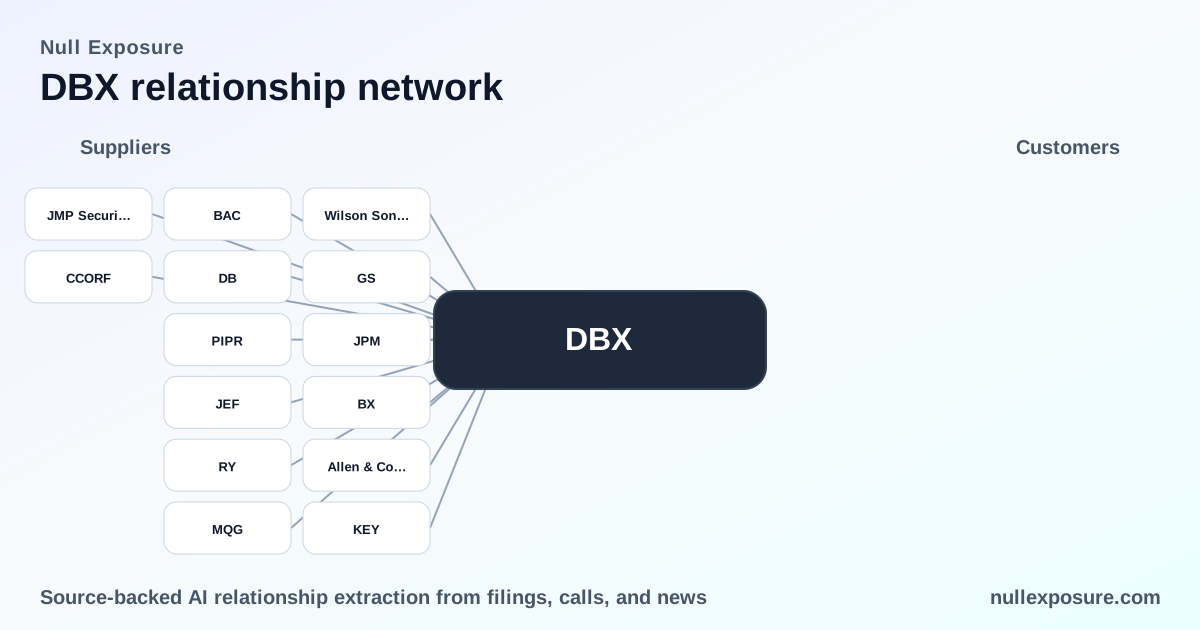
DBX: Customer Footprint, Contracting Posture, and a single flagged customer signal
Dropbox (ticker DBX in this dataset) operates and monetizes as a subscription-first collaboration platform: it sells cloud storage and productivity services to individuals, small businesses, teams, and enterprises, collecting recurring revenue through monthly and annual plans while a small cohort of large organizations holds multi‑year contracts. This review focuses on customer relationships and operating constraints that matter to investors evaluating DBX’s commercial durability and concentration risk. For a concise portal to our coverage, visit https://nullexposure.com/.
How DBX makes money and what that implies for customer risk
Dropbox’s business is fundamentally recurring. The company sells subscriptions across consumer and business tiers, which creates predictable revenue streams and a high degree of revenue visibility. The firm reported 18.22 million paying users as of December 31, 2024 and discloses revenue by geography (U.S. and international), demonstrating a global footprint with meaningful U.S. exposure. According to company filings through year‑end 2024, no single customer accounted for more than 1% of revenue, which establishes a structural buffer against counterparty concentration.
- Contracting posture: subscription dominant, with annual and monthly plans and a minority of customers on multi‑year deals. This supports steady cashflow but makes churn management critical.
- Customer mix and criticality: the base spans individuals to Fortune 100 enterprises; however, the absence of revenue contribution above 1% per customer signals low counterparty concentration and a broad dispersion of commercial risk.
- Global distribution: revenue reporting splits U.S. versus international, and the firm serves customers across roughly 180 countries, underscoring international exposure and cross‑border complexity.
- Commercial maturity: the combination of millions of paying users and some multi‑year enterprise agreements indicates a mature subscription business with product-market fit at multiple buyer sizes.
What the constraints tell investors about operating leverage and vulnerability
Dropbox’s customer signals—drawn from its filings and the relationship indexing for DBX—drive three investment-relevant conclusions:
- Predictable top line with subscription sensitivity. Subscription pricing and renewals create recurring revenue but leave the company exposed to macro demand shifts in collaboration and content tools.
- Low counterparty concentration reduces idiosyncratic credit risk. With no customer exceeding 1% of revenue, large customer defaults or losses are an unlikely driver of near‑term revenue shocks.
- Customer segmentation is broad, not narrow. Serving individuals through very large enterprises diversifies revenue but requires a continued multi‑product go‑to-market strategy to retain different buyer cohorts.
These are company‑level signals derived from public filing excerpts and should be read as characteristics of DBX’s operating model rather than attributes linked to any single downstream counterparty—unless a constraint explicitly names that counterparty.
For additional dossier-level intelligence on customer relationships, visit https://nullexposure.com/.
Single flagged customer relationship in the record: CareDx (CDNA)
Our relationship index for DBX returned one external match: CareDx, Inc. (CDNA). Below is the concise investor‑grade reading and source note.
CareDx — a named user of Databricks infrastructure
CareDx announced the launch of its Vantx AI platform, described as built within a modern cloud environment “powered by Databricks” and incorporating the Llama 3 foundation model alongside ML techniques for structured clinical datasets; our index maps that mention as a DBX customer flag for CareDx. This indicates CareDx leverages a scalable managed analytics platform in production for clinical data workloads. (TradingView / Zacks news report, May 2, 2026: https://www.tradingview.com/news/zacks:d24e23b69094b:0-caredx-introduces-vantx-ai-platform-for-complex-transplant-datasets/)
- Plain‑English takeaway: CareDx has deployed an AI platform in the cloud that uses Databricks technology as a core component, signaling enterprise adoption of DBX’s managed analytics services in the healthcare vertical.
- Source: TradingView / Zacks news summary on CareDx Vantx launch, first reported May 2, 2026.
Note: the indexed relationship entry is a single news‑driven signal; it does not change the company‑level constraints described above such as subscription contracting, global revenue distribution, or the lack of any >1% revenue customers.
Investment implications from the customer map and constraints
- Revenue durability is high but dependent on retention. The subscription model plus 18.22 million paying users (year‑end 2024) produces recurring cash flow; the key operational risk is churn and the effectiveness of upsell into teams and enterprises.
- Concentration risk is low. The company’s disclosure that no customer represented more than 1% of revenue in the periods presented materially reduces single‑counterparty downside.
- Enterprise adoption signals optional new revenue vectors. Enterprise customers and occasional multi‑year contracts provide higher‑ACV (annual contract value) revenue that improves margin stability, while adoption by customers in regulated sectors (e.g., healthcare groups like CareDx using Databricks) demonstrates the platform’s appeal beyond consumer use cases.
- Geographic and product complexity requires scale in sales and compliance functions. Global reach and mixed buyer sizes force continuous investment in localization, security, and enterprise support—areas that exert margin pressure but protect long‑term retention.
Bottom line and recommended next steps for investors
Dropbox’s commercial profile is that of a broadly diversified subscription business with mature enterprise traction and low customer concentration. The single externally flagged customer in our relationship index—CareDx—reflects enterprise use of managed analytics platforms and underscores cross‑industry adoption of cloud data services. Investors should monitor three vectors: (1) churn and net revenue retention, (2) enterprise multi‑year contract growth, and (3) international revenue trends, all of which will determine forward operating leverage.
For continuous updates on customer relationship signals and a deeper look at counterparty mappings for DBX, explore our research hub at https://nullexposure.com/.