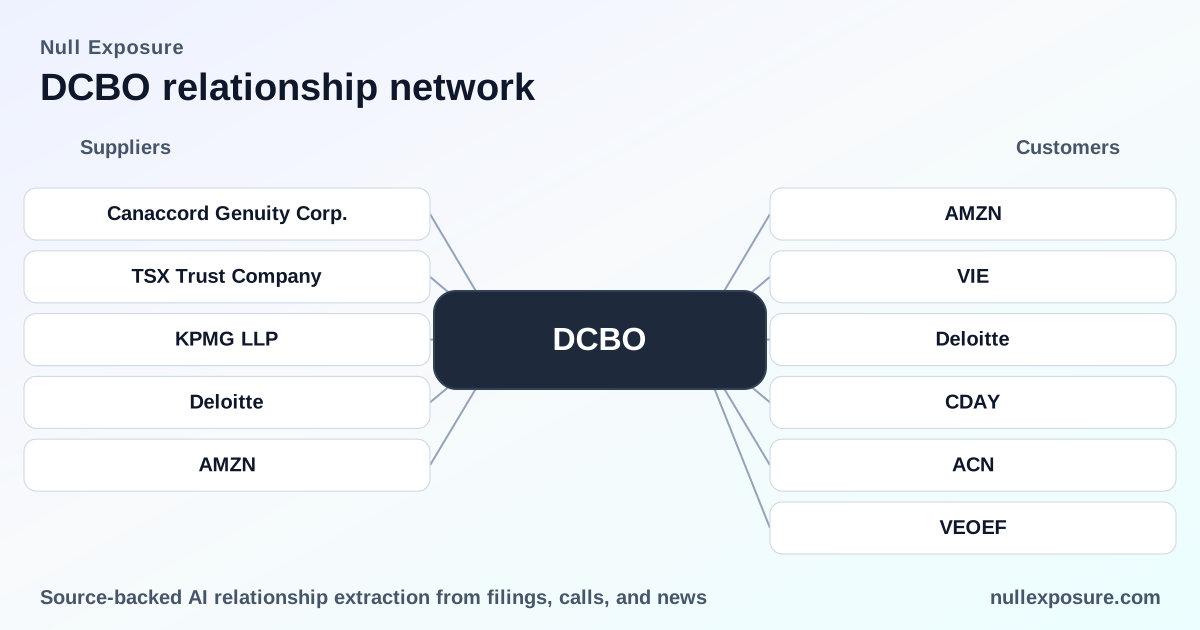
Docebo (DCBO): Customer footprint, concentration signals, and why large accounts move the needle
Docebo sells a cloud-based learning management system to corporate training organizations and channel partners and monetizes through subscription ARR and services for enterprise academies. The company's growth strategy is land-and-expand with system integrators and large enterprise accounts, driving recurring revenue while relying on a handful of meaningful relationships that can materially influence net dollar retention and near-term ARR dynamics.
Explore more research on customer-driven risk and opportunity at NullExposure.
Why customers matter more than churn for Docebo
Docebo’s product becomes more valuable as adoption deepens inside a customer or across a partner’s client base. New wins like Veolia and expanded usage at Amazon are the kind of events that translate into multi-year ARR expansion, while the wind-down of legacy relationships (Dayforce) and the loss of a large partner (AWS) demonstrate how concentrated exposures can depress headline growth metrics in the short term. Company remarks in FY2026 earnings commentary explicitly tie these client moves to measured changes in ARR and net dollar retention. Source: management commentary on the Q4 2025 call (FY2026) — https://www.insidermonkey.com/blog/docebo-inc-nasdaqdcbo-q4-2025-earnings-call-transcript-1706280/
Customer relationships that drive the story
Amazon / AWS (AMZN)
Docebo reported expanded adoption within Amazon as evidence of deeper platform penetration, but separately disclosed that the loss of AWS materially depressed net dollar retention, driving a decline to 99% in reported figures; management identified AWS as a principal contributor to the NDR swing. Source: management remarks cited in Needham coverage and FY2026 call transcript — https://www.insidermonkey.com/blog/needham-reiterates-buy-on-docebo-inc-dcbo-sees-significant-upside-from-current-levels-1681089/?amp=1 and https://www.gurufocus.com/stock/DCBO/transcripts/8663591
Veolia (VIE / VEOEF)
Veolia is a notable new enterprise win in FY2026 cited by management as proof of sustained demand and the company’s ability to penetrate industrial and services customers. This addition supports Docebo’s argument that its sales motion is working in large, multi‑geography accounts. Source: Needham and Finviz reporting on FY2026 commentary — https://finviz.com/news/286387/needham-reiterates-buy-on-docebo-inc-dcbo-sees-significant-upside-from-current-levels and https://www.insidermonkey.com/blog/needham-reiterates-buy-on-docebo-inc-dcbo-sees-significant-upside-from-current-levels-1681089/?amp=1
Dayforce / Ceridian (CDAY)
Management quantified Dayforce as declining to roughly 3–4% of total revenues as the relationship winds down, signaling a limited but measurable legacy revenue run‑off rather than a structural loss of enterprise demand. The item is important because it illustrates the size of discrete legacy contracts relative to total ARR. Source: Q4 2025 earnings call transcript (FY2026) — https://www.insidermonkey.com/blog/docebo-inc-nasdaqdcbo-q4-2025-earnings-call-transcript-1706280/
Deloitte (system integrator)
Docebo is working with Deloitte to power “their own academies,” meaning the company acts as the LMS backbone for large SI firms that then deliver training solutions to end customers — a channel relationship that scales indirectly through partner go‑to‑market activity. Source: Q4 2025 earnings call transcript (FY2026) — https://www.insidermonkey.com/blog/docebo-inc-nasdaqdcbo-q4-2025-earnings-call-transcript-1706280/
Accenture (ACN) and other system integrators
Management highlighted partnerships with Accenture and other global/regional system integrators as a deliberate distribution lever; SIs both implement Docebo for their customers and run their own academies on the platform, creating a hybrid direct-plus-channel penetration model. Source: Q4 2025 earnings call transcript (FY2026) — https://www.insidermonkey.com/blog/docebo-inc-nasdaqdcbo-q4-2025-earnings-call-transcript-1706280/
What these customer signals reveal about the operating model
-
Contracting posture: Docebo runs a subscription-heavy model with enterprise implementations handled through SIs and professional services. The firm’s contractual profile is therefore a mix of renewable SaaS ARR and project-based professional fees tied to deployments and academy builds. Evidence: management commentary on wins and SI implementations (FY2026) — https://www.insidermonkey.com/blog/docebo-inc-nasdaqdcbo-q4-2025-earnings-call-transcript-1706280/
-
Concentration and criticality: A small number of large accounts and partners (AWS, Amazon, major SIs) can move key metrics such as net dollar retention and short-term ARR. Management explicitly linked the NDR decline to AWS and quantified Dayforce as a few percent of revenues, signaling moderate concentration risk despite a broad customer base. Source: FY2026 commentary and transcripts — https://www.gurufocus.com/stock/DCBO/transcripts/8663591 and https://www.insidermonkey.com/blog/docebo-inc-nasdaqdcbo-q4-2025-earnings-call-transcript-1706280/
-
Maturity of relationships: Wins like Veolia reflect successful penetration into large enterprise accounts, while SI partnerships indicate product maturity adequate for third‑party resale and embedding; this combination lowers new‑logo sales friction but increases dependency on partner execution. Source: Needham and management remarks (FY2026) — https://finviz.com/news/286387/needham-reiterates-buy-on-docebo-inc-dcbo-sees-significant-upside-from-current-levels and https://www.insidermonkey.com/blog/needham-reiterates-buy-on-docebo-inc-dcbo-sees-significant-upside-from-current-levels-1681089/?amp=1
Investment implications and risk checklist
-
Upside driver: Continued expansion inside large customers and scaling through SIs can lift ARR and improve gross margins; the Veolia win and expanded Amazon usage are leading indicators of this trajectory. Source: FY2026 coverage — https://finviz.com/news/286387/needham-reiterates-buy-on-docebo-inc-dcbo-sees-significant-upside-from-current-levels
-
Key risk: Concentration effects from a handful of large relationships materially affect net dollar retention and quarter-to-quarter ARR growth, as demonstrated by the AWS impact and Dayforce wind‑down. Investors must underwrite the possibility of lumpy client renewals or partner terminations. Source: Q4 2025 earnings call and FY2026 transcripts — https://www.gurufocus.com/stock/DCBO/transcripts/8663591 and https://www.insidermonkey.com/blog/docebo-inc-nasdaqdcbo-q4-2025-earnings-call-transcript-1706280/
-
Operational leverage: The SI channel (Deloitte, Accenture, smaller regional integrators) can compress customer acquisition costs and accelerate multi-customer rollouts, but requires tight partner management to convert implementations into recurring ARR. Source: earnings call (FY2026) — https://www.insidermonkey.com/blog/docebo-inc-nasdaqdcbo-q4-2025-earnings-call-transcript-1706280/
For investors modeling DCBO, the single best sensitivity is net dollar retention and revenue contribution from top accounts and partner-enabled deployments; shifts there will drive valuation multiples more than incremental small-account growth.
If you want a consolidated view of customer concentration and partner exposure for investment due diligence, NullExposure maintains organized relationship intelligence and analysis at https://nullexposure.com/.
Bottom line
Docebo’s commercial evidence in FY2026 shows a platform that scales through large enterprise wins and system‑integrator adoption, but its performance is sensitive to movements among a handful of sizable relationships. Investors should weigh the upside from new large customers and SI channels against the clear demonstration that losses or wind‑downs of a single partner can depress headline retention and ARR growth.