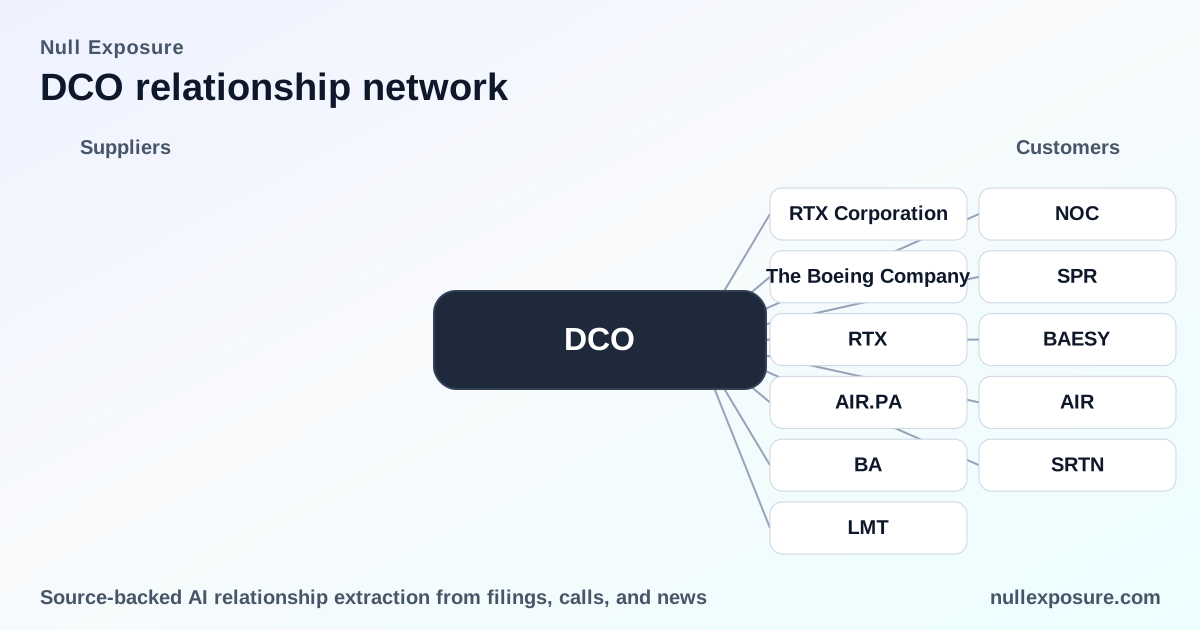
Ducommun (DCO): Customer Relationships That Anchor a Defense‑Heavy Revenue Base
Ducommun monetizes engineering and precision manufacturing services by producing mission‑critical components and assemblies for aerospace primes and government programs, earning revenue primarily under customer purchase orders and a mix of short‑term and long‑term subcontracts. Revenue concentration with prime contractors—RTX at 18.5% and Boeing at 8.2% of 2024 net revenues—drives both upside from defense ramp activity and exposure to program timing and prime execution. Learn more at https://nullexposure.com/.
Why the customer roster matters to investors
Ducommun operates as a specialized manufacturer and engineering services seller to a small set of large aerospace and defense customers. The company combines short‑cycle purchase‑order work with long‑term program subcontracts, and it sells into markets where the U.S. Government is a major end customer. Those structural features produce a set of predictable characteristics:
- Concentration and criticality: Aerospace & defense customers represented 96% of net revenues in 2024, making prime relationships materially important to Ducommun’s top‑line stability.
- Contracting posture: Evidence supports a mix of long‑term program agreements and shorter, single‑year contracts, with long‑term government subcontracts eligible for milestone or progress payments that improve cash visibility.
- Role complexity: Ducommun functions as a manufacturer, seller, and engineering services provider, frequently producing customer‑specific components that are not easily repurposed.
- Global reach and active backlog: The company positions itself as a global provider with a large number of active contracts at any time, implying ongoing working capital and execution demands.
These operating characteristics explain why defense program ramps (missiles, rotary/ fixed‑wing platforms) and prime production rates (e.g., Boeing 737 MAX) are principal value drivers and risk factors for DCO.
Mapping every reported customer relationship
RTX / Raytheon Technologies Corporation
Ducommun identifies RTX as its single largest customer, responsible for 18.5% of 2024 net revenues; Ducommun also reports RTX as the focal point of DOD framework agreements ramping missile production. (Ducommun FY2024 Form 10‑K; Q4 2025 earnings call reports and press coverage, Mar 2026.)
The Boeing Company (BA)
Boeing generated 8.2% of 2024 net revenues for Ducommun and continues to influence the commercial aerospace segment through MAX‑related destocking and production cadence. Ducommun cites Boeing operational challenges and inventory reductions as a material variable for its commercial business. (Ducommun FY2024 Form 10‑K; Q4 2025 earnings call transcript and subsequent press commentary, Mar–May 2026.)
Lockheed Martin (LMT / Lockheed)
Lockheed Martin is a named prime participating in long‑term DOD framework agreements alongside RTX; Ducommun cites Lockheed as a driver of future missile franchise strength. (Q4 2025 earnings call and related press releases, Mar 2026.)
Airbus (AIR / AIR.PA)
Ducommun records modest commercial aerospace growth attributable to Airbus platforms and in‑flight entertainment work, offsetting weaker Boeing volumes on the 737 MAX. Airbus is thus a meaningful commercial counterbalance. (Q4 2025 earnings call; company press release summarized in Manilatimes/GlobeNewswire, Feb–Mar 2026.)
Northrop Grumman (NOC)
Ducommun references historical and ongoing work with Northrop Grumman and highlights exposure to prime program timing as a company‑level risk, indicating Northrop is part of its prime customer set. (Q4 2025 earnings call transcripts and investor note briefs, Mar 2026.)
Spirit AeroSystems (SPR / SRTN / Spirit)
Ducommun confirms substantial business with Spirit related to the MAX build rate; the company flags Spirit destocking alongside Boeing as a commercial execution factor. (Q3 and Q4 2025 earnings call remarks, Mar 2026.)
BAE Systems (BAESY / BAE)
BAE Systems appears as a growing commercial relationship, with Ducommun reporting over $21 million of business year‑to‑date in the referenced period — an example of non‑U.S. prime work that has scaled. (Q3 2025 earnings call, Mar 2026.)
(Each relationship summary above is drawn from Ducommun’s filings and public earnings commentary; specific references include the FY2024 Form 10‑K and Q3/Q4 2025 earnings call transcripts and contemporaneous press coverage cited in March–May 2026.)
Explore more customer mapping and risk signals at https://nullexposure.com/.
What the relationship mix implies for valuation and risk
Ducommun’s client list delivers a clear investment framework: defense program ramps provide a path to margin expansion and backlog growth, while commercial aerospace cyclicality—anchored to Boeing and Spirit—creates earnings volatility. The combination of long‑term government subcontracts and numerous active purchase orders gives Ducommun both revenue visibility and execution risk tied to prime schedules.
Key investment implications:
- Upside engine: Long‑term DOD framework agreements with prime contractors (RTX, Lockheed) underpin scalable missile program volumes and structural revenue growth.
- Concentration risk: RTX and Boeing together account for a significant portion of revenue, so prime‑level execution, contractor budget decisions, or FAA/production shocks will have outsized P&L impact.
- Contract cashflow dynamics: Long‑term government subcontracts introduce milestone and progress payments that reduce financing strain, while short‑term orders sustain throughput and factory utilization.
- Operational stickiness: Manufacturing to customer specifications creates high switching costs and supports margin durability once production stabilizes, but limits rapid redeployment of capacity.
Bottom line: a defense‑anchored, prime‑dependent supplier
Ducommun is a specialized, prime‑dependent manufacturer and engineering services provider whose financial trajectory tracks defense program ramps and the commercial aerospace production cycle. Investors should weigh the high degree of customer concentration and the company’s established long‑term subcontracting posture against the clear revenue upside from recent DOD framework agreements. For analysts building scenario models, prioritize program timing assumptions, prime production rates, and the cadence of milestone payments when forecasting cash flow and leverage.
For a concise dashboard of Ducommun’s counterparty exposures and constraint signals, visit https://nullexposure.com/ for our structured view.