Deciphera Pharmaceuticals (DCPH): Who pays for Qinlock and why it matters to investors
Deciphera Pharmaceuticals develops targeted oncology therapies and monetizes primarily through licensing and localized commercialization agreements for its lead asset QINLOCK (ripretinib), supplemented by direct U.S. sales. The company captures value by retaining core clinical and regulatory control while outsourcing regional commercial execution to specialized partners, generating royalties, distribution margins, and milestone payments that de-risk geography-specific rollouts for investors.
Explore Deciphera’s customer map and partner exposures: https://nullexposure.com/
Why partner-led commercialization is Deciphera’s go-to model
Deciphera’s commercialization strategy concentrates on clinical innovation and regulatory filings while relying on partners to manage payor access and on-the-ground distribution. This capital-light approach preserves cash for R&D, reduces the company’s need to build global sales infrastructure, and produces revenue streams that are geographically diversified but concentrated by product. Investors should treat Deciphera as a product-centric biotech where partner performance and contracting terms materially influence top-line growth and timing.
Who the company works with (and what that means)
Below I cover every partner relationship surfaced in available reporting and filings. Each entry is a concise, plain-English summary with a supporting source.
Zai Lab Ltd — Greater China and Taiwan commercialization
Deciphera licensed QINLOCK to Zai Lab, which has developed and commercialized the product in Greater China and Taiwan, providing Deciphera with a regional revenue stream tied to Zai Lab’s commercial execution. Source: BioSpace coverage of the transaction and Zai Lab’s FY2024 filing noting that “we source QINLOCK from Deciphera.” (BioSpace, May 2, 2026; Zai Lab FY2024 10‑K, Dec 31, 2024: https://www.biospace.com/ono-enters-into-a-definitive-agreement-to-acquire-deciphera-pharmaceuticals, https://www.sec.gov/ix?doc=/Archives/edgar/data/0000000000/zlab-2024-12-31.htm)
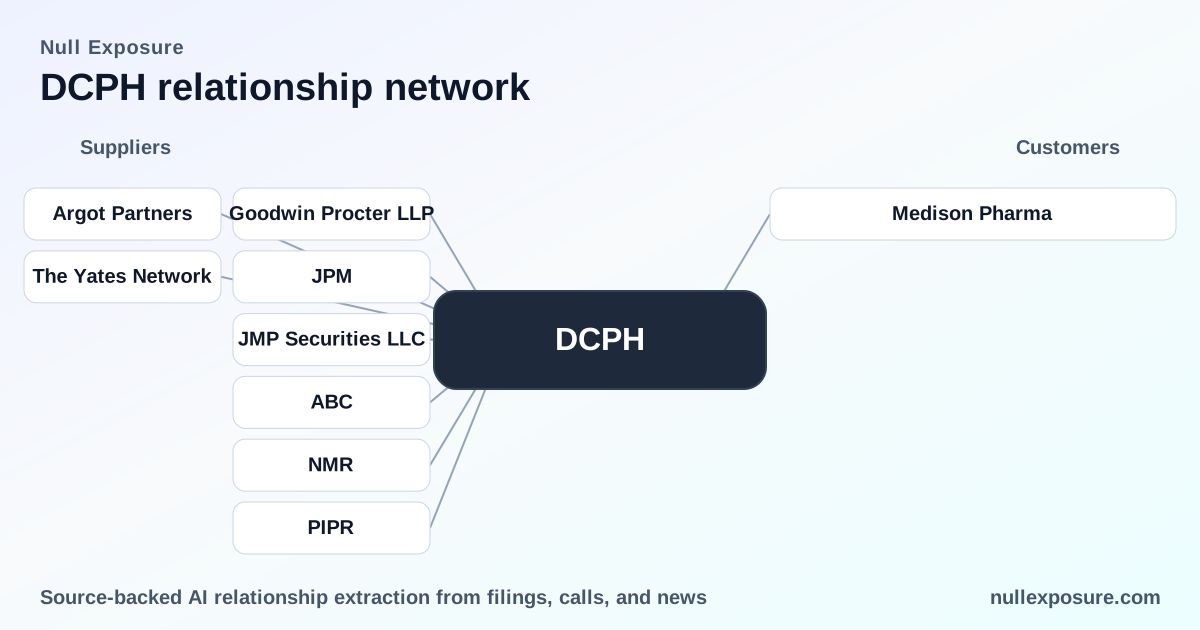
Medison Pharma — exclusive distributor for Canada and Israel
In November 2020 Deciphera signed an exclusive distribution agreement with Medison Pharma to commercialize QINLOCK in Canada and Israel, enabling Deciphera to rely on an experienced regional partner for reimbursement negotiations and provincial formulary access. Subsequent press confirmed formulary listings in Ontario and Quebec following Health Canada approval. Source: Medison and Deciphera press releases and formulary announcement (PR Newswire, 2020 and 2023: https://www.prnewswire.com/news-releases/medison-pharma-enters-exclusive-distribution-agreement-with-deciphera-pharmaceuticals-to-commercialize-qinlock-ripretinib-in-a-multi-regional-agreement-301167378.html, https://www.prnewswire.com/news-releases/medison-pharma-announces-public-formulary-listing-of-qinlock-ripretinib-in-canadian-provinces-ontario-and-quebec-for-advanced-gastrointestinal-stromal-tumor-gist-treatment-301942841.html)
ONO Pharmaceutical — acquisition bid and market re‑rating
In May 2026 ONO Pharmaceutical announced plans to acquire Deciphera at a significant premium, triggering a sharp stock move and representing an exit valuation that consolidates Deciphera’s commercial relationships into a larger, integrated global player. The announcement reframes partner risk into a corporate-strategic value realization for shareholders. Source: trading and news coverage of ONO’s acquisition announcement (TradingView/Invezz commentary, May 2, 2026: https://www.tradingview.com/news/invezz:54999e7c8094b:0-ono-to-buy-deciphera-pharmaceuticals-at-a-huge-premium/)
How these relationships feed revenue and risk profiles
- Revenue mechanics: Licensing and distribution contracts convert regional sales into royalties, supply agreements, or distributed revenue; Deciphera benefits from localized commercialization efficiencies without the full cost of building global infrastructure.
- Concentration and criticality: The commercial success of QINLOCK is the dominant revenue driver; partner performance in key territories materially affects near-term revenue growth and access timelines.
- Contracting posture: Deciphera’s posture is partner-centric — it retains clinical control while outsourcing market access and distribution — which accelerates international launches but concentrates counterparty risk in a small set of commercial partners.
- Maturity signal: The existence of multiple, executed regional agreements and third-party formulary listings signals a transition from R&D to commercial-stage cash flow, albeit still concentrated around a single approved product.
Constraints and company-level operating signals investors should track
Although there are no contract excerpts in the available records that specify commercial terms, the documented partner model implies several company-level constraints investors must monitor:
- Counterparty execution risk is material. Revenue timing and scale depend on partner launches, payor access, and formulary listings, so sales volatility will track partner execution cycles rather than internal salesforce scaling.
- Geographic revenue concentration requires monitoring. Deciphera’s international footprint is built through selective partners; any regional regulatory setbacks or distribution issues will have outsized P&L impacts.
- Strategic optionality through M&A. The ONO acquisition process converts partner-dependent commercial economics into a corporate exit value; acquisition interest reduces standalone operational risk for equity holders but introduces execution and regulatory approval risk on the transaction itself.
- Margin profile depends on deal economics. Licensing and distribution typically yield lower gross margins than direct sales; investors should focus on published royalty rates, supply agreements, and any milestone recognition in future filings.
Explore a deeper relationship analysis and visual maps at https://nullexposure.com/
Investment implications — clear positives and the key watchpoints
- Positive: Deciphera’s partner model accelerates global access for QINLOCK with limited capital outlay, which is favorable for R&D budget allocation and reduces the runway pressure common to small-cap biotech.
- Positive: The announced acquisition interest from ONO demonstrates strategic value recognition and provides a credible path to realization for shareholders.
- Watch: Commercial outcomes in partner territories — reimbursement, formulary decisions, and local physician adoption — are the prime drivers for revenue upside or downside.
- Watch: Concentration around a single marketed product creates binary outcomes tied to lifecycle management, label expansions, and competitor dynamics.
Bottom line
Deciphera optimizes for scientific development and uses targeted commercialization partnerships to turn QINLOCK into recurring revenue across select markets; partner execution and any M&A outcome are the dominant variables for valuation over the next 12–24 months. For investors and operators evaluating counterparty exposure, contract terms and regional sales performance will determine whether Deciphera’s partner-centric model continues to pay off or requires a strategic pivot.
If you want the full relationship map and primary-source links organized for diligence, visit https://nullexposure.com/ and request the Deciphera customer file.