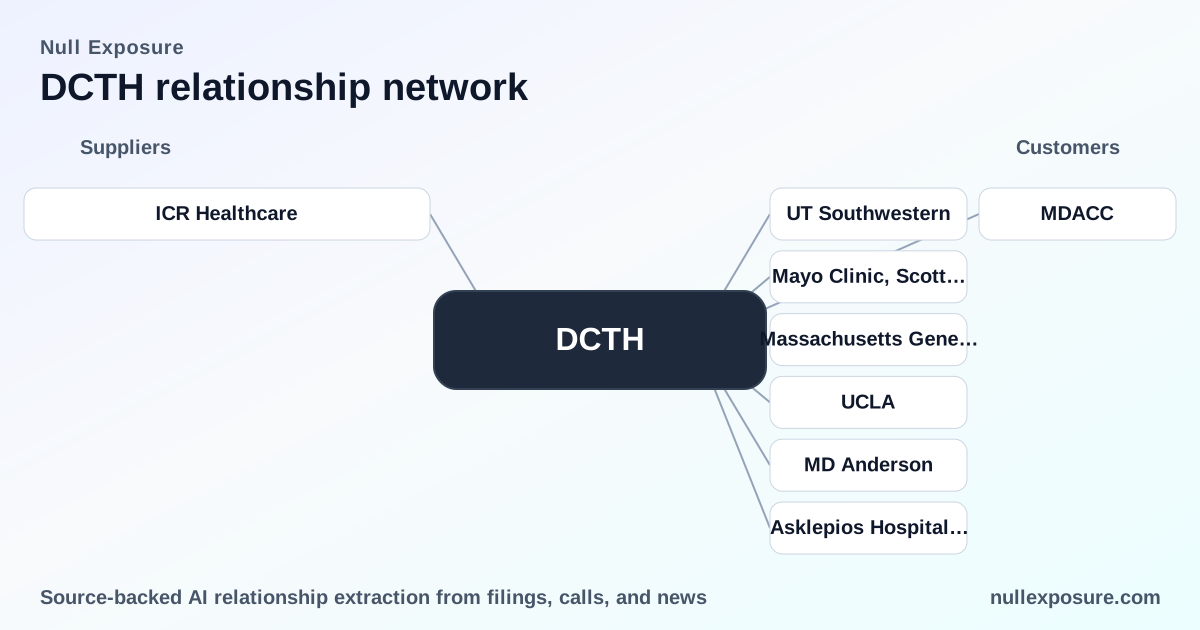
Delcath Systems (DCTH): Institutional Adoption and Commercial Footprint
Delcath Systems monetizes a specialty interventional oncology platform by manufacturing and directly selling a drug/device combination (the HEPZATO™ KIT) and supporting hepatic delivery systems (CHEMOSAT) to a narrow network of REMS‑certified treatment centers in the United States and Europe. Revenue flows from device and kit sales to hospitals and treating centers under approved agreements, with the company retaining direct sales and distribution responsibility in key markets. For a concise commercial-monitoring subscription and relationship intelligence on Delcath, visit https://nullexposure.com/.
Thesis — why customer relationships matter to value
Delcath’s valuation and near‑term revenue trajectory are tightly linked to the rate of adoption at high‑profile academic and specialty hospitals, the number of REMS‑certified treatment sites, and the company’s ability to scale distribution in the US and EMEA. Institutional customers drive not only unit sales of HEPZATO kits but also credibility and clinical momentum—critical for a niche, procedure‑driven product tied to specialized interventional workflows.
What adoption looks like on the ground
Management reported on the Q4 2025 earnings call that Delcath now counts 28 REMS‑certified treatment sites, and named leading academic centers among adopters. According to the same call and subsequent media recaps, the company is seeing protocol adoption at major centers and growing clinical experience that supports commercialization. Insider coverage of the earnings call reiterated the list of named centers and protocol evolution in FY2026.
Customer relationships — who is using Delcath systems today
Below are the institutions mentioned in company and press disclosures, with concise, plain‑English summaries and source notes.
MD Anderson Cancer Center (MD Anderson / MDACC)
MD Anderson is explicitly named by management as one of the REMS‑certified treatment sites using Delcath’s system to treat liver‑dominant disease; the institution anchors Delcath’s roster of high‑profile adopters. This was disclosed on the company’s Q4 2025 earnings call and cited in media recaps in early FY2026.
Source: Q4 2025 earnings call; media recap of the Q4 2025 call in FY2026.
UT Southwestern / UT Southwestern Medical Center
UT Southwestern is cited both on the Q4 2025 earnings call as a REMS‑certified site and in a January 2026 UT Southwestern press release announcing its regional first offering of the Delcath proprietary drug/device treatment. UT Southwestern is the first center in Texas to offer the therapy and is presented as a regional commercialization milestone.
Source: Q4 2025 earnings call; UT Southwestern press release (Jan 2026).
Mayo Clinic, Scottsdale
Mayo Clinic in Scottsdale is listed among named REMS‑certified treatment centers on the Q4 2025 earnings call and reiterated in media summaries of that call; its inclusion strengthens Delcath’s presence at major referral hospitals in the Southwest.
Source: Q4 2025 earnings call; media recap in FY2026.
UCLA (University of California, Los Angeles)
Management highlighted UCLA as a leading center adopting CHOPIN‑inspired protocols, noting flexible sequencing and combination‑therapy use in eligible patients—an endorsement of clinical integration rather than a pure procurement mention.
Source: Q4 2025 earnings call; media coverage in FY2026.
Massachusetts General Hospital (MGH)
Massachusetts General Hospital is called out alongside UCLA as an academic center adopting CHOPIN‑inspired protocols, signaling clinical protocol uptake at top academic institutions rather than merely pilot cases.
Source: Q4 2025 earnings call; media recap in FY2026.
Asklepios Hospital Barmbek (Hamburg, Germany)
A retrospective single‑center study from Asklepios Hospital Barmbek was published reporting outcomes from 38 patients who underwent 99 procedures using Delcath’s CHEMOSAT system, demonstrating European clinical experience with percutaneous hepatic perfusion and supporting the company’s EMEA footprint.
Source: BioSpace press release summarizing the Cancers journal publication (FY2025).
How these relationships translate into operating constraints and commercial signals
Delcath’s customer data and corporate disclosures reveal a compact, specialty commercialization model with the following operational characteristics:
-
Geography and market focus: The company operates primarily in the United States and Europe, with direct responsibility for sales, marketing, and distribution in Europe and direct shipments to hospitals in the US. This dual‑market footprint requires a regulatory and commercial organization that supports cross‑border account management and REMS compliance.
Source: company segment disclosures and product approvals (reported across FY2024–FY2026).
-
Role and contracting posture: Delcath functions as manufacturer, seller, and distributor—it ships HEPZATO kits directly to treating centers under approved agreements and handles European distribution. This creates clear vendor‑hospital contracting relationships and elevates the company’s operational exposure to hospital purchasing and procedure scheduling cycles.
Source: corporate sales/distribution statements and product commercialization language.
-
Concentration and criticality: The installed base is small and highly concentrated—management reported 28 REMS‑certified sites and prior disclosures showed 16 facilities had treated at least one patient by March 2025, with 22 centers accepting referrals at year‑end 2024. That concentration creates revenue sensitivity to a limited number of high‑volume centers, while adoption at flagship academic hospitals increases both credibility and concentration risk.
Source: earnings call (Q4 2025) and earlier rollout disclosures (FY2024–FY2025).
-
Maturity and activation stage: Commercialization is early but progressing—first commercial use of the HEPZATO kit occurred in January 2024, and adoption has expanded into top academic centers and European hospitals with published single‑center clinical series. The transition from initial commercial launches to broader uptake will drive near‑term revenue inflection points.
Source: first commercial use note (Jan 2024) and clinical publication (FY2025).
-
Product segmentation: The HEPZATO KIT is Delcath’s lead product and core revenue driver, and the company’s reporting groups research, manufacture, and distribution of hepatic delivery systems as its single reportable segment—so customer wins feed directly into the consolidated top line.
Source: product approvals and segment disclosures.
Strategic implications for investors and operators
- High leverage to a small number of influential academic centers: wins at MD Anderson, UCLA, MGH, Mayo Clinic, and UT Southwestern drive both procedure volume and downstream referral flows; this is a quality‑over‑quantity commercial model.
- Regulatory and operational complexity is baked into the model: REMS certification, veno‑venous bypass workflows, and training requirements limit rapid commoditization but create defensible switching costs for established sites.
- European clinical publications complement US commercialization: the Asklepios study provides external evidence of procedural outcomes that support EMEA adoption and payer discussions.
Key takeaway: Delcath’s revenue expansion depends on converting a growing list of high‑profile REMS sites into repeat procedural volume while scaling distribution in Europe and maintaining tight operational support for complex liver perfusion procedures.
For deeper relationship maps and monitoring of institutional adoption trends, explore our coverage at https://nullexposure.com/.