DuPont’s customer map: What investors should know about counterparties, contracts and concentration
DuPont monetizes by selling differentiated specialty-chemical products and systems to manufacturers, distributors and industrial end-users, and by commercializing engineered solutions such as water-treatment MemCor systems; revenue is recognized at the point of shipment with customary 30–60 day payment terms. The business is primarily B2B, globally distributed, and increasingly shaped by strategic divestitures that shift where DuPont sits in customers’ value chains. For an organized view of DuPont’s counterparty relationships and what they imply for cash flow and risk, see https://nullexposure.com/.
Quick read: the operating model that shapes customer risk
DuPont’s commercial posture is defined by several practical constraints that drive investor analysis. Revenue is transacted under short-term commercial terms—product sales are recognized at a point in time (typically shipment) with payment terms typically 30–60 days—so working-capital dynamics and receivables management matter to near-term cash flow. The company is global in scale (subsidiaries in ~50 countries and manufacturing in ~24), which diversifies demand but raises exposure to regional supply disruption. Management also reports that no single customer accounted for a significant portion of sales in 2024, making concentration risk low. Finally, DuPont acts across roles—manufacturer, seller and supplier to distributors—which keeps the company embedded in industrial supply chains rather than retail end markets.
If you want a focused feed of counterparty changes and strategic customer wins, visit https://nullexposure.com/ for ongoing tracking.
Relationship snapshots: counterparties called out in recent reporting
Below are the named counterparties surfaced in the recent corpus of press and company communications, with a concise plain-English note and the source cited.
Celanese (CE)
DuPont sold its Mobility & Materials (M&M) business—part of a broader asset transfer—to Celanese in a deal valued at about $11 billion, shifting those automotive and engineered-polymers customer relationships to Celanese and materially changing DuPont’s exposure in that end market. According to Delaware Online and PlasticsNews coverage of the 2022 transaction, Celanese completed the integration and subsequently positioned the acquisition as central to its engineered-polymers strategy. (Delaware Online, 2022; PlasticsNews and RubberNews coverage of the transaction.)
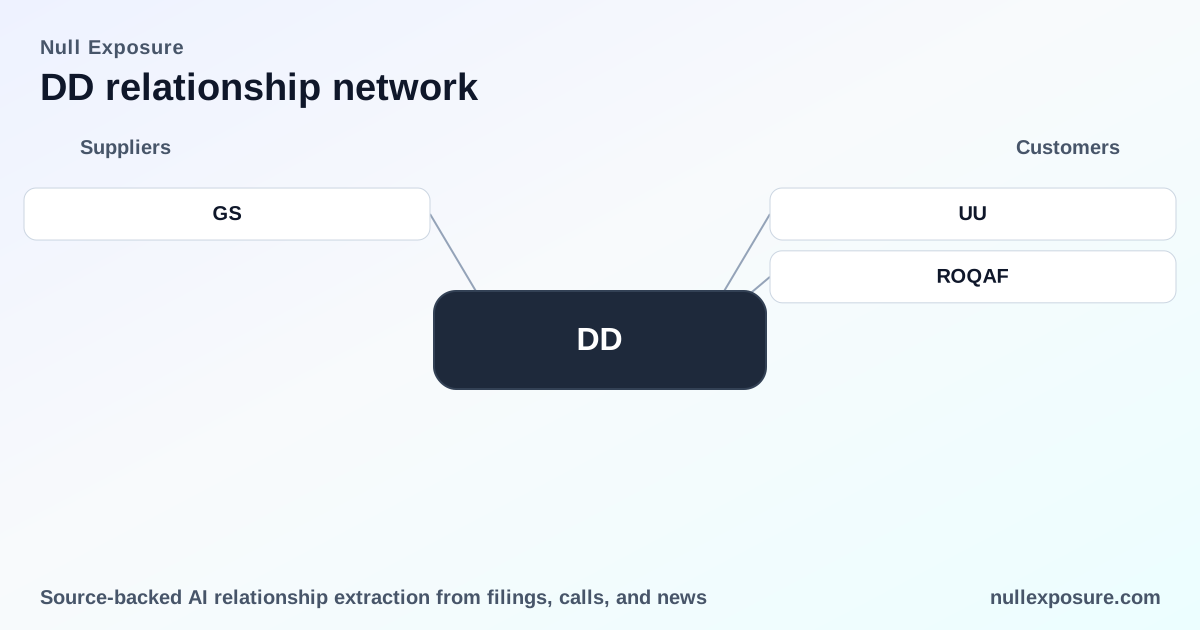
United Utilities (UU)
DuPont Water Solutions won a contract to supply MemCor membrane bioreactor (MBR) systems for major wastewater-treatment expansions at three facilities in North West England, demonstrating the company’s role as a systems supplier in municipal and regulated water projects. Media reports in March 2026 highlighted United Utilities selecting DuPont’s MemCor technology for those plant upgrades. (TradingView / Zacks reporting; Finviz news, March 2026.)
MATCH Hospitality Europe
DuPont noted commercial activity tied to a Madrid hotel that was designated as an official partner property for the Formula 1 Spanish Grand Prix under an agreement with MATCH Hospitality Europe, illustrating non-product revenue interactions and corporate hospitality relationships that can augment customer engagement channels. A business news report flagged the hotel designation and booking momentum in April 2026. (BusinessWorld Online, April 2026.)
Arclin, Inc.
Arclin completed the acquisition of DuPont’s Aramids business, transferring those specialty-fiber customer relationships and product lines to Arclin and removing that revenue and related manufacturing obligations from DuPont’s ongoing footprint. MarketScreener reported on the closing and its implications for DuPont’s portfolio in 2026. (MarketScreener, 2026.)
ROQ / ROQAF
DuPont’s Artistri textile/pigment inks were featured at an industry event where ROQ equipment performed live printing demonstrations using Artistri water‑based DTG pigment inks and related pretreatment chemistries, signalling ongoing channel partnerships with textile-equipment vendors and brand-facing demonstrations to win application-level customers. DuPont’s own press materials describe the collaboration in 2026. (DuPont press release, 2026.)
What these relationships imply for revenue profile and risk
- Short-term contracts and point‑in‑time revenue recognition mean DuPont’s top-line cash conversion is sensitive to shipment timing and distributor inventories. Collections and order flow are the primary levers over near-term cash; long-tail contractual lock-ins are not the dominant force in standard product sales.
- Global manufacturing and a dispersed customer base reduce the impact of losing any single account but increase operational complexity—logistics, tariffs and regional regulatory compliance shape margins and working-capital needs.
- Divestitures (Celanese, Arclin) are reshaping counterparty sets and reduce DuPont’s exposure to certain end markets while increasing its dependency on remaining segments such as water solutions, electronics materials and industrial chemistries. These moves are strategic: they concentrate management on higher-margin or higher-growth segments, but they also transfer customer credit and demand risk to acquirers.
- Role diversity—manufacturer, seller, supplier to distributors—creates mixed margin dynamics. When DuPont acts as a systems supplier (for example, MemCor in municipal projects), contract economics and aftermarket service attach rates become more critical than for commodity product shipments.
Key takeaways for investors and operators
- Counterparty concentration is low; single-customer risk is immaterial. That lowers headline credit vulnerability but elevates the importance of aggregate demand trends across diversified end markets.
- Working-capital management is the primary operational lever because sales are typically recognized at shipment with 30–60 day terms. Investors should monitor days‑sales‑outstanding and inventory turns.
- Strategic divestitures have materially altered DuPont’s customer set, transferring established customer relationships to buyers such as Celanese and Arclin and tightening DuPont’s focus on areas like water and electronics. Watch for the completeness of divestiture integration and residual contingent liabilities.
- Industrial systems wins (e.g., MemCor with United Utilities) are strategically valuable, as they demonstrate differentiated technology content and potential for higher service and aftermarket revenue relative to commodity product sales.
Bottom line
DuPont operates as a global B2B chemical and materials company that generates cash through point-of-sale product shipments and selective systems contracts, while reshaping its customer base through divestitures. For investors, the critical diagnostics are working-capital trends, margin progression in the remaining segments, and the pace at which divested asset buyers absorb transferred customer relationships. Monitor MemCor systems wins, the post‑deal positioning of the Celanese and Arclin transactions, and short-term receivable dynamics to judge whether DuPont’s portfolio simplification is converting into steadier, higher-quality cash flow.
For regularly updated counterparty intelligence and relationship tracking, visit https://nullexposure.com/.