Dominion Diamond (DDC) — customer relationships and operating implications for investors
Dominion Diamond operates as a miner and trader of rough diamonds and historically monetized through asset ownership and sales of mined roughs into the wholesale jewelry and industrial channels. Over the last five years the company has converted material mining assets into cash and liability relief through sales—shifting the revenue base from mine production to balance-sheet management, indemnity transfers and residual trading. For investors, the commercial profile is now defined more by counterparties and legacy settlements than by ongoing mine production.
Quick financial and strategic snapshot investors need first
Dominion’s trailing revenue is $274.0M with a negative EBITDA of -$223.2M, and book value per share near $1.57; insiders control roughly 44% of the floated stock while institutional ownership is negligible. These figures underline a company that has transitioned from operating miner to one managing the economic consequences of asset sales and restructuring — a profile that concentrates counterparty, legal and indemnity risk over production risk. Explore the company profile at Null Exposure: https://nullexposure.com/.
How the relationships shape the balance sheet and cashflow
Dominion’s public record in the results provided centers on the disposition of the Ekati mine and legacy brand transactions. Those events created a small universe of materially important counterparties — purchasers, potential acquirers and legacy brand buyers — whose arrangements determined how liabilities and proceeds flowed after asset sales. Understanding each named relationship is critical to assessing residual exposure, indemnity transfers and any upside from residual trading or litigation recoveries.
Relationship summaries (each result item covered)
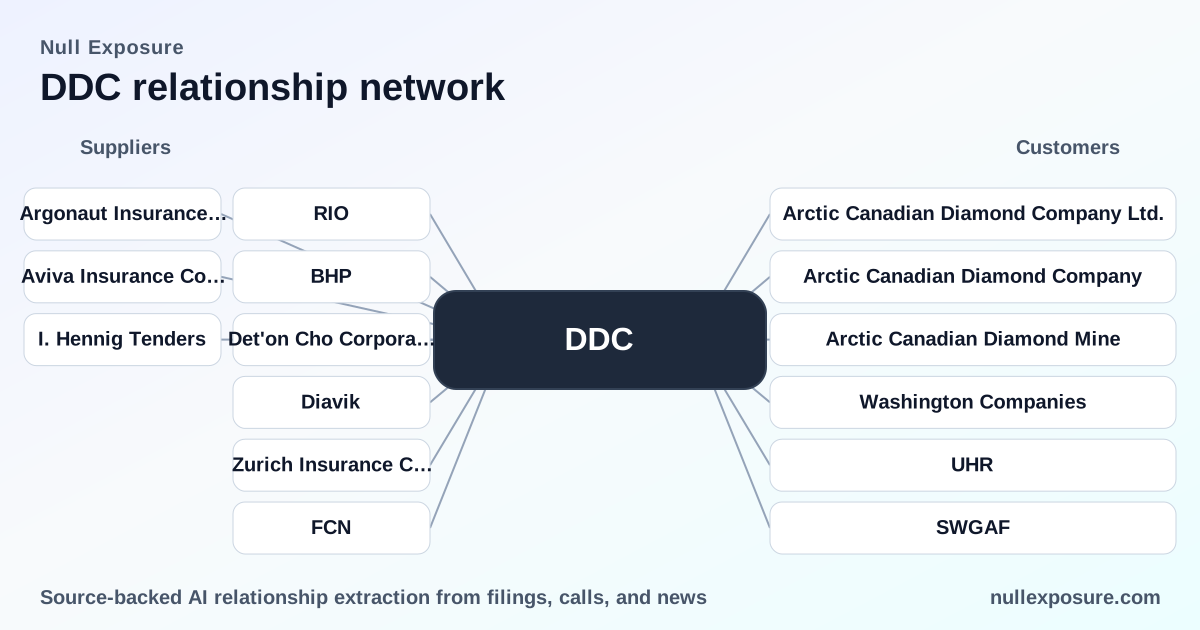
- Arctic Canadian Diamond Mine — Cabin Radio reported that Ekati was sold to Arctic Canadian Diamond Mine, a vehicle formed by some of Dominion’s creditors, reflecting a creditor-led transfer in February 2021; the article surfaced in March 2026 as part of legacy litigation coverage (https://cabinradio.ca/168940/news/dominion-diamond-doesnt-have-to-pay-former-employees-adjudicator/).
- Arctic Canadian Diamond Company — A 2021 Cabin Radio story noted that Dominion finalized the sale of the Ekati diamond mine to Arctic Canadian Diamond Company, marking the transfer of Canada’s first diamond mine out of Dominion control (https://cabinradio.ca/55130/news/economy/dominion-finalizes-sale-of-ekati/).
- Washington Companies (2017 purchaser reference) — JCK reported that Washington Companies purchased the miner in 2017 after an activist investor conflict, citing an earlier ownership episode in the company’s history (https://www.jckonline.com/editorial-article/dominion-diamond-insolvency/).
- Arctic Canadian Diamond Company (mining.com closure notice) — Mining.com confirmed the sale of Ekati to Arctic Canadian Diamond Company and closed the transaction, underlining the completion of a strategic asset transfer in 2021 (https://www.mining.com/sale-of-ekati-mine-to-arctic-canadian-diamond-closes/).
- Arctic Canadian Diamond Company Ltd. (Torys legal summary) — A legal summary from Torys describes transaction mechanics: Arctic assumed US$70M of indebtedness, C$279M of surety-related obligations and other pre-filing liabilities as part of acquiring substantially all of Dominion’s assets, documenting the structured liability assumption at closing (https://www.torys.com/work/2021/02/51e46313-c362-4514-822a-3695a071def5).
- Arctic Canadian Diamond Company Ltd. (OAOA report) — Local reporting recorded that Arctic, formed and owned by funds managed by DDJ Capital, Brigade Capital and Western Asset, completed the Ekati acquisition, highlighting the private-credit and distressed-investor ownership behind the buyer (https://www.oaoa.com/local-news/dominion-diamond-mines-sells-ekati-mine-to-arctic-canadian-diamond-company-ltd/).
- Swatch (UHR reference) — JCK noted a historical brand transaction in which Dominion sold the Harry Winston brand to Swatch in 2013, a non-core divestment that earlier altered Dominion’s brand and downstream marketing exposure (https://www.jckonline.com/editorial-article/dominion-diamond-ceo-resigns/).
- UHR (duplicate Swatch/filing reference) — The same JCK item references UHR/Swatch’s acquisition of Harry Winston in 2013, reinforcing that the company previously monetized luxury-brand assets separate from mine operations (https://www.jckonline.com/editorial-article/dominion-diamond-ceo-resigns/).
- Washington Companies (attempted affiliate purchase) — Mining.com reported that Dominion had attempted to sell Ekati to an affiliate of Washington Companies for C$160M in the year before the Arctic transaction, showing there were competing bid dynamics and strategic negotiations prior to the creditor-led sale (https://www.mining.com/sale-of-ekati-mine-to-arctic-canadian-diamond-closes/).
- SWGAF (Harry Winston name usage) — JCK’s insolvency coverage notes that Dominion operated under the Harry Winston name from 2007 until that brand sale to Swatch in 2013, documenting legacy corporate identity and brand-level activity (https://www.jckonline.com/editorial-article/dominion-diamond-insolvency/).
- Swatch (SWGAF reference duplicate) — The same insolvency article reiterates that Swatch acquired the Harry Winston business and brand in 2013, completing the historical record of that divestment (https://www.jckonline.com/editorial-article/dominion-diamond-insolvency/).
What these relationships reveal about Dominion’s operating model
There are no constraint records in the provided relationship constraints feed, so the following are company-level signals drawn from the financials and the public transaction record:
- Contracting posture: Dominion shifted from an asset-owner contracting model (owner-operator of Ekati) to a liability-transfer posture through structured sales and indemnity assumptions; transaction documents show third parties assumed large pieces of indebtedness and surety obligations.
- Concentration: After the Ekati sale, revenue-generating operations contracted materially; counterparty concentration rises because a small set of acquirers and creditors now determine the company’s cash settlements and legal exposures.
- Criticality: The company’s critical cashflow drivers are now indemnity/settlement receipts and any remaining trading of legacy inventory, not ongoing mine production, which increases sensitivity to legal outcomes and buyer liquidity.
- Maturity and risk profile: Financials (TTM revenue of $274M, negative EBITDA) and high insider ownership reflect a company in transition from operating maturity to restructuring / wind-down dynamics, which elevates event risk relative to steady-state commodity producers.
Investment implications and risks
- Counterparty risk is central: Arctic and the named creditor funds now drive much of Dominion’s realized economic outcome through assumed liabilities and indemnities. Legal outcomes or disputes tied to those transfers directly affect recoveries.
- Balance-sheet uncertainty persists: Negative EBITDA and the structural shift away from asset-based production concentrate investors’ returns on settlement proceeds and litigation outcomes rather than stable cashflow.
- Governance concentration: With insiders holding roughly 44%, strategic decisions and exit dynamics will reflect insider priorities more than broad institutional governance.
For an in-depth relationship map and to track ongoing news and legal developments tied to these counterparties, visit Null Exposure: https://nullexposure.com/.
Conclusion — a short verdict for allocators
Dominion’s profile is now a counterparty and legal-recovery story more than a straightforward mining operation. Value for investors will be realized through settlement navigation, indemnity enforcement and residual trading or litigation outcomes, not through traditional mine production metrics. Allocate with conviction only after modeling counterparty recoveries and event-driven timing.