3D Systems (DDD): Customer Map and What It Means for Revenue, Risk and Execution
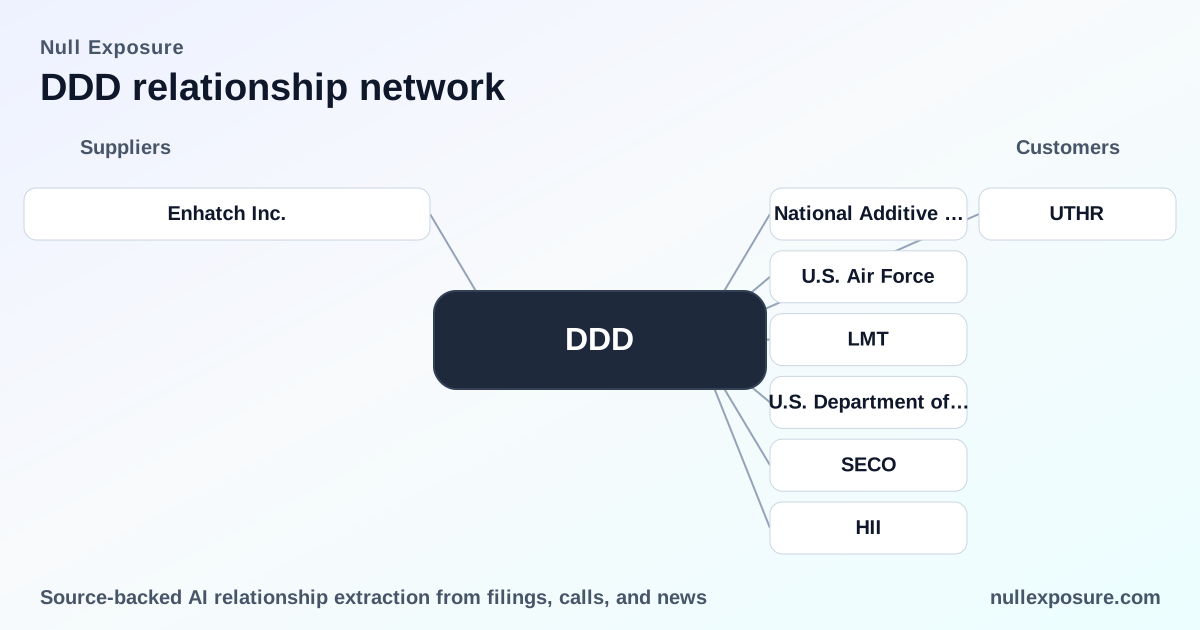
3D Systems monetizes a mix of capital hardware, materials consumables, software (licensed and cloud/subscription), and advanced manufacturing services—supplying printers, factory software, engineering services and production runs to commercial customers and government prime contractors. Revenue is a hybrid of one‑off capital sales and growing recurring streams (software subscriptions, maintenance and services), plus project and contract work with defense and aerospace customers. For a mapped view of counterparties visit https://nullexposure.com/.
Strategic customers and partners you need to know
This section lists every counterparty that appears in the public record for DDD’s customer relationships and gives a concise operating takeaway and source for each.
National Additive Manufacturing Innovation (NAMI)
3D Systems records related‑party revenue tied to NAMI; the 2024 Form 10‑K shows $3.8 million in sales and $2.6 million in associated cost of sales attributable to NAMI for FY2024, indicating an active commercial relationship and potential intra‑group manufacturing or JV transactions. (Company 10‑K, FY2024)
Lockheed Martin (LMT)
Lockheed Martin is named as a collaborator in the NAMI Saudi joint venture to qualify and use 3D Systems’ Direct Metal Printing technology for aerospace and defense components, positioning 3D Systems as a supply partner into Lockheed’s manufacturing chain. (Management commentary on the 2025 Q3 earnings call; GlobeNewswire/Jan 2026 release)
Eureka Pumps AS
Eureka Pumps of Norway has partnered with 3D Systems to produce large‑format metal spare parts on demand using 3D Systems’ Direct Metal Printing (DMP) platform, highlighting commercial adoption in industrial aftermarket parts and on‑demand replacement parts. (GlobeNewswire product release, Apr 13, 2026; investing.com coverage)
U.S. Air Force
3D Systems announced a $7.65 million award from the U.S. Air Force for an advanced large‑format metal 3D printer demonstrator (GEN‑IIDMP‑1000), representing a direct defense contract and R&D/technology demonstration work for a federal customer. (GlobeNewswire press release, Aug 26, 2025)
U.S. Department of Defense
The Air Force award builds on a broader relationship with the U.S. Department of Defense; 3D Systems reports working with the DoD on additive manufacturing programs since 2019, underlining a sustained government contracting relationship beyond single awards. (GlobeNewswire press materials tied to the Aug 2025 contract announcement)
CollPlant (CLGN)
3D Systems entered a co‑development agreement with CollPlant to explore 3D bioprinted regenerative soft tissue matrices for breast reconstruction, positioning DDD into regulated, life‑science product co‑development rather than only equipment supply. (PR Newswire/CollPlant announcement, referenced FY2022 and earlier industry coverage)
Hexagon (HEXA‑B)
Hexagon appears in press analysis as the acquirer of 3D Systems’ Geomagic software suite for $123 million in April 2025; while this is a divestiture, it alters customer‑facing software ownership and competitive dynamics for DDD’s software offerings. (TS2.tech reporting and related coverage, April 2025)
United Therapeutics (UTHR)
United Therapeutics reached a milestone in a regenerative medicine partnership with 3D Systems resulting in a $2 million award, reflecting DDD’s engagement in specialized biomedical manufacturing and potential milestone‑based revenue recognition. (TradingView coverage of 2Q 2025 results)
Saudi Electric Company (SECO)
Saudi Electric Company acquired a 30% interest in NAMI, per 3D Systems’ 2025 Q3 earnings commentary, signaling regional strategic investment that localizes additive manufacturing capacity in Saudi Arabia and expands DDD’s route to market in the Kingdom. (Management commentary on the 2025 Q3 earnings call)
Huntington Ingalls Industries (HII)
Huntington Ingalls Industries collaborated with 3D Systems to develop and qualify copper‑nickel (CuNi30) alloy solutions for naval components, accelerating production timelines for shipbuilding applications and underscoring DDD’s role in naval supply chains. (GlobeNewswire Jan 5, 2026 release)
How these relationships shape DDD’s operating model and commercial posture
The customer roster shows a deliberate mix of large enterprise and government prime contracts, regional strategic joint ventures, and specialty life‑science partners. From that mix we derive several company‑level signals about contracting, concentration and maturity:
-
Contracting posture: DDD runs a portfolio that blends project‑based, fixed‑term government and defense awards (e.g., U.S. Air Force $7.65M demonstrator) with recurring software and maintenance contracts and cloud subscription models for its factory software, creating a balance between lump‑sum capital sales and predictable recurring revenue. (Company disclosures on software maintenance and subscriptions)
-
Counterparty profile and criticality: Customers span government, aerospace primes, industrial aftermarket and biotech—a profile that raises strategic criticality where defense and aerospace certifications (AS/EN 9100 via NAMI) make DDD a supplier to mission‑critical chains, while commercial partners (Eureka Pumps, United Therapeutics, CollPlant) diversify end‑markets.
-
Geographic footprint and localization: The NAMI Saudi JV and engagements across APAC, EMEA and the Americas signal a regionalization strategy: onshore production and qualification for regulated and defense customers to meet national industrialization goals. (Company geographic disclosures; earnings call)
-
Maturity and spend scale: Public entries include mid‑single to low‑double‑digit million dollar contract awards and related‑party sales in the millions, consistent with the constraint signal that some customers sit in a $10m–$100m spend band and that one customer represented about 16% of consolidated revenue for FY2024—a non‑trivial concentration to monitor at the investor and operator level. (Company 10‑K; constraint excerpts)
Risks and operational watch‑points for investors and operators
-
Revenue concentration: A single customer accounted for ~16% of consolidated revenue in FY2024, so loss or downsizing of large healthcare or enterprise customers would have outsized P&L impact. (Company 10‑K, FY2024)
-
Program timing and award dependency: Defense and aerospace engagements are milestone and qualification heavy; awards like the $7.65M Air Force contract are valuable but timing‑dependent, and delivery schedules influence revenue recognition and working capital.
-
Recurring revenue ramp: Software subscriptions and maintenance provide margin stability; investors should track bookings, renewal rates, and migration of licensed users to cloud subscription models as the leading indicator of recurring cash flow growth. (Company disclosures on subscription revenue recognition)
-
Regulatory and qualification barriers as moat: Certifications (e.g., AS/EN 9100 via NAMI) and material qualifications (CuNi30 for naval parts) are barriers to entry that increase customer stickiness once achieved.
Key operational metrics to watch include contract awards and backlog, subscription ARR and renewal cadence, margin mix between hardware and recurring software, and geographic revenue composition.
If you want a consolidated counterparty report and ongoing monitoring for DDD’s customer counterparties, see our coverage hub at https://nullexposure.com/ for mapped relationships and source‑level context.
Bottom line for investors
3D Systems has repositioned from being primarily a hardware vendor to a hybrid supplier of capital equipment, factory software subscriptions, and certified manufacturing services for high‑value niches in aerospace, defense and medical. That mix produces meaningful upside from recurring software and services, balanced against concentration and program timing risks. For investors and operators the critical lenses are contract concentration, defense program qualification milestones, and subscription revenue traction—these will determine whether DDD converts technological position into sustained, predictable cash flow.