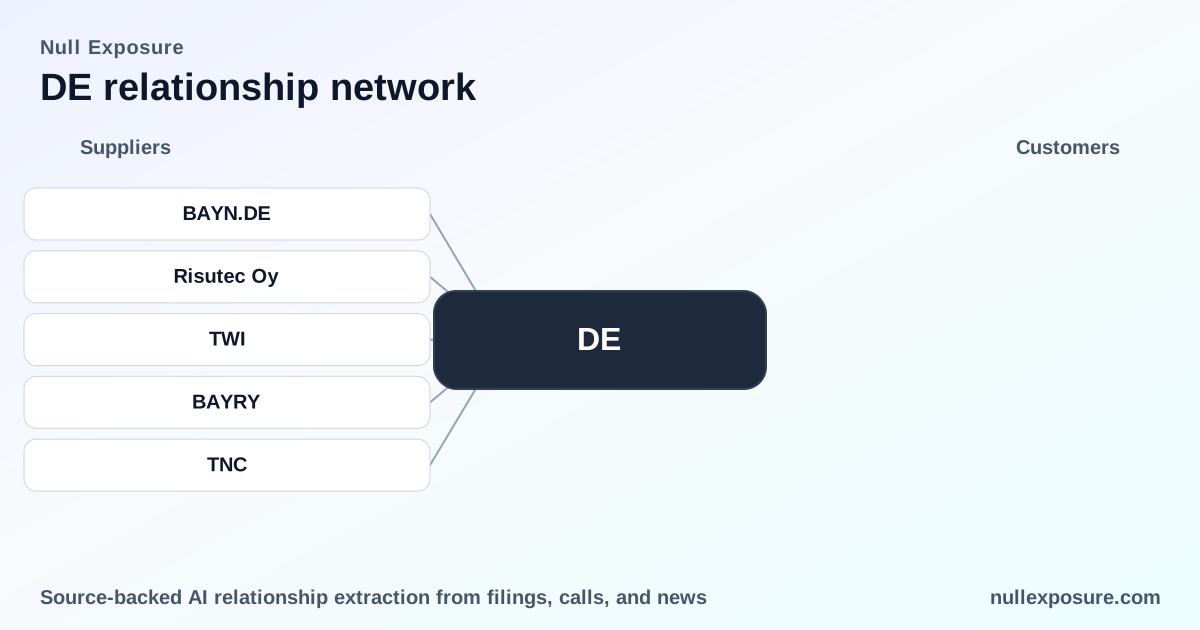
Deere & Company (DE) — Customer Relationships, Commercial Posture, and Investor Implications
Deere & Company sells heavy agricultural, construction, and turf equipment while monetizing through three clear levers: capital equipment sales (through a broad independent dealer network), financial services (dealer and retail financing and leases), and growing recurring revenue from parts, extended warranties, telematics, and subscription software. The firm’s balance between durable capital sales and recurring service finance creates a predictable cash flow mix, with capital cycles amplified by dealer inventory and lease receivables that are material to operating performance.
If you want to track Deere’s customer exposure and commercial cadence, Null Exposure publishes relationship briefs and trend signals at https://nullexposure.com/.
How Deere actually structures customer economics
Deere runs a hybrid industrial-commercial model that couples traditional manufacturing with embedded finance and digital services. Several operating characteristics define investor-facing risk and optionality:
- Contracting posture is skewed long. Deere discloses material unsatisfied performance obligations for contracts longer than one year (about $1,810 million remaining as of November 2, 2025, allocated across FY2026–2030 and beyond), and many leases include multi-year terms and end-of-lease purchase options; this creates revenue visibility and backlog-driven supply requirements.
- Revenue mix blends one-time hardware with recurring revenue. Advanced payments and deferred revenue cover extended warranties, subscription telematics, and precision-services; usage-based services are recognized over the service period, producing recurring cash flow as OEM-installed electronics proliferate.
- Geographic concentration is meaningful but global. Sales remain concentrated in North America (the majority of volume and inventory flows), with Western Europe, Latin America and Asia/other contributing; Deere assigns sales by customer location and reports a material multinational footprint.
- Distribution is dealer-centric. Roughly 2,050 independent dealer locations in the U.S. and Canada drive retail penetration and create a channel risk that is partially mitigated by Deere Financial wholesale and retail financing.
- Segmentation is evolving. The core is hardware (capital equipment), but services and software are scaling, with financial services and telematics adding margin durability over time.
These operating signals imply backlog sensitivity to economic cycles, growing annuity-style revenue that reduces cyclicality incrementally, and finance-driven balance sheet exposure as a feature of the business rather than an ancillary activity.
What the observed customer relationships reveal
Below are the customer and partner relationships pulled from recent coverage. Each relationship is stated plainly with the underlying source.
SiteOne Landscape Supply (SITE) — dealer/distributor traction in turf channels
SiteOne is noted as a distributor of John Deere tractors and turf products, selling irrigation, lighting, and nursery supplies into professional landscaping channels; SiteOne’s distribution role reinforces Deere’s turf equipment placement beyond core agriculture. A TradingView report on May 3, 2026 referenced SiteOne’s distribution of John Deere tractors and related turf care products (https://www.tradingview.com/news/stockstory:11e91eddf094b:0-q4-earnings-highs-and-lows-siteone-nyse-site-vs-the-rest-of-the-specialty-equipment-distributors-stocks/).
Worthington Steel (WS) — supplier recognition and upstream supplier quality
Worthington Steel earned Deere’s highest supplier rating for the 14th consecutive year and received a community engagement award, indicating a high-quality, long-standing supplier relationship that supports Deere’s manufacturing inputs and supplier continuity. The award and ranking were reported in a MarketBeat synopsis citing a BusinessWire release on April 20, 2026 (https://www.marketbeat.com/instant-alerts/worthington-steel-nysews-lowered-to-buy-rating-by-wall-street-zen-2026-03-28/).
EquipmentShare (EQPT) — fleet partnerships with major OEMs, including John Deere
EquipmentShare sources equipment from major OEMs, explicitly identifying John Deere in its fleet supply mix; that relationship signals Deere’s fleet resale and rental channel penetration and the secondary-market role of its equipment in rental platforms. A TradingView article on March 9, 2026 documented EquipmentShare’s fleet sourcing from John Deere among other OEMs (https://www.tradingview.com/news/tradingview:680450ae6292b:0-equipmentshare-tech-enabled-equipment-rental-platform-files-for-nasdaq-global-select-market-ipo/).
Commercial constraints and what they mean for investors
The firm-level constraints embedded in Deere’s disclosures present structural investment signals rather than isolated facts:
- Contract duration and revenue visibility: The company reports significant unsatisfied performance obligations for multi-year contracts, which creates a predictable revenue stream for the short-to-medium term and reduces immediate exposure to demand shocks for those contracted items. This also implies a logistics and working-capital commitment to fulfill contracted deliveries.
- Leases and finance amplify balance-sheet exposure: Leases can span up to seven years and routinely include purchase options; Deere Financial underpins a substantial portion of equipment movement and introduces credit-cycle sensitivity into operating results. Investors should treat financing receivables and lease portfolios as an operationally integral asset class that tracks equipment replacement cycles.
- Recurring and usage-based revenue are accelerating: Deferred revenue from subscriptions, extended warranties, telematics, and usage-based services creates higher-margin, durable cash flow that partially offsets cyclicality in capital equipment sales; however, the absolute scale of SaaS-style revenue in 2025 remained limited versus hardware sales.
- Channel concentration is material: North America remains the dominant market by sales and dealer density. The independent dealer network is both an asset for market reach and a concentration risk if dealer inventory cycles compress.
- Role diversity reduces single-point exposure: Deere operates as manufacturer, financier, and service provider simultaneously, which reduces single-channel risk but increases operational complexity and regulatory/credit risk exposure.
Key takeaway: Deere’s business is capital-intensive and cyclical by nature, but a growing annuity layer from finance, parts, warranties, and telematics provides defensive cash flow characteristics that investors should value as a partial hedge against equipment cyclicality.
Investment implications and risk considerations
For an investor or operator evaluating Deere’s customer relationships, prioritize three vectors:
- Earnings cyclicality vs. recurring revenue: Hardware sales drive headline revenue and margins; recurring streams bolster gross margin stability. Model both separately.
- Credit exposure: Monitor Deere Financial metrics (delinquency, loss rates, wholesale inventory finance) because financing performance transmits directly to earnings volatility.
- Supply-chain and supplier quality: Relationships like Worthington Steel’s sustained supplier rating reduce input disruption risk; persistent supplier awards are a positive signal for manufacturing continuity.
If you want consolidated relationship intelligence and trend alerts on Deere’s commercial links and channel exposure, go to https://nullexposure.com/ for more detailed briefs.
Bottom line
Deere’s customer ecosystem is broad—spanning dealers, distributors, suppliers, and equipment rental platforms—and it is structured to monetize both large capital sales and an expanding annuity stream from services and finance. Investors should value Deere for resilient free cash generation underpinned by finance and services, but underwrite the company’s cyclicality and credit exposure when projecting returns.