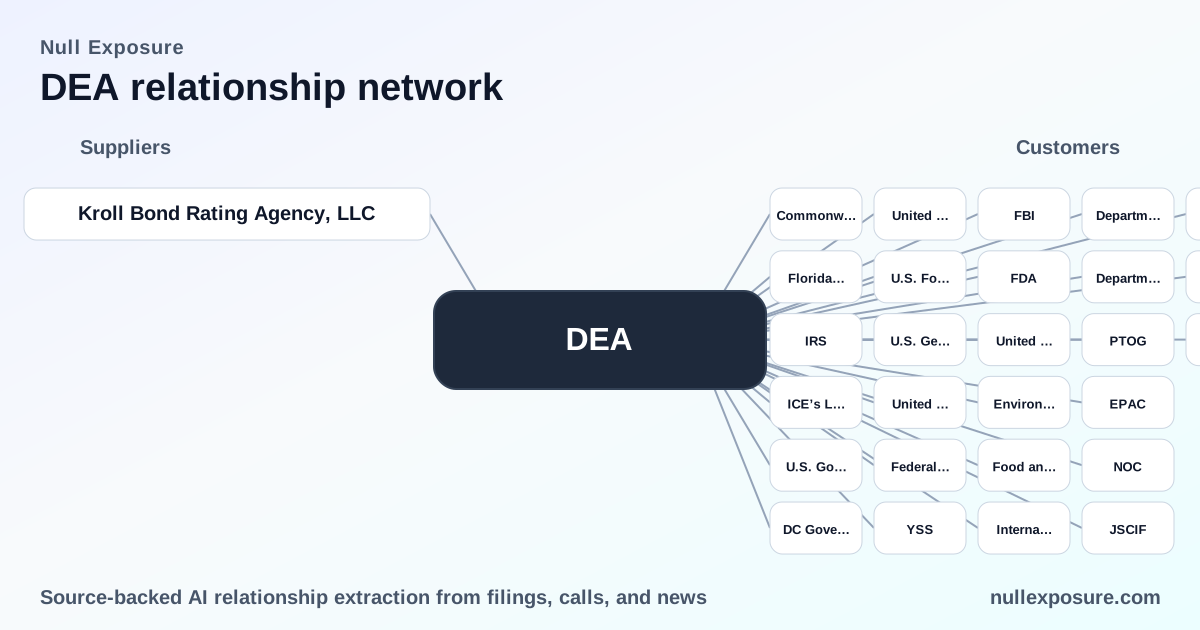
Easterly Government Properties (DEA): The customer ledger that underwrites the REIT
Easterly Government Properties operates as a government-focused landlord: it acquires, develops and manages Class A commercial real estate and monetizes through long-term lease income from federal, state and local agencies and a small set of non-government tenants. The company drives value by delivering mission-critical facilities (SCIFs, laboratories, courthouses) and capturing predictable cash flow under multi-year, often non‑cancelable leases; see a compact portfolio summary at https://nullexposure.com/ for relationship-level detail.
Why the customer list matters more than square footage
Easterly’s business model is a revenue-first leasing platform. More than 90% of revenue is generated from U.S. Government tenants, leases are typically long-dated, and assets are concentrated in the United States — a structure that produces high revenue visibility but concentrates counterparty and policy risk. For investors, that trade-off shows up as stable rental cash flow with single‑counterparty exposure to government budget cycles, renewal risk and project-delivery execution on development assets.
Operating model signals investors should treat as facts
- Contracting posture: long-term leases dominate. Company disclosures describe initial terms of 10–20 years and explicit 20‑year non‑cancelable commitments for selected courthouse and VA projects, supporting durable cash flow.
- Counterparty profile: government-first. Management states government agencies account for the vast majority of revenue and leased square footage, a structural concentration that defines credit and renewal dynamics.
- Geography: domestic only. All assets and revenue are U.S.-based, simplifying political/regulatory jurisdiction but concentrating sovereign risk.
- Materiality: tenant relationships are critical to earnings. Over 90% of revenue from government tenants means tenant performance is core to financial outcome.
- Role and stage: owner/lessor with active development work. Easterly is primarily a seller of long-term occupancy (landlord) and an active developer/operator of mission-specific facilities.
These company-level characteristics explain why investors treat Easterly as a specialized, credit‑linked REIT rather than a commodity office landlord.
The tenant roster — concise takeaways on every relationship in the filings and press
Below are one- to two-sentence plain-English summaries for each tenant relationship cited in public materials, with the source cited in-line.
- Commonwealth of Virginia — Easterly reports assets leased primarily to the Commonwealth of Virginia with lease expirations ranging from 2027 to 2036, highlighting multi‑year tenor in state leasing (BizWire, Q4 2025 results, Feb 23, 2026).
- U.S. Food and Drug Administration (FDA) — The company completed development of a 162,000 sq ft FDA laboratory in Atlanta (“FDA – Atlanta”), demonstrating its laboratory development capability (BizWire, Feb 23, 2026).
- U.S. General Services Administration (GSA) — Easterly leases properties either directly to agencies or through the GSA; a new courthouse will start a 20‑year firm term lease via the GSA for the Judiciary, illustrating the GSA’s role as lease vehicle (MarketScreener / BizWire, Mar 2026 / Feb 2026).
- U.S. Government (aggregate) — Management states the firm is focused on properties leased to the U.S. Government and adjacent partners, and government tenants constitute the bulk of revenue (aijourn / company disclosures, 2026).
- DC Government / District of Columbia Government — The company acquired a 289,873 sq ft facility on April 3, 2025 that is 98% leased primarily to the DC Government (BizWire, Feb 23, 2026).
- Florida Department of Law Enforcement (FDLE) — A new property is designated to be leased to FDLE and will include state‑of‑the‑art laboratories and a training center, reflecting state agency laboratory demand (BizWire, Feb 23, 2026).
- Internal Revenue Service (IRS) — IRS‑occupied assets (e.g., IRS‑Fresno) are listed among Easterly’s portfolio properties, underlining tax agency tenancy across markets (MarketScreener, Mar 2026).
- ICE’s Law Enforcement Support Center (LESC) — LESC is the primary occupant of a facility and operates 24/7, underscoring the mission‑critical nature of certain DHS subcomponents (BizWire, Feb 23, 2026).
- United States Judiciary — A new courthouse project will commence a 20‑year firm lease via the GSA to benefit the Judiciary upon delivery, locking in long-term cash flow for that asset (BizWire, Feb 23, 2026).
- Department of Veterans Affairs (VA) — A financings note supports a 20‑year firm lease commitment from the VA with expected completion in October 2028; the referenced loan was characterized as carrying an anticipated 12% yield in investor commentary (InsiderMonkey, Q1 2026 earnings call transcript, May 2, 2026).
- Parbel of Florida (L’Oréal subsidiary) — Easterly leases a small portion of its portfolio to non‑governmental tenants such as Parbel of Florida, reflecting limited private‑sector diversification (StockInvestor, May 2026).
- United Technologies (Pratt & Whitney subsidiary) — United Technologies is cited as another small non‑government tenant, representing government‑adjacent industrial occupancy (StockInvestor, May 2026).
- York Space Systems (YSS) — A 138,125 sq ft facility acquired Aug 28, 2025 is 100% leased to York Space Systems in Greenwood Village, Colorado, signaling exposure to commercial space/defense‑adjacent tenants (BizWire, Feb 23, 2026).
- Federal Bureau of Investigation (FBI) — FBI offices in markets like El Paso, New Orleans and Pittsburgh include secure classified spaces and SCIFs, emphasizing specialized build‑to‑spec assets (InsiderMonkey / MarketScreener, May / Mar 2026).
- Environmental Protection Agency (EPA) — EPA‑Lenexa appears in the portfolio list, consistent with Easterly’s federal environmental and laboratory tenancy (MarketScreener, Mar 2026).
- Department of the Treasury (TREAS) — Treasury‑Parkersburg is listed among assets that house Treasury functions, reflecting diversified federal agency exposure (MarketScreener, Mar 2026).
- United States Patent and Trademark Office (PTO) — PTO‑Arlington is included in the company’s property roster, another indicator of federal agency occupancy (MarketScreener, Mar 2026).
- Northrop Grumman (NOC) — Easterly calls out government‑adjacent defense contractors like Northrop Grumman that utilize SCIF‑capable space, revealing demand from prime defense contractors for secure facilities (REIT.com video, 2026).
- JSC / JSCIF — Properties labeled JSC — including JSC‑Suffolk / JSCIF — are included in portfolio disclosures, reflecting miscellaneous federal or government‑adjacent tenancy labels used in filings (MarketScreener, Mar 2026).
- Department of Homeland Security (DHS / DHSBF) — The company acquired a 74,549 sq ft facility primarily leased to DHS near Burlington, Vermont on May 7, 2025, showing direct DHS tenancy in the portfolio (BizWire, Feb 23, 2026).
Investment implications: a disciplined checklist
- Revenue visibility is high thanks to long-term, non‑cancelable leases—this supports yield stability but compresses upside if rents reprice below market.
- Concentration risk is real: over 90% of revenue tied to government tenants makes Easterly vulnerable to agency budget stress or nonrenewal at lease maturity.
- Asset specialization is a moat and a constraint: SCIFs and laboratories create barriers to substitution and support higher spreads, but they also increase development complexity and execution risk.
- Non‑government tenants provide modest diversification (York Space Systems, Northrop Grumman, Parbel, United Technologies), but they represent a small share of leased area.
For a granular breakdown of tenant-level counters and how they influence cash‑flow risk metrics, visit https://nullexposure.com/ and review the relationship-level analytics.
Bottom line for portfolio managers
Easterly is a niche, government‑centric REIT that converts mission‑critical facility demand into long‑dated lease cash flow. The primary investment thesis is predictable income underpinned by high‑quality public tenants; the principal risk is concentrated counterparty exposure to U.S. Government agencies and execution on development projects. For income‑oriented strategies that understand sovereign and renewal dynamics, Easterly delivers credit‑linked rent rolls worth a close look.